

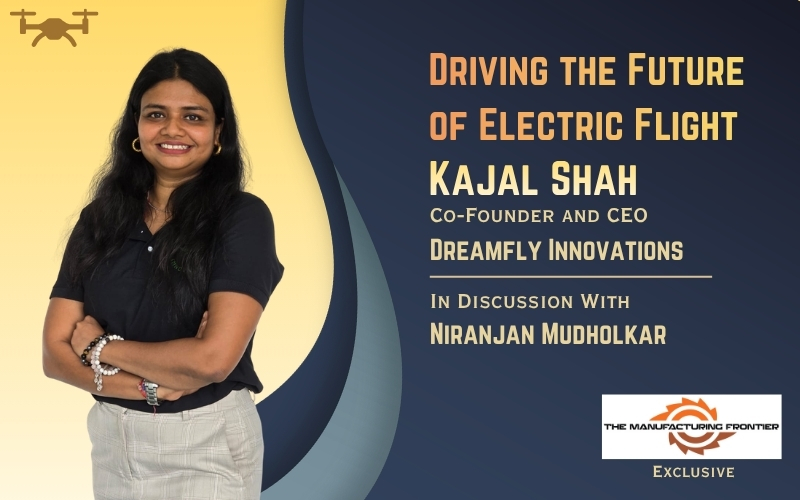
“It becomes quickly apparent that performance and reliability can’t stand independent of one another — one will always be sacrificed to the other unless you engineer for both from the start. That mindset carried over directly into how we approach batteries at Dreamfly.” Kajal Shah, Co-Founder and CEO, Dreamfly Innovations
India’s push toward manufacturing self-reliance often finds its truest test not in policy declarations, but in the exacting demands of deep-tech engineering. While standard electric mobility allows for spatial compromises and safe standstills, unmanned aerial systems operate under relentless aerodynamic, thermal, and weight constraints. Deploying energy systems capable of enduring sub-zero Himalayan altitudes for tier-one defence players requires a standard of reliability that off-the-shelf, repackaged components simply cannot provide.
In this exclusive conversation, Niranjan Mudholkar sits down with Kajal Shah, Co-Founder and CEO of Dreamfly Innovations, to explore what it really takes to build an aviation-grade hardware startup in India. Drawing from her foundational experience in high-volume automotive engine design at Tata Motors, Shah candidly unpacks the friction of navigating nascent local supply chains, the imperative of designing proprietary Battery Management Systems (BMS), and the process of cultivating niche electro-mechanical talent in-house. The result is a sharp, grounded look at the reality of indigenous deep-tech innovation, where enduring engineering, rather than shortcuts, drives the future of electric flight.
QnA
Rather than importing cells and assembling them locally, Dreamfly chose a harder route by designing the thermal architecture, BMS, and electronics completely in-house. What motivated you to build from the ground up rather than take the easier assembly route?
Honestly, it came down to trust. When you are putting a battery on a drone that is flying over difficult terrain or carrying out a surveillance mission, you cannot afford to treat it as a commodity component that has simply been imported and repackaged. Cell chemistry, thermal behaviour and the electronics that manage all of it need to be designed together, as one system, if you want genuine reliability. Assembling imported cells might have been the quicker path to market, but it would have meant depending on someone else’s design choices for the parts of the battery that matter most in flight. We chose to build the thermal architecture, the BMS, and the electronics ourselves because that is the only way we could actually vouch for how the battery would behave under stress, rather than hoping it would.
A drone battery faces unique operational stresses. How does engineering a battery for flight fundamentally differ from designing one for a ground-based EV?
Space, essentially, and how little room there is for error. An EV battery has the luxury of space, cooling systems, and the ability to pull over if something goes wrong. A drone battery has none of that. Every gram we add costs endurance, so we are constantly balancing energy density against weight in a way ground vehicles rarely have to. And thermally, there is nowhere for heat to go once you are airborne, so the margin between “working” and “failing” is much narrower. We had to design our thermal architecture specifically around that reality, keeping operating temperatures meaningfully lower than a standard pack, because a battery event mid-flight is a very different problem to one in a stationary vehicle.
Your battery systems are deployed in extreme sub-zero, high-altitude military environments for defence leaders like Tata Advanced Systems and L&T. What were the biggest engineering hurdles in ensuring reliability under such unforgiving conditions?
Extreme temperature variation was likely the hardest part of all. Developing a battery that could maintain its performance in subzero conditions and also endure quick changes in altitude and climate required a redesign of more than just the battery; it also required us to reconsider our heating and monitoring systems. We designed a battery heater system, allowing the batteries to continue to perform well in freezing conditions, as well as a BMS system to provide up-to-the-minute information about the condition of each cell, ensuring no battery would fail silently in the field. All of this did not happen on our first try. It required many iterations and failures before we felt the system was ready.
Before launching Dreamfly in 2022, you worked as an R&D manager in Engine Design at Tata Motors. How did your background in automotive engine design shape your approach to leading a deep-tech hardware startup?
The design of an engine instils in you a kind of reverence for thermal and mechanical stresses that I don’t believe is learned any other way. It becomes quickly apparent that performance and reliability can’t stand independent of one another — one will always be sacrificed to the other unless you engineer for both from the start. That mindset carried over directly into how we approach batteries at Dreamfly.
I also came away from that experience with a strong bias towards rigorous testing and validation before anything is called “done”. Deep-tech hardware doesn’t reward shortcuts, and my time in engine design instilled that discipline early.
Beyond the engineering mindset, being part of design and development where components were built to mass-manufacture reliably at a scale of one lakh (100,000) units a month gave me a completely different kind of experience and vision. It taught me what it actually takes to move from a working prototype to something that can be manufactured consistently at scale, which is a lesson I carry into every decision we make at Dreamfly today.
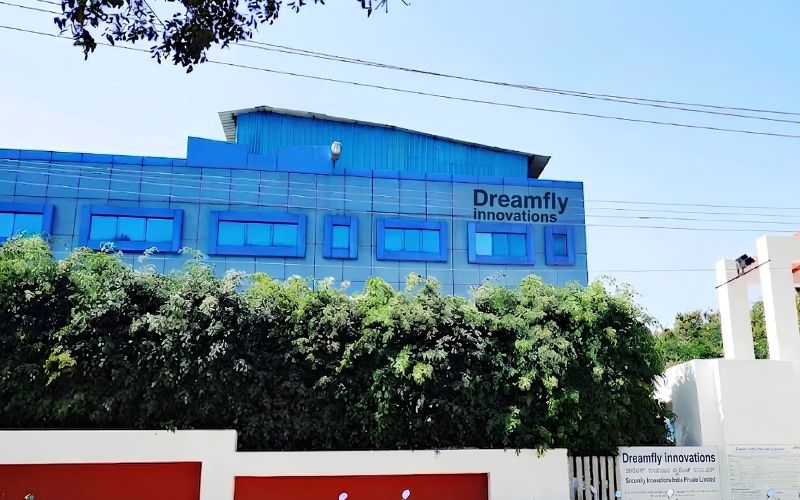
Setting up a specialized manufacturing facility in India comes with unique supply chain and operational bottlenecks. What were the most unexpected operational challenges you faced while scaling up your Bengaluru plant?
The biggest surprise wasn’t one bottleneck — it was how much of our supply chain simply didn’t exist locally at the quality level aviation-grade batteries demand. Specialized cells, connectors, and testing equipment remain heavily import-dependent in India, so lead times and quality consistency became things we had to engineer around, not just plan for.
The second challenge was finding vendors who understood the gap between “good enough for consumer electronics” and “good enough to fly”. Aerospace and defence-grade tolerances are unforgiving, and many capable suppliers hadn’t been asked to hold that bar before. We spent far more time than expected vetting and hand-holding vendors through our specifications.
Talent was the third — people who think across electrochemistry, mechanical design, and manufacturing scale-up simultaneously are rare, so we built much of that capability in-house.
None of this is unique to us — it’s structural for deep-tech hardware in India today. But the automotive mindset of “reliability isn’t negotiable” meant we’d already built in buffers that absorbed most surprises before they became setbacks.
India’s Atmanirbhar Bharat vision heavily promotes domestic manufacturing, yet critical supply chains remain dependent on imports. From where you sit, what is the reality of true battery self-reliance in India today versus the policy narrative?
The intent of Atmanirbhar Bharat is indeed noble and essential; however, the actual scenario is such that self-sufficiency is a process and not an event. The design, engineering, assembling, and quality checking of the products can certainly be and are entirely done in India. But building a fully self-sufficient supply chain, right down to raw materials, is a longer journey that the whole ecosystem is still working towards. I would say we are further along on the engineering and manufacturing side than people often assume, and that is where companies like ours are focused, proving that world-class design and production capability can exist here, while the broader materials ecosystem continues to mature around us.
Deep-tech hardware startups in India often face a talent deficit in niche domains like thermal management and specialized BMS design. How are you building and nurturing specialized engineering talent inside Dreamfly?
Much of this lies in the early establishment of ownership. There is a dearth of ready experts in areas like thermal management and custom BMS design in India, and so we rely on bringing in engineering basics and then building up those specializations through heavy investment into learning, typically through the guidance of our founders who mentor and teach their expertise directly. This is done in an environment where questions and failed experiments are considered part of the learning process rather than being discouraged. While it is certainly a slower process than recruiting ready-made experts, it ensures that the expertise we acquire is our own.
Looking ahead, does Dreamfly plan to expand its high-reliability battery architectures into commercial logistics, electric aviation or global defence markets?
That is very much the direction we see ourselves heading in. The fundamentals we have built- thermal safety, reliability under stress, and intelligent power management- are not specific to one use case; they are relevant anywhere endurance and safety genuinely matter. Commercial logistics and electric aviation are natural extensions of what we already do well, and we do see real potential for our technology in global markets over time, not just India. For now, our focus remains on strengthening what we have built here, but expanding the reach of that architecture is very much part of how we think about the future.
