

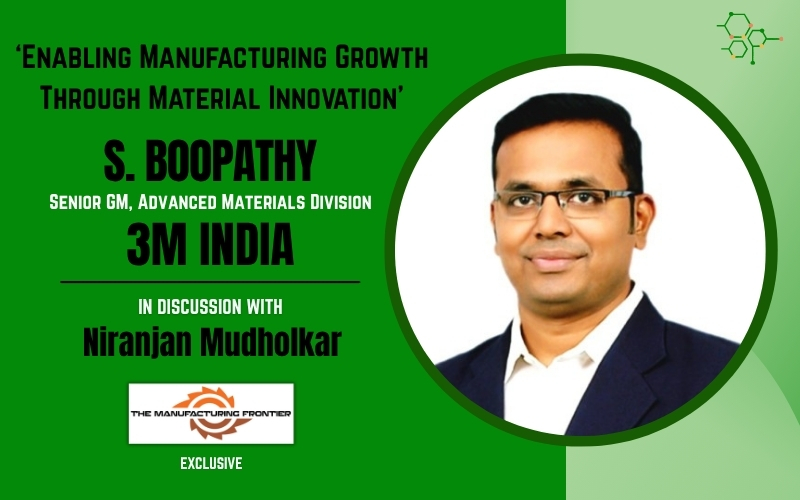
“The next phase of Indian manufacturing will not be driven by automation alone. It will come from combining digital technologies, strong manufacturing capabilities, and material science innovation to create products that perform better, last longer, and are more sustainable.” S. Boopathy, Senior General Manager, Advanced Materials Division (AdMD), 3M India
The discussions around Industry 4.0 usually tend to focus more on digital twins, automation, artificial intelligence and robotics. However, while intelligent systems optimize how we build, material science determines how well the final product performs under demanding conditions.
In this insightful dialogue, Niranjan Mudholkar, Founder & Editor-in-Chief of The Manufacturing Frontier, sits down with S. Boopathy, Senior General Manager of the Advanced Materials Division (AdMD) at 3M India. Mr. Boopathy offers a practical perspective on how India’s industrial landscape is evolving and how it is shifting focus from mere upfront procurement costs to total lifecycle value, enhanced productivity as well as long-term reliability. From solving critical coefficient of thermal expansion (CTE) and corrosion hurdles in hybrid material designs to pioneering lightweighting via engineered glass microspheres and advanced ceramics, the discussion delves into the practical physics of modern engineering. Mr. Boopathy emphasizes that the true catalyst for India’s manufacturing transformation lies in early-stage R&D collaboration and robust local application engineering. According to him, this will ensure that cutting-edge innovations translate seamlessly from laboratory formulations into resilient, sustainable and globally competitive shop floor realities.
QnA
How do you see advanced materials contributing to Industry 4.0 and the next phase of manufacturing?
Industry 4.0 is often associated with AI, automation, robotics, and data. However, while these technologies improve how products are designed and manufactured, materials determine how those products ultimately perform. What is changing today is our ability to predict material performance more accurately through modelling, simulation, and data analytics. This allows manufacturers to evaluate materials earlier, reduce development time, and optimize designs more efficiently.
As industries pursue electrification, energy efficiency, and sustainability, advanced materials are becoming increasingly important. Established materials are finding new applications, while new innovations are being developed to address emerging challenges. For me, the real opportunity lies in combining digital tools with material science to help customers develop better products faster and more efficiently.
How are advanced materials helping Indian manufacturers improve productivity and competitiveness?
Indian manufacturing is becoming increasingly sophisticated, and customers are looking beyond the upfront cost of a material. They are evaluating the value it creates over the life of a product. Advanced materials can improve productivity through longer component life, lower energy consumption, reduced maintenance, better process efficiency, and enhanced product performance. Today’s conversation is less about selling a material and more about solving a manufacturing problem. A material may cost more initially, but if it improves productivity, reliability and durability, the overall economics can be significantly better. That is where I believe material science can make a meaningful contribution to the productivity and global competitiveness of Indian manufacturing.
Rapid prototyping and digital twin modelling are speeding up product development. How does 3M collaborate with customer R&D teams early in the development cycle?
The earlier material expertise is brought into the development process, the greater the opportunity to create and capture the value. At 3M, we work closely with OEMs, Tier suppliers based on the design requirements with their R&D teams from the concept stage. Our scope is limited to performance of the advanced material either direct as finished product and or formulated in the procurement value chain, our support can range from material selection to component evaluation and validation. Whether the challenge involves lightweighting, thermal management, advanced ceramics or sustainability goals, early collaboration helps customers reduce development risk and accelerate time to market.
Modern products increasingly combine materials with different properties. What innovations are helping address CTE and corrosion challenges in hybrid designs?
Manufacturers are increasingly combining metals, composites, ceramics, and polymers to improve performance and efficiency. However, these combinations create challenges related to thermal expansion, corrosion, vibration, and long-term durability. The challenge is making different materials work together reliably over time.
3M’s Advanced fillers, reinforcement solutions, thermal management materials, ceramics, and friction-enhancement technologies help engineers manage these issues and improve overall product reliability. For example, 3M™ Glass Microspheres are highly engineered fillers and a 3M materials innovation that help address both coefficient of thermal expansion (CTE) and corrosion-related challenges in hybrid designs. Their unique combination of spherical shape, controlled true density, and high crush strength enables lightweighting while supporting key performance requirements. This is particularly important in electric vehicles, renewable energy systems, aerospace and industrial equipment where operating conditions continue to become more demanding. The future of engineering is increasingly about enabling different materials to work together seamlessly, and material innovation is helping make that possible.
Lightweighting is becoming increasingly important. What is 3M doing in this area?
Lightweighting remains one of the most effective ways to improve energy efficiency and overall system performance. For example, 3M™ Glass Bubbles, engineered hollow glass microspheres, and 3M™ Friction Shims, an innovative friction-enhancing solution, both help customers reduce weight while maintaining critical performance characteristics. These technologies support lightweighting and performance optimization across transportation, infrastructure, composites, and industrial applications.
Another example is 3M™ Nextel™ Ceramic Fibers. Originally developed for demanding aerospace environments, these materials are now finding relevance in energy systems, industrial processing, transportation, and other high-temperature applications. One of the most interesting aspects of material science is that innovations developed for one industry often find applications in several others. The objective is not simply to reduce weight. It is to help customers achieve the right balance of performance, durability, efficiency and sustainability.
How critical is local application engineering and testing support in helping Indian manufacturers adopt new technologies?
In my experience, this is often the difference between an interesting technology and successful commercial adoption. Customers need confidence that a material will perform under their operating conditions and integrate smoothly into their manufacturing processes. That requires testing, validation, troubleshooting, and optimization. Local application engineering expertise, supported by both global and local lab capabilities, helps customers evaluate technologies faster, reduce implementation risk, and shorten qualification cycles. Innovation creates value only when it can be successfully applied to solve a customer’s real-world problem.
Looking ahead to the next decade of industrial growth in India, which material science breakthroughs could have the greatest impact?
Looking ahead, I see several areas becoming increasingly important for India’s industrial growth, including artificial intelligence-enabled manufacturing, climate control, electronics, green energy, and advanced materials that support greater self-reliance and localization in industry. India has a unique opportunity because many sectors are investing in new capacity and new technologies at the same time. This creates the potential to adopt advanced materials much earlier in the development cycle compared with many mature markets, where legacy systems can slow down transformation.
Sustainability will also be a major driver. Industries will need materials and technologies that help support environmental goals while still maintaining productivity, consistency, reliability, and performance. In my view, the biggest breakthroughs will come from materials that address multiple customer challenges at once, such as reducing weight, improving durability, enhancing energy efficiency and enabling more efficient manufacturing processes. The next phase of Indian manufacturing will not be driven by automation alone. It will come from combining digital technologies, strong manufacturing capabilities, and material science innovation to create products that perform better, last longer, and are more sustainable.
