

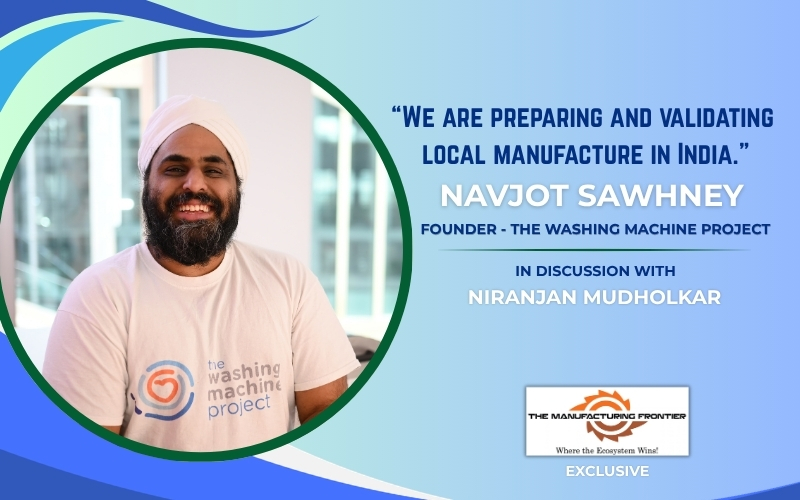
“We are preparing and validating local manufacture in India, not yet operating a continuous line at 10,000 units a year. That figure is intended capacity, not current output.” Navjot Sawhney, Founder, The Washing Machine Project
It is quite natural for today’s manufacturing journalism to focus on high-speed automation lines, multi-axis CNC machining cells, mega-foundries and digital twin architectures. Yet, at The Manufacturing Frontier, we believe the true measure of industrial excellence is not merely found in high-throughput automotive assembly or semiconductor cleanrooms; it lives equally in how engineering and frugal industrial design solve humanity’s most stubborn, neglected challenges.
And very few challenges depict this divide as vividly as manual laundry! Globally, nearly 50% of the world’s population still washes clothes entirely by hand, spending up to 20 hours per week bent over washbasins and rivers. Across low-income, remote and displaced communities, this exhausting labor falls disproportionately on women and girls, stealing time that could otherwise be utilized for education, livelihoods and personal development.
To challenge this reality, Navjot Sawhney founded The Washing Machine Project. At the heart of this project is the Divya Manual Washing Machine, a hand-cranked appliance designed to save time, preserve health and open up opportunities across underserved environments. Nav, as Navjot Sawhney is popularly known, shared this incredible story with Niranjan Mudholkar, Founder & Editor-in-Chief, The Manufacturing Frontier. It is absolutely inspiring to know that since its initial design in 2018, the project has deployed hundreds of machines, impacting more than 105,000 lives across the globe!
Now, as the initiative embarks on establishing a manufacturing footprint in India with an ambitious planned capacity of up to 10,000 units per year, Nav tells The Manufacturing Frontier what it truly takes to transition a humanitarian prototype into a scalable, industrial-grade reality.
The Reality Check
In modern industrial discourse, announcements of scale often blur the line between aspiration and operating reality. Nav, an engineer by training, offers an honest manufacturing perspective right at the beginning: “We are preparing and validating local manufacture in India, not yet operating a continuous line at 10,000 units a year. That figure is intended capacity, not current output.”
Of course, Nav understand that local sourcing is a central goal because it should shorten lead times and make repair easier. But establishing an Indian production ecosystem promises compressed lead times and a localized supply chain, validating a full Indian Bill of Materials (BOM) against domestic Micro, Small, and Medium Enterprise (MSME) clusters remains an active engineering checkpoint. Rather than projecting premature localization figures, Nav and his team are at present methodically benchmarking Indian Tier-2 and Tier-3 suppliers. “That is a measure we intend to report as production readiness progresses,” he says.
Similarly, deploying continuous production demands robust quality gates. While long-term roadmaps envision automated end-of-line test benches, Nav is absolutely clear about one thing: ‘those protocols must emerge from real-world testing rather than boardroom optimism’.
Field-First Engineering
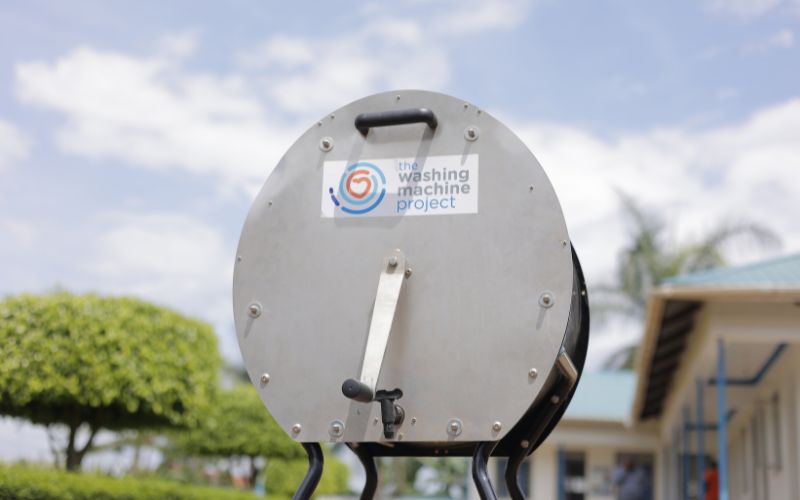
In industrial appliance design, the instinct is often to enforce proprietary service ecosystems. For rural villages and refugee settlements, however, proprietary parts represent a failure mode. If a machine cannot be repaired using the basic hand tools already hanging in a village mechanic’s workshop, it inevitably ends up abandoned.
And that’s exactly why the engineering thought process behind the Divya washing machine focuses on robust field serviceability. “Divya is designed to be disassembled and repaired with locally available skills, tools and off-the-shelf replacement parts rather than proprietary service equipment. One concrete example is the redesigned drain tap, which uses a commonly available fitting so it can be replaced locally. I do not want to claim that every fastener has been standardized to a particular metric size, or that seals, bushings and drivetrain parts have been validated against hard or particulate-heavy water, without checking the final India specification and test results,” Nav explains.
Designing with Women, Not Just for Them
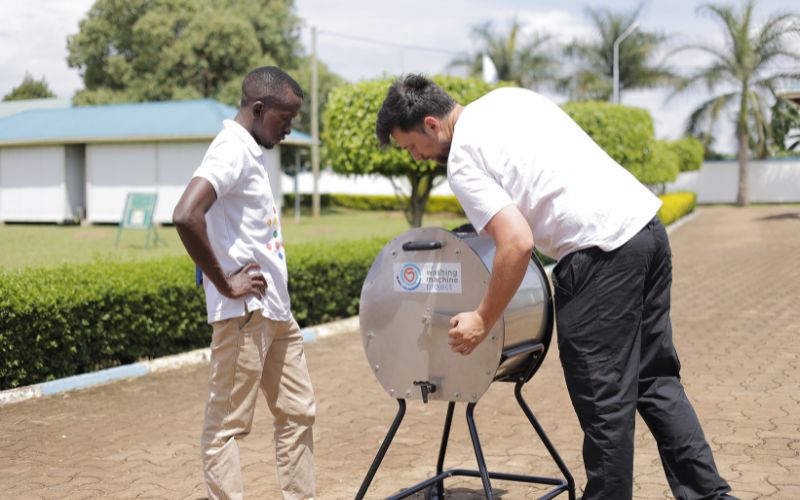
Too often, product design treats ergonomics as a laboratory exercise. For the Divya washing machine, the most significant mechanical revisions emerged from a very simple and raw fact: women and girls shoulder the burden of manual laundry and are the primary operators of Divya. “The clearest changes we can point to are a wider lid opening, after users told us how difficult it was to load and remove blankets and other heavy wet fabrics; an integrated scrub surface for stubborn marks on cuffs and collars; a larger, replaceable drain tap that cuts drain time; and stronger wheels because machines were being moved and shared more than we had anticipated. These came from conversations and co-creation with users, including women in India. I would describe them as user-led design changes, not claim a formal biometric study unless we can provide its methods and data,” explains Nav.
The Last Mile
Any innovation cannot and should not be treated as a silver bullet; something that tends to happen with new hardware in the emerging markets! Well, the Divya washing machine may reduce water consumption but it cannot eliminate the task of fetching water where piped infrastructure does not exist. Nor does it bypass the need for safe, managed greywater disposal in densely packed settlements. The solution, therefore, lies beyond the factory gate.
“Divya can work without electricity or fixed plumbing, but water availability, quality and safe disposal can still limit its usefulness. Our published product information says it can use about half the water of handwashing; that is a comparison with a handwashing baseline, not a universal saving for every household or setting. In dense settlements or camps, greywater needs a locally appropriate drainage arrangement agreed with the site or implementing partner. We should not suggest the machine alone solves sanitation infrastructure,” Nav admits.
The TMF Perspective
At present, Nav and his team at The Washing Machine Project are developing local manufacture alongside implementation partnerships, rather than assuming factory capacity automatically translates into rural reach. “The practical model is to work with organizations already embedded in communities on placement, user training, maintenance and follow-up,” Nav says. He also understands that freight cost, spares and inventory across different geographies are still challenges to be validated as they scale.
Nevertheless, the journey of the Divya washing machine underscores a profound manufacturing truth: building an elegant mechanism is only half the battle. As Nav has mentioned, the harder, more enduring discipline lies in validating local supply chains, designing for maintainability under extreme constraints and respecting the operational realities of the end user.
As Indian manufacturing continues to assert itself on the global stage, initiatives like The Washing Machine Project prove that industrial excellence reaches its highest potential when engineering skills are deployed to ‘wash away’ the daily burdens of the underserved.
