

“Volatility is a given in commodities, so we build resilience into how we operate. Integration is the first layer. Controlling casting, drawing, annealing, tinning and cable extrusion in-house gives us oversight of the full production cycle and removes dependencies that disrupt delivery.” Pramod C., Director, Gopalan Metals
As India accelerates toward an electrified, digitally connected economy, one foundational material sits quietly at the center of this transformation: high-purity, precision-engineered copper. From electric vehicle drivetrains and renewable energy grids to high-speed rail and 5G networks, the country’s next-generation infrastructure depends on conductors that can deliver uncompromising performance over decades.
Stepping into this critical industrial space is Gopalan Metals, the specialized manufacturing arm of the four-decade-old Gopalan Group. Anchored by its integrated facility in Hoskote, the company is bridging a vital gap in India’s supply chain; it is combining the agility and technological expertise required by modern OEMs with the financial strength, accountability and trust of an established enterprise.
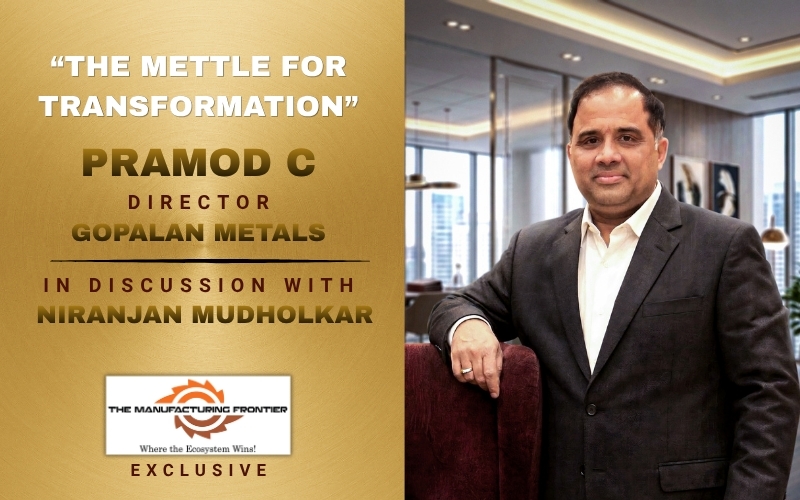
In this exclusive conversation with Niranjan Mudholkar, Founder & Editor-in-Chief, The Manufacturing Frontier (TMF), Pramod C., Director, Gopalan Metals, shares how his background in architecture shapes a systems-driven, detail-obsessed approach to metallurgy. He also elaborates on the disruptive demand drivers that are reshaping copper consumption while explaining how backward integration and SAP-backed operations insulate partners from commodity volatility. The most important take away is his thought behind why building world-class downstream capacity at home is the true key to strengthening the Make in India vision.
How does Gopalan Metals build upon Gopalan Enterprises’ legacy, and what was the strategic motivation that led the group to venture into specialised copper manufacturing?
Gopalan Enterprises has spent 40 years building credibility, financial strength and engineering depth across real estate and other sectors. Gopalan Metals carries that foundation into advanced manufacturing. Our Hoskote facility marks the group’s strategic entry into the space, inheriting the discipline of a legacy business: long-term thinking, accountability to partners, and respect for quality.
The motivation came from a clear read of India’s industrial supply chain. As the country moved toward high-speed rail, EVs and a digital economy, demand for high-purity, precision-engineered copper skyrocketed. The market sat between large commodity producers and smaller firms that could not consistently meet global standards. We saw room for a manufacturer that combines precision with the reliability of a four-decade industrial name. That is why we launched Gopalan Metals to build the essential nervous system for India’s next generation of infrastructure.
You have a background in architecture. How has that discipline’s focus on structural integrity and technical logic influenced your leadership style and your approach to manufacturing high-precision copper solutions?
Architecture teaches us to look beyond the visible design and understand the engineering, planning and systems that make something strong, functional and sustainable over time. We believe the same principles apply to manufacturing.
At Gopalan Group, we have built our presence across residential and commercial real estate, retail, hospitality and other businesses over four decades. Across these diverse sectors, one principle remains constant: quality is not achieved through a single decision; it is the result of getting every detail right. That philosophy is equally relevant to Gopalan Metals, where precision and consistency determine the performance and reliability of our copper products.
In copper manufacturing, parameters such as purity, electrical conductivity, tensile strength and dimensional accuracy must be controlled throughout the production process. From raw material selection and continuous casting to wire drawing, annealing and insulation, every stage has a bearing on the final product. Our approach is to view the entire process as an integrated system rather than a series of independent operations, ensuring consistency and quality at every stage.
This philosophy also shapes our leadership and operational approach. We value structured thinking, clearly defined processes, attention to detail and decisions supported by data. Our SAP-integrated operations help us maintain visibility across materials, production planning and inventory, enabling better coordination and more informed decisions. At the same time, we believe manufacturing must remain responsive to customer requirements, particularly when working with OEMs and industrial clients who need specific technical specifications.
With Gopalan Wires & Cables, we are extending our capabilities from copper manufacturing into products that serve residential, commercial and industrial applications, where electrical safety, precision and consistent quality are essential. Our ambition is to build on the Gopalan Group’s legacy of trust while developing manufacturing capabilities that meet evolving industry requirements.
Ultimately, architecture reinforces an important principle for us: a strong structure depends on the integrity of every component, including those that are not immediately visible. We carry that principle into our business by building strong systems, maintaining high standards and keeping the end user at the centre of our decisions. Whether we are developing a building or manufacturing a copper conductor, our objective remains the same—to deliver quality, reliability and lasting value.
Copper is often called the ‘metal of electrification’. How do you see the current surge in India’s infrastructure and energy transition specifically impacting the demand for world-class copper rods and wires?
Every part of India’s energy transition runs on copper, from transmission lines and transformers to EV drivetrains, solar farms and charging networks. The scale is visible in the numbers. The Centre for Social and Economic Progress (CSEP) projects India’s copper demand at 3.24 million tonnes in conventional sectors by FY2030, with a further 274 thousand tonnes coming from the energy transition.
The implication for manufacturers is a rising need for high-purity, high-conductivity material. Rods feed transformers and switchgear, busbars carry power through substations and panels, and fine wires serve electronics and telecom. Buyers in these segments want consistent quality and dependable lead times. Local producers that deliver global-grade specifications will win that business. Our continuous casting, wire drawing and annealing lines are built for this moment, and demand of this scale rewards precision as much as volume.
Gopalan Metals serves a diverse range of industries—from marine to electronics. Which of these sectors do you anticipate will see the most “disruptive” growth in copper consumption over the next five years?
Three sectors stand out. Automotive leads, because electrification multiplies the copper content of every vehicle, from motors and battery systems to wiring harnesses and charging infrastructure. Renewable energy and power distribution come next. Solar plants, grid upgrades and substations all depend on conductors that cut energy loss over decades of service. Electronics and telecom complete the picture. 5G rollout, robotics and microelectronics demand fine and super-fine wires where accuracy is vital.
Marine and defence will grow steadily, and our tinned annealed wires give those customers corrosion-resistant performance. The sharper shifts will come where technology cycles move fastest. We are expanding in renewable energy and power distribution, and we continue to introduce products aligned with evolving electronics and automotive standards. The common thread across all of them is specification. Customers will pay for purity, consistency and responsiveness, and that is where we compete.
India currently faces a gap in domestic copper supply. How can the industry strengthen the “Make in India” vision through local production?
Local production starts with capability. According to the International Institute for Sustainable Development (IISD), imports account for more than 50% of the primary and secondary raw materials behind India’s copper semis and finished goods, and domestic mining covers only about 5% of refined copper requirements. That gap makes downstream manufacturing the most practical lever for self-reliance.
Industry strengthens ‘Make in India’ by converting metal into precision products at home. High-purity rods, wires and cables made in India reduce dependence on imported finished goods and shorten supply chains for OEMs. Copper is 100% recyclable, so a circular approach keeps value within the country. Our Hoskote plant, with a capacity of approximately 7,200 MT a year of OFC rods and 1,400 MT of copper strips, shows what focused domestic capacity looks like. Self-reliance is built plant by plant, with global standards applied locally.
Given the volatility in global commodity markets, what strategies is Gopalan Metals employing to ensure a steady, reliable supply of high-quality copper for your domestic partners?
Volatility is a given in commodities, so we build resilience into how we operate. Integration is the first layer. Controlling casting, drawing, annealing, tinning and cable extrusion in-house gives us oversight of the full production cycle and removes dependencies that disrupt delivery. Digital visibility is the second. Our SAP ERP, spanning materials management, production planning, sales and distribution, and finance, tracks raw materials and finished goods in real time. That lets us schedule precisely and keep Just-In-Time commitments to partners. Quality is the third. We make rods from high-purity electrolytic copper and test every product in-house before dispatch, so domestic customers receive consistent material batch after batch. Finally, copper’s 100% recyclability supports a circular approach to material use. Together, these layers give OEMs, contractors and infrastructure developers a supplier they can plan around, with faster turnaround than rigid legacy producers typically offer.
As we look toward India becoming a global manufacturing hub, what is your personal vision for the role Gopalan Metals will play in supporting the country’s industrial frontier?
My vision is for Gopalan Metals to be recognized globally as one of the finest and most trusted copper manufacturers, known for technological excellence. As India grows into a global manufacturing hub, industries from power and rail to automotive and electronics will need a domestic partner that meets international standards without compromise, and we intend to be that partner. Our role is to supply the material that carries power and data through the country’s next-generation infrastructure: precision rods, conductors, wires and cables made in India. We keep expanding across domestic and international markets, with a focus on renewable energy and power distribution, and keep diversifying our portfolio as electronics and automotive standards evolve. Efficient, automated production and a circular approach to copper let us grow responsibly. If we do this well, Indian manufacturers will have no reason to look globally for quality copper. They will find it here, in Hoskote.
