

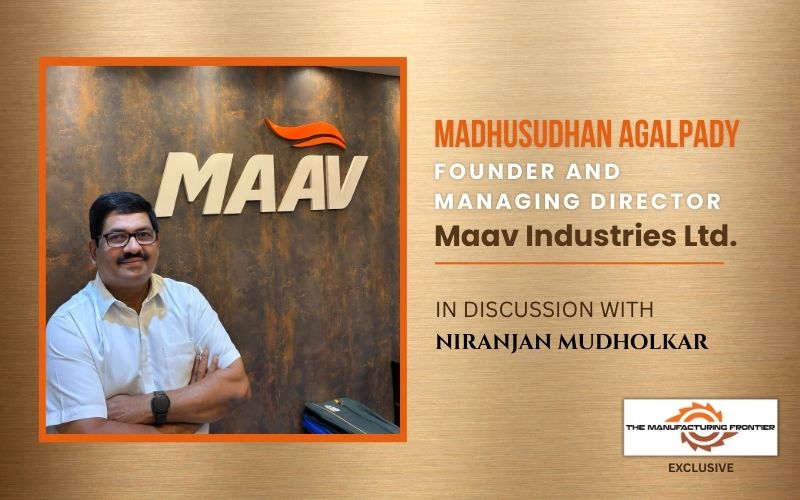
“Our long-term vision is to make sustainability inseparable from quality, to ensure that recycled materials are not seen as a compromise but as the preferred standard. We believe the tipping point is approaching where recycled products will rival, and in many applications surpass, virgin materials in both performance and acceptance.” Madhusudhan Agalpady, Founder and Managing Director, Maav Industries Ltd.
You started Maav Industries with a ₹5, 000 loan from your mother, walking away from a secure government job. What was the single most defining moment in those early years that solidified your belief that you were on the right path?
The defining moment came when our very first batch of products sold out within days in the local Mangalore market, not because of scale but because customers returned asking for more. That repeat demand showed me that trust and quality would always create their own market, no matter how small the beginnings.
In those early years, every sale was a test of credibility; we didn’t have marketing budgets, only our word and commitment to deliver. When customers began to recommend us to others, it became clear that our foundation wasn’t just about trading goods but about building relationships rooted in reliability. Looking back, it wasn’t a single large order or milestone that gave me confidence. It was the small, consistent signs of faith from customers, the shopkeepers who stocked our products again, the farmers who said our ropes lasted longer; that told me I had chosen the right path in leaving a secure job to build something sustainable and valuable for the community.
“The biggest challenge was shifting from being an intermediary to becoming a creator, moving from simply ensuring supply to being accountable for quality at every stage of production. Manufacturing required not only investment in machinery and facilities but also in people, processes, and long-term discipline that distribution alone never demanded.”
Maav Industries evolved from a distribution business to a full-scale manufacturing enterprise. What was the biggest challenge in making that pivot, and how did you leverage your experience in distribution to build a robust production ecosystem?
The biggest challenge was shifting from being an intermediary to becoming a creator, moving from simply ensuring supply to being accountable for quality at every stage of production. Manufacturing required not only investment in machinery and facilities but also in people, processes, and long-term discipline that distribution alone never demanded.
What helped us navigate that pivot was our deep understanding of the market as distributors. For over a decade, we had firsthand exposure to what customers wanted, what retailers struggled with, and where existing products fell short. That knowledge became our blueprint when setting up production, we weren’t just manufacturing for the sake of capacity, we were solving problems we had witnessed for years on the ground. We used our distribution networks to test and refine early product batches, gathering feedback quickly and adjusting our processes in real time. This built credibility with partners who had known us as traders and now trusted us as manufacturers. Over time, the combination of market insight, established relationships, and disciplined execution allowed us to transform into a robust, end-to-end enterprise without losing the customer trust we had earned in our trading days.
Maav Industries has a stated goal of recycling 10, 000 tons of plastic annually by 2030, a significant jump from the current 1, 800 tons. What are the key technological and logistical hurdles you must overcome to achieve this ambitious target, and how do you ensure the financial viability of such a large-scale recycling operation?
Scaling from 1,800 tons to 10,000 tons is less about machines and more about building a complete ecosystem around waste. The biggest challenge lies in consistency; waste plastics come in many grades, and ensuring uniform quality for industrial applications demands advanced segregation and processing technology. Logistically, India’s collection network is highly fragmented, and creating structured supply chains requires partnerships with municipalities, local collection centers, and even informal waste workers. Without this groundwork, capacity alone cannot translate into throughput.
Financially, viability depends on two levers: efficiency and integration. By investing in modular recycling units, energy-efficient processes, and R&D for high-grade recycled compounds, we reduce operational costs while producing materials that command better margins. At the same time, our diversified manufacturing portfolio allows us to absorb recycled plastic into our own production, cutting dependence on virgin raw materials and shielding us from volatile input prices. In essence, the path to 10,000 tons is not just about scale, it is about creating a circular economy model where recycling becomes self-sustaining both environmentally and commercially.
“For us, recycling isn’t just about reducing waste; it’s about creating inputs that seamlessly integrate into manufacturing. By channeling these recycled compounds into our ropes, hardware, and plastic products, we ensure that sustainability does not come at the cost of reliability.”
Maav uses a “proprietary in-house recycling system” to process post-use plastic. What makes this system unique, and what role does this technology play in producing high-quality finished products from recycled materials?
What makes our system unique is its focus on consistency. Most recycling setups struggle with variation in input quality, but our in-house process combines mechanical filtration, chemical stabilization, and controlled blending to deliver uniform recycled granules that can compete with virgin plastic in strength and durability.
We designed the system to be modular and adaptive, capable of handling different grades of post-use plastic without compromising output quality. This allows us to work with the fragmented waste streams in India while still meeting industrial-grade specifications.
For us, recycling isn’t just about reducing waste; it’s about creating inputs that seamlessly integrate into manufacturing. By channeling these recycled compounds into our ropes, hardware, and plastic products, we ensure that sustainability does not come at the cost of reliability. Over time, this closed-loop system has become a cornerstone of how Maav delivers value, offering customers the assurance that every finished product carries both environmental responsibility and uncompromised performance.
With three primary verticals, Plastics, Hardware, and Power Tools, how do you manage to maintain quality and operational efficiency across such a diverse product portfolio, especially as you expand into D2C and e-commerce channels?
The key is standardization, no matter the product line, we anchor every vertical to the same core principles of quality control, supplier vetting, and customer feedback loops. Whether it’s a power tool or a plastic rope, our internal benchmarks for durability and performance remain consistent. Operationally, we rely on specialized units with dedicated teams for each vertical, but we integrate them through a common backbone of processes, procurement, testing, and logistics. This balance between specialization and centralization helps us scale without losing control over quality.
As we enter D2C and e-commerce, efficiency comes from technology. We are investing in digital inventory management, traceability systems, and direct customer service platforms. These tools not only improve operational visibility but also help us capture real-time data on consumer preferences, which then informs product improvements across divisions.
Ultimately, diversity in our portfolio is not a challenge but a strength. Each vertical draws on the same discipline of quality, yet contributes unique learnings that make the entire system more resilient and customer-focused.
As the global focus on sustainability intensifies, what is your long-term vision for Maav Industries? Do you see a future where recycled products not only compete with but also surpass virgin-material products in terms of quality and market share?
Our long-term vision is to make sustainability inseparable from quality, to ensure that recycled materials are not seen as a compromise but as the preferred standard. We believe the tipping point is approaching where recycled products will rival, and in many applications surpass, virgin materials in both performance and acceptance.
This shift will be driven by technology and economics. Advances in processing are already closing the gap in strength, durability, and finish between recycled and virgin inputs. At the same time, volatile raw material costs and tightening regulations make recycled alternatives not just environmentally necessary but commercially smarter.
For Maav, the goal is twofold: to scale recycling capacity to 10, 000 tons annually by 2030 and to integrate those materials seamlessly into our plastics, hardware, and power tool lines. By building consumer trust through consistent quality and offering products that prove recycled doesn’t mean “second best,” we aim to create a portfolio where sustainability is a value-add, not an afterthought.
In the long run, we see recycled products not only competing with but defining the market, because the industries of tomorrow will reward responsibility and performance in equal measure.
“Sustainability and values cannot be treated as add-ons; they must be built into decisions from day one. This means being willing to take the longer, harder path: sourcing responsibly, investing in quality even when margins are tight, and treating people, employees, partners, and customers, with fairness.”
As an entrepreneur with nearly four decades of experience, what is the most important piece of advice you would offer to someone looking to build a sustainable and values-driven business in today’s market?
The single most important advice I would give is to build for trust before you build for scale. In today’s market, customers and partners have endless options, but they return only to those who deliver consistently on their word. Without trust, even the most innovative idea struggles to survive.
Sustainability and values cannot be treated as add-ons; they must be built into decisions from day one. This means being willing to take the longer, harder path: sourcing responsibly, investing in quality even when margins are tight, and treating people, employees, partners, and customers, with fairness. These principles don’t always deliver instant results, but they compound over time into a reputation that no competitor can easily replicate.
I have seen businesses rise and fall with trends, but those anchored in responsibility and trust endure. If you can align profitability with purpose, and never compromise on integrity, you will not just build a business, you will build a legacy.
