

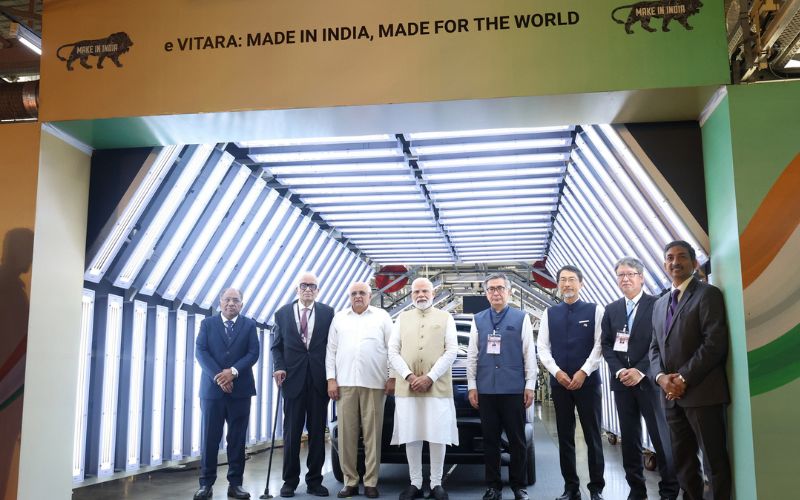
“Make in India, Make for the World, Electric vehicles made in India will be exported to 100 countries from today, Hybrid Battery Electrode Manufacturing is also starting today. India has the power of democracy, the advantage of demography and a very large pool of skilled workforce, making it a win-win situation for every partner. The world will drive EVs that say, Made in India!” PM Modi
In a major example of the success of Make in India, Prime Minister Narendra Modi inaugurated and flagged off the “e VITARA”, Suzuki’s first global strategic Battery Electric Vehicle (BEV). The Made-in-India BEVs will be exported to more than one hundred countries, including advanced markets such as Europe and Japan. With this milestone, India will now serve as Suzuki’s global manufacturing hub for electric vehicles.
Prime Minister also inaugurated the next phase of India’s battery ecosystem with the start of local production of hybrid battery electrodes at TDS Lithium-Ion Battery plant in Gujarat. The plant, a joint venture of Toshiba, Denso and Suzuki, will boost domestic manufacturing and clean energy innovation. This development ensures that more than eighty percent of the battery value will now be manufactured within India.
Addressing the gathering, the Prime Minister noted that amid the festive spirit of Ganeshotsav, a new chapter is being added to India’s ‘Make in India’ journey. He remarked that this marks a significant leap towards the shared goal of “Make in India, Make for the World.” PM Modi highlighted that starting today, electric vehicles manufactured in India will be exported to 100 countries. He further announced the commencement of Hybrid Battery Electrode manufacturing in the country. Emphasizing that today also brings a new dimension to the friendship between India and Japan, the Prime Minister extended his heartfelt congratulations to all citizens of India, to Japan, and to Suzuki Motor Corporation.
Recalling that the seeds of India’s success story were sown 12–13 years ago, PM Modi said that in 2012, during his tenure as Chief Minister, land was allotted to Maruti Suzuki in Hansalpur. He emphasized that even at that time, the vision was of Aatmanirbhar Bharat and Make in India. He remarked that those early efforts are now playing a significant role in fulfilling the nation’s current resolutions.
“India possesses the strength of democracy and the advantage of demography; India also has a vast pool of skilled workforce, creating a win-win situation for every partner,” emphasized PM Modi. He pointed out that Suzuki Japan is manufacturing in India, and the vehicles produced here are being exported back to Japan. The Prime Minister remarked that this reflects not only the strength of India-Japan relations but also the growing trust of global companies in India. He stated that companies like Maruti Suzuki have effectively become brand ambassadors of Make in India. Noting that for four consecutive years, Maruti Suzuki has been India’s largest car exporter, the Prime Minister announced that from today, EV exports will also begin on the same scale. He affirmed that in dozens of countries around the world, the EVs that will run will proudly bear the label—Made in India.
Underlining that the most critical component of the EV ecosystem is the battery, the Prime Minister said that until a few years ago, batteries in India were entirely imported. He added that to strengthen EV manufacturing, it was essential for India to begin domestic battery production. Shri Modi recalled that in 2017, the foundation of the TDSG battery plant was laid with this vision. He announced that under a new initiative by TDSG, three Japanese companies will jointly manufacture battery cells in India for the first time. He added that battery cell electrodes will also be produced locally within India. The Prime Minister emphasized that this localization will empower India’s self-reliance. He remarked that this will accelerate the growth of the hybrid electric vehicle sector. He extended his best wishes for this historic beginning.
Mentioning that until a few years ago, EVs were viewed merely as an alternative option, the Prime Minister emphasized his belief that EVs offer concrete solutions to multiple challenges. He recalled that during his visit to Singapore last year, he had proposed converting old vehicles and ambulances into hybrid EVs. PM Modi commended Maruti Suzuki for accepting this challenge and developing a working prototype within just six months. He shared that he personally reviewed the prototype of the hybrid ambulance and said that these hybrid ambulances align perfectly with the PM E-DRIVE scheme. The Prime Minister noted that under this ₹11,000 crore scheme, a dedicated budget has been allocated for e-ambulances. He highlighted that hybrid EVs will help reduce pollution and offer a viable option to transform old vehicles.
Affirming that clean energy and clean mobility represent the future of India, PM Modi emphasized that through such efforts, India is rapidly emerging as a reliable hub for clean energy and clean mobility.
Source: PIB
