

“For industry leaders, the focus must shift from merely exploring automation to aggressively implementing it. This means investing not only in traditional industrial robots but also in collaborative robots (cobots) that work alongside human workers, and Autonomous Mobile Robots (AMRs) for material handling.”
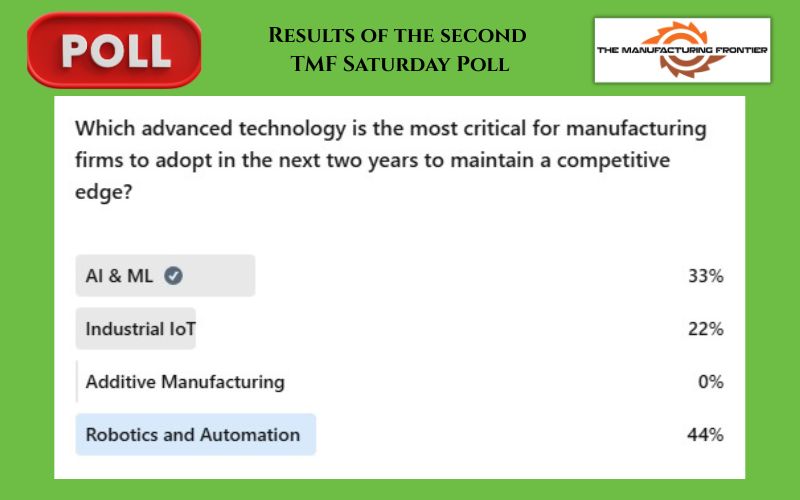
The results of The Manufacturing Frontier’s (TMF) second Saturday Poll deliver a decisive and unambiguous mandate for the industry: Robotics and Automation are considered the most critical advanced technology for manufacturing firms to adopt in the next two years to maintain a competitive edge. Garnering a commanding 44% of the vote, this category significantly eclipsed its rivals, with AI & ML trailing at 33%, Industrial IoT at 22%, and a notable 0% for Additive Manufacturing.
This poll result is not a fleeting trend; it is a profound reflection of the immediate pressures facing manufacturing. In a global economy grappling with persistent labour shortages, fluctuating supply chains, and an unyielding demand for higher quality and greater customization, the transformative power of automation is being valued above all else.
The respondents, largely industry professionals, are clearly signalling that they view the foundational elements of automation—precision, speed, cost efficiency, and safety—as the most reliable and impactful levers for near-term competitive success. While technologies like AI & ML are undeniably the strategic future of the smart factory, their immediate value is often seen as being amplified by a robust automated infrastructure. In essence, you need a critical mass of robots and automated systems to generate the actionable data that makes AI and ML truly valuable. The factory floor’s most pressing need is not just smarter decision-making, but the capability to execute on those decisions instantly and repeatedly at scale.

Industrial IoT’s 22% share is a clear indication that connectivity and data generation are viewed as an enabling technology, crucial but secondary to the ultimate act of production and movement—the physical work performed by robots. The complete absence of votes for Additive Manufacturing (3D Printing) suggests that for the vast majority of firms, this technology remains a niche or prototyping tool, not a core, mission-critical component of high-volume, competitive production within the two-year adoption window.
The message for manufacturing firms is crystal clear: The race for productivity is being won on the factory floor, robot by robot. The firm that automates its most repetitive, dangerous, or high-precision tasks first will be the one that can meet fluctuating demand with consistent quality, optimise its dwindling human resources, and ultimately lower its cost-per-unit to maintain its margin and market position.
For industry leaders, the focus must shift from merely exploring automation to aggressively implementing it. This means investing not only in traditional industrial robots but also in collaborative robots (cobots) that work alongside human workers, and Autonomous Mobile Robots (AMRs) for material handling. Moreover, the 33% vote for AI & ML suggests a hybrid strategy is optimal: implementing AI-powered machine vision for automated quality control, or using machine learning to program more efficient robot paths.
The TMF poll is a clear-eyed reality check. In the next two years, competitive advantage in manufacturing will be determined by the speed and scale of deploying smart machines. The era of seeing robotics as a cost centre is over; the industry has declared it the single most critical investment for survival and supremacy.
