

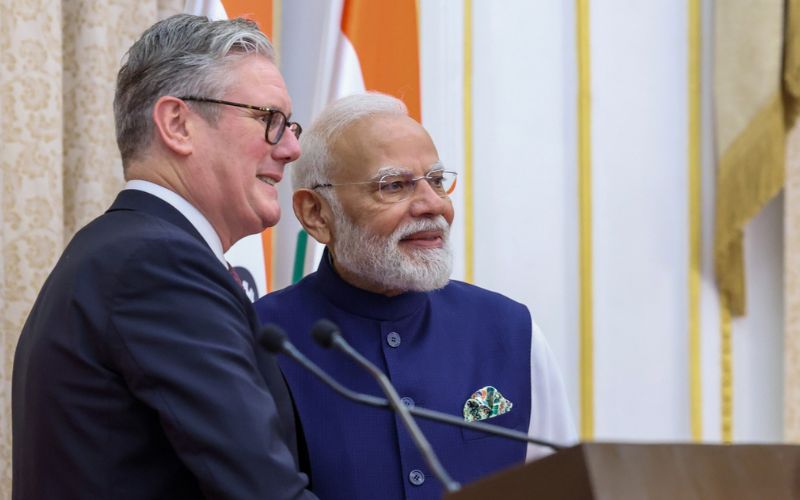
“The Prime Ministers reiterated their shared commitment to global peace, prosperity and a rules-based international order. They agreed to work closely in promoting reformed multilateralism, including reform of the United Nations Security Council (UNSC).”
In the joint statement issued by both countries during official visit of the UK PM Sir Keir Starmer, the UK has reiterated its long-standing support for India’s legitimate aspirations for permanent membership in a reformed UNSC.
This is Prime Minister Starmer’s first official visit to India. The visit follows the visit of Prime Minister of India to the United Kingdom on 23–24 July 2025, during which both sides signed the historic India–UK Comprehensive Economic and Trade Agreement (CETA) and adopted the India – UK Vision 2035 and a Defence Industrial Roadmap.
Defence and Security: The Leaders agreed to expand bilateral exchanges between the armed forces of India and UK through joint exercises, training and capacity building. Prime Minister Modi welcomed the port call of UK’s Carrier Strike Group and the Royal Navy’s exercise KONKAN with the Indian Navy. Both sides committed to robust maritime security collaboration in the Indo-Pacific, including establishment of the Regional Maritime Security Centre of Excellence (RMSCE) under the Indo-Pacific Oceans Initiative (IPOI).
In the context of cooperation on training, the two Leaders welcomed progress on an arrangement that will see Indian Air Force Qualified Flying Instructors integrated into UK Royal Air Force training, alongside an agreement that will facilitate our strong training and education relationship.
Both Prime Ministers are pleased to the intent to finalize an India – UK Inter-Governmental Agreement (IGA) on cooperation in developing maritime electric propulsion systems for Indian Naval platforms.
Both leaders also announced the agreement to proceed via government-to-government route on an initial supply of Lightweight Multirole Missile (LMM) systems. This will further support India’s air defence capabilities and, in the spirit of Atmanirbhar Bharat, meet the current and future requirements of the Indian Ministry of Defence, and support a long-term collaboration on complex weapons between the two countries.
The two Prime Ministers unequivocally and strongly condemned terrorism and violent extremism in all its forms and manifestations. They called for zero tolerance for terrorism and concerted international efforts to combat terrorism in a comprehensive and sustained manner, in accordance with the UN Charter and international law. They agreed to counter radicalization and violent extremism; combat financing of terrorism and the cross-border movement of terrorists; prevent exploitation of new and emerging technologies for terrorist purposes; tackle terrorist recruitment; enhance cooperation in information sharing, judicial co-operation, capacity building; and strengthen bilateral and multilateral co-operation in these spheres, including at UN and FATF. They condemned in the strongest terms the April 2025 terrorist attack in Pahalgam, Jammu and Kashmir. They committed to strengthen co-operation to take decisive and concerted actions against globally proscribed terrorists, terror entities and their sponsors.
The Prime Ministers reiterated their shared commitment to global peace, prosperity and a rules-based international order. They agreed to work closely in promoting reformed multilateralism, including reform of the United Nations Security Council (UNSC). The UK reiterated its long-standing support for India’s legitimate aspirations for permanent membership in a reformed UNSC.
Source: PIB
