

“The standout finding, commanding 50% of the votes, is the sentiment that “Green Business = Good Business”. This majority view signifies that sustainability has moved firmly out of the niche CSR (Corporate Social Responsibility) department and into the realm of strategic business imperatives.”
The results of the 3rd The Manufacturing Frontier (TMF) Saturday Poll reveal a significant shift in how the manufacturing sector perceives and prioritizes sustainability. The overwhelming majority of votes indicate that for today’s manufacturing organizations, sustainability is a core business strategy rather than merely a regulatory hurdle.
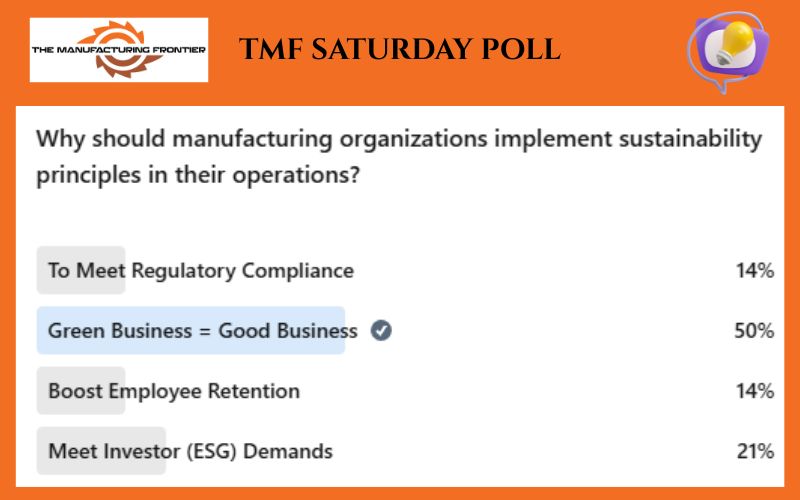
The poll asked, “Why should manufacturing organizations implement sustainability principles in their operations?” and the responses paint a clear picture of the industry’s evolving drivers.
Industry Trends: The Business Case Dominates
The standout finding, commanding 50% of the votes, is the sentiment that “Green Business = Good Business”. This majority view signifies that sustainability has moved firmly out of the niche CSR (Corporate Social Responsibility) department and into the realm of strategic business imperatives.
This trend shows manufacturers increasingly recognize that adopting sustainable practices—such as optimizing resource use, reducing waste, and transitioning to cleaner energy—directly leads to:
Operational Efficiency and Cost Reduction: Less waste and more efficient energy use mean lower operating costs.
Competitive Advantage: Sustainable products and transparent practices appeal to a growing segment of environmentally conscious consumers and B2B partners, opening new market opportunities.
Innovation: The challenge of “going green” often drives process and product innovation, leading to proprietary technologies and new revenue streams.
The Growing Influence of Financial and Talent Capital
While the pure business case leads, two other critical factors collectively account for a significant 35% of the motivation, underscoring the growing pressures from both the financial world and the labour market.
Investor Demands: ESG as a Financial Mandate (21%)
The 21% vote for “Meet Investor (ESG) Demands” highlights the rising power of Environmental, Social, and Governance (ESG) criteria in the financial markets. For manufacturers, a strong ESG profile is no longer optional—it is increasingly a prerequisite for attracting and securing investment.
Access to Capital: Investors, lenders, and insurers use ESG ratings to assess risk and long-term value. Companies with poor scores face higher borrowing costs or reduced access to capital.
Risk Mitigation: Proactive sustainability efforts, such as reducing carbon footprint and ensuring ethical supply chains, are viewed as smart business practices that mitigate future regulatory, reputational, and physical risks. This trend mandates greater supply chain transparency and detailed reporting on resource consumption and emissions.
The War for Talent: Sustainability as a Retention Tool (14%)
The 14% share for “Boost Employee Retention” confirms that sustainability has become a key element of the modern employee value proposition.
Values Alignment: Millennials and Gen Z, in particular, prioritize working for companies whose values align with their own. A demonstrable commitment to environmental stewardship instils a sense of purpose, pride, and loyalty among employees.
Workforce Engagement: Sustainability initiatives, such as waste reduction programs or community involvement, often boost employee morale and engagement, directly contributing to lower turnover and higher productivity. Sustainable manufacturing is increasingly linked to sustainable Human Resource Management (HRM).
Regulatory Compliance: A Baseline, not a Driver
The traditional motivator, “To Meet Regulatory Compliance”, received the smallest share at 14%. This result is not an indication that compliance is unimportant, but rather that for the forward-looking segment of the industry, it has become a baseline expectation—a floor, not a ceiling.
Today’s leading manufacturers are not just aiming for the minimum required by law; they are proactively adopting standards that exceed current regulations to future-proof their operations against anticipated stricter mandates and to capture the greater financial and talent benefits that accompany a genuinely green business model.
In conclusion, the TMF poll results demonstrate that the manufacturing industry’s journey toward sustainability is primarily driven by the pursuit of long-term economic resilience and competitive advantage. The financial market (investors) and the labour market (employees) serve as powerful co-drivers, ensuring that sustainability is permanently embedded as a strategic pillar for the future of manufacturing.
Want to participate in the next TMF Saturday Poll?
Cast your vote here and tell us what is your Go-to-Activity for fitness:
https://www.linkedin.com/feed/update/urn:li:activity:7382674490377437184
