

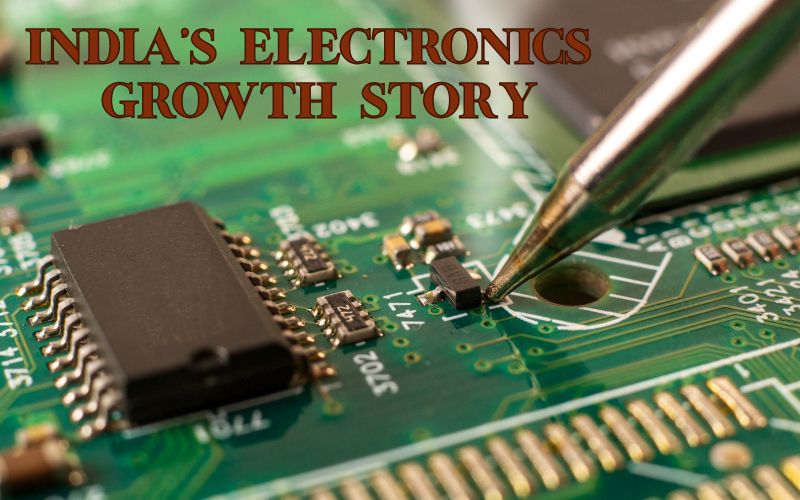
“India has successfully built a strong launchpad for its electronics future. The next phase of growth, however, must change from simply increasing production to mastering the entire value chain—especially the semiconductor and display component ecosystems.”
The story of India’s economic growth often focuses on its prowess in the services sector, but a silent revolution has been unfolding in its factories that make appliances and gadgets. The amazing increase in electronics production over the last decade—from ₹1.9 lakh crore in 2014–15 to a projected ₹11.3 lakh crore in 2024–25, a nearly six-fold rise—marks a fundamental shift in the nation’s industrial landscape. This transformation is more than just a statistical victory; it represents India’s determined journey from a technology consumer heavily reliant on imports to a robust global manufacturing and export hub.
At the heart of this dramatic surge lies the mobile phone industry. This segment is the undisputed accelerator of India’s ‘Make in India’ ambition. In just ten years, mobile phone production value has exploded by an astonishing 28-fold, growing from ₹18,000 crore to ₹5.45 lakh crore. Crucially, the number of manufacturing units scaled from a mere 2 in 2014 to over 300 today, churning out approximately 330 million devices annually. This rapid vertical integration has allowed India to achieve near self-reliance, moving from importing 78% of its mobile requirements to manufacturing almost all devices domestically. It is this combination of scale and strategic self-sufficiency that has secured India’s position as the world’s second-largest mobile phone manufacturer.
Global Reach
The true validation of this domestic success, however, is found in the export market. The overall electronics exports have grown eight times during the decade, hitting ₹3.27 lakh crore. Within this figure, mobile phone exports showcase a growth trajectory that defies precedent, rocketing 127 times from ₹1,500 crore to ₹2 lakh crore. This is not merely an increase in volume but a significant qualitative leap into high-value manufacturing.
The electronics sector’s overall maturity is evidenced by its successful penetration of discerning global markets. The United States, United Arab Emirates, the Netherlands, the United Kingdom and Italy now stand as India’s top five export destinations, confirming the global trust in the quality and supply chain reliability of Indian-made goods. In a landmark achievement, India recently overtook China to become the top smartphone exporter to the United States in Q2 FY 2025-26. Furthermore, the commitment of global giants like Apple, whose exports from India crossed the ₹1 lakh crore mark in 2024, signals India’s ascent as a reliable cornerstone in the fragmented global technology supply chain. The inflow of over US$ 4 billion in FDI since FY2020-21 underscores this international confidence in India’s manufacturing capacity.
Role of Policy Reforms
This remarkable growth is a direct result of focused policy intervention. The National Policy on Electronics (NPE) set a clear vision: to position India as a global hub for Electronics System Design and Manufacturing (ESDM), targeting US$ 400 billion in revenue by 2025. This policy, alongside subsequent production-linked incentive (PLI) schemes, has successfully de-risked large-scale investment for both domestic and international players. By championing design-led manufacturing and supporting R&D, the policy framework encourages not just assembly, but true innovation and value addition.
The socioeconomic impact is equally profound. Over the last ten years, electronics manufacturing has generated a massive 25 lakh direct and indirect jobs, providing crucial employment opportunities across the manufacturing ecosystem. This employment creation fuels domestic consumption and generates a skilled workforce, creating a virtuous cycle that reinforces India’s competitive advantage.
The Road Ahead
India has successfully built a strong launchpad for its electronics future. The next phase of growth, however, must change from simply increasing production to mastering the entire value chain—especially the semiconductor and display component ecosystems. Meeting the ambitious US$ 400 billion revenue goal will require sustained policy push towards higher-value manufacturing and design IP creation. The foundation has been laid, the momentum is undeniable, and the global market is receptive. India is no longer just manufacturing for itself; it is strategically positioning itself to be the world’s trusted, next-generation factory floor. The decade ahead promises to be the decade of India’s electronics might.
Data source: https://www.pib.gov.in/PressReleasePage.aspx?PRID=2177755
