
“By focusing our collective energy on co-designing the very fabric of education, we can empower the next generation of professionals to become the pioneers and drivers of next-gen tech adoption, not just passive recipients of theoretical knowledge.”
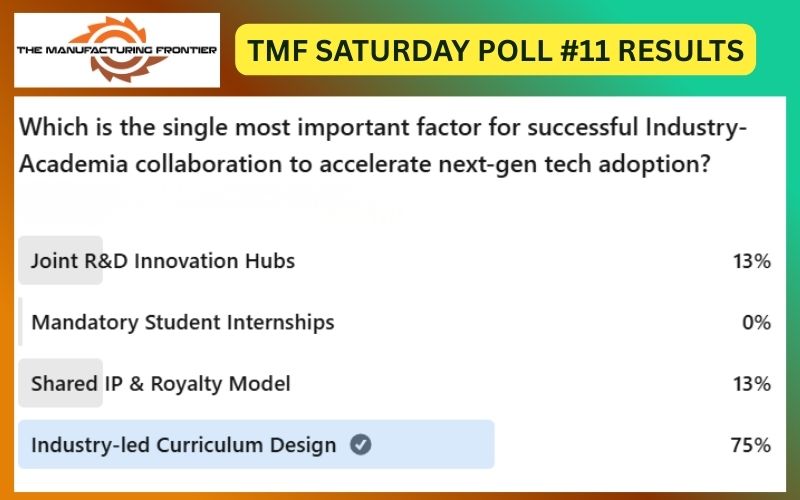
The results of the recent TMF Saturday Poll #11 have delivered a resounding, almost unanimous verdict that shifts the spotlight in the industry-academia collaboration debate. The question: “Which is the single most important factor for successful Industry-Academia collaboration to accelerate next-gen tech adoption?” yielded a clear winner: Industry-led Curriculum Design, securing a staggering 75% of the votes.
The remaining options—Joint R&D Innovation Hubs (13%), Shared IP & Royalty Model (13%), and Mandatory Student Internships (0%)—while important components, were dwarfed by the consensus on curriculum design. This outcome is more than just a poll result; it’s a powerful directional signal that challenges traditional models and underscores a fundamental truth: The relevance of education is the ultimate accelerator of technology adoption.
The Skills Mismatch: An Existential Threat
For years, the technology sector has grappled with a persistent and widening skills mismatch. As technologies like AI, ML, IoT, Big Data and Green Manufacturing rapidly reshape the global economy, academic curricula have often struggled to keep pace. The lag between theoretical knowledge imparted in the classroom and the practical, in-demand skills required in the modern workplace creates a significant friction point for tech adoption.
The 75% vote is a collective industry plea for universities to move beyond being just knowledge repositories. It advocates for a transition towards a dynamic, adaptive model where the industry—the direct user and driver of next-gen technology—acts as the primary consultant in shaping the educational roadmap.
Why Curriculum Design Trumps All
Why did Industry-led Curriculum Design resonate so overwhelmingly compared to the other factors?
Relevance and Future-Proofing: A curriculum co-created with industry ensures that students are trained on the latest tools, technologies and methodologies. This directly bridges the gap between theory and practice. By integrating emerging fields like fintech analytics, behavioural economics, digital communication, and ethical leadership into diverse programs, we are preparing graduates not just for current jobs, but for roles that haven’t even been fully defined yet.
A Prerequisite for Other Factors: You can build the most advanced Joint R&D Innovation Hubs (13%), but without a pipeline of graduates who possess the foundational, industry-relevant skills to utilize the equipment and solve complex, real-world problems, the hub becomes a beautiful, expensive shell. Similarly, mandatory internships (0%) are ineffective if the student’s academic background doesn’t provide the necessary context to make a meaningful contribution from day one. Relevant skills are the currency of collaboration.
The Foundation of Employability: The mandate for higher education today is not just to provide employment but to ensure employability. Industry involvement on curriculum advisory boards and through micro-credentials, co-teaching, and specialized workshops ensures that the learning outcomes are directly aligned with workforce readiness. This drastically reduces the time, effort, and resources companies spend on initial training.
The Collaborative Path Forward
For the 75% mandate to be fully realized, both industry and academia must embrace a cultural shift:
Academia Must Be Agile: Universities need to adopt flexible credit systems, multidisciplinary learning and continuous improvement cycles (like the PDSA cycle) for curriculum revision. They must view industry engagement not as an elective, but as an integral part of maintaining academic excellence.
Industry Must Invest Strategically: Industry partners must commit to more than just guest lectures. They should actively participate in curriculum advisory boards, provide faculty development programs (Source 1.2, 2.6), offer real-time data for case studies, and sponsor challenge-based learning projects. This must be seen as a long-term investment in future talent, not just short-term recruitment.
Focus on Soft Skills: While technical competency is paramount, industry-led curriculum must also intentionally cultivate essential soft skills—problem-solving, adaptability, critical thinking, and collaboration—which are becoming the most sought-after qualities in dynamic workplaces (Source 1.3).
A Call to Action
The result of the TMF Saturday Poll is a call to action. It’s an undeniable push for a deeper, more structural and more meaningful partnership. By focusing our collective energy on co-designing the very fabric of education, we can empower the next generation of professionals to become the pioneers and drivers of next-gen tech adoption, not just passive recipients of theoretical knowledge.
Let’s shift the conversation from how to collaborate to what we are teaching and ensure that every graduate is future-ready!
The next TMF Saturday Poll is now opening. Give your vote at the below link:
https://www.linkedin.com/posts/the-manufacturing-frontier_engineofgrowth-atmanirbharbharat-pli-activity-7405456443165933568-u4qM?utm_source=share&utm_medium=member_desktop&rcm=ACoAAAKdKgsBEnnsJn6AZgH975vaADYrlq_xxoI
