

“By combining data-led planning with human-centric execution, logistics companies can not only manage seasonal spikes efficiently but also convert them into opportunities for long-term growth, customer trust, and competitive differentiation.” Utkarsh Tripathi, Co-Founder & Chief Operating Officer (COO) of Hexalog
Seasonal peaks would remain a fundamental characteristic of logistics due to retail marketing campaigns, e-commerce booms, harvest cycles, and international trading patterns. Those who perform well under such conditions would do so as a result of their operational approach and philosophy of preparing and being nimble rather than reactive and remedial.
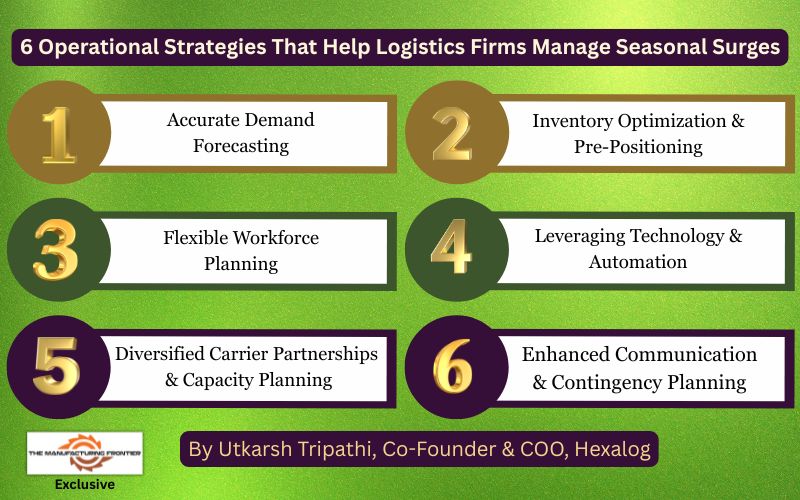
1. Accurate Demand Forecasting: The ability to forecast demand effectively is a huge aspect of efficient peak season handling. Instead of just analyzing historical shipment volumes, companies are increasingly incorporating sophisticated analytics that include analysis of real-time order trends, geographic, and overall economic factors. Some companies use AI algorithms for anomaly detection, for instance, unexpected peaks driven by promotion or unexpected flare-ups in the marketplace. By incorporating multiple factors, including internal information and external information such as weather patterns, holidays, or trade, logistics companies are able to make precise decisions regarding resource deployment.
2. Inventory Optimization and Pre-Positioning: Strategic inventory management helps achieve faster and more accurate distribution during peak periods of demand. Analysis of demand patterns is carried out in very small areas, like a city, a district, or a neighbourhood, to identify the most strategic sites for warehouse placement. Strategies for inventory, especially rotation based on projected demand and establishing safety levels for what are deemed to be higher-priority goods, mitigate threats of inventory shortages as well as having an overabundance of goods. “Pre-positioned inventory can help ease pressures of central warehousing and transportation infrastructure.
3. Flexible Workforce Planning: The workforce plays a very important role in surge management. Logistics companies utilize techniques like cross-training, temp hiring, and flexible shift work to efficiently scale their workforce to meet peak demands. To handle these demands efficiently and avoid operational disruptions due to a shortage of workforce capacity, cross-trained personnel can easily shift between functions like warehouse management, sorting, and last-mile delivery to meet surge demands instantaneously. Modern workforce management solutions make it possible to better forecast workforce needs and monitor productivity in real-time to manage surge demands easily and efficiently.
4. Leveraging Technology and Automation: Technology and automation play a crucial role in ensuring the efficient scaling of business volumes during peak periods. Automated warehouse management solutions and robotic picking are capable of minimizing human-dependent tasks. Route optimization and live tracking solutions help in ensuring that the movement of goods from one place to another happens in an optimized manner even in traffic or when there is strain on the network. The use of dashboards enabled by data analysis allows managers to foresee any issues in the system and correct course accordingly. Analytical solutions enabled by the use of sensors help in monitoring temperature-sensitive or high-value goods.
5. Diversified Carrier Partnerships and Capacity Planning: Bottlenecks related to capacity tend to arise at peak times of the year and hence the need for diverse networks on the part of carriers. Companies that are involved in logistics engage with various regional and last-mile carriers and multimodal transport companies in order to share risks and prevent any stoppage of services through diversification. Capacity management is accomplished through advance booking of transport capacity, designing alternative routes, and loads management on transport carriers to prevent congestion on the networks. In addition, there are companies that have adopted flexible contracts that enable scale-up quickly due to unexpected surge volumes.
6. Enhanced Communication and Contingency Planning: Communication and contingency planning are integral for operational resilience during seasonal peaks. Logistics companies set up proper channels of communication within and outside the organization to coordinate responses based on live updates. There can be contingency plans based on certain scenarios like road blockage, vehicle failure, or unexpected shortages of staff. The contingency plan includes predetermined escalation procedures, alternate routes, contingency staff mobilization, and resource redistribution so that operations can continue despite disruptions. Proactive communication helps ensure all stakeholders are in sync and responding accordingly, even during seasons of high activity.
The Role of people
While operational preparedness, capacity planning, and technology adoption are critical during seasonal surges, the role of people often determines how effectively these strategies are executed on the ground. Logistics operations experience sustained pressure during peak periods, making employee wellbeing not just a cultural initiative but an operational necessity.
Companies that invest in employee welfare—through structured engagement initiatives, morale-boosting sessions, and recognition programmes—are better positioned to maintain productivity, accuracy, and service quality throughout extended festive seasons. High-stress environments demand high levels of motivation, clarity, and emotional resilience, all of which are strengthened when teams feel supported and valued.

At Hexalog, we view our people as a decisive factor in navigating peak operational cycles. Their wellbeing remains a top priority, particularly during periods of heightened demand. Each festive season is approached as an opportunity to acknowledge the effort, commitment, and adaptability demonstrated by our teams across functions.
This year, our festive season initiative is themed “Arohan – Scale New Heights.” Spanning over five months, the programme focuses on continuous appreciation and recognition of teams that go beyond their defined roles, align with the company’s vision, and embody our core belief of amplifying businesses beyond boundaries. Through consistent engagement and celebration, we reinforce a culture where performance is driven not by pressure alone, but by purpose and collective pride.
In an industry where seasonal surges are inevitable, organizations that prioritize employee morale alongside operational efficiency build resilience that extends well beyond peak periods—creating teams that are prepared, motivated, and capable of delivering excellence under pressure.
Seasonal surges are no longer short-term disruptions for logistics firms; they are recurring stress tests that demand strategic foresight and operational maturity. Organizations that succeed during peak periods are those that move beyond reactive firefighting and invest in scalable processes, technology-driven visibility, strong partner ecosystems, and resilient teams.
By combining data-led planning with human-centric execution, logistics companies can not only manage seasonal spikes efficiently but also convert them into opportunities for long-term growth, customer trust, and competitive differentiation. As peak seasons continue to expand in duration and complexity, the ability to prepare holistically will define which players lead the industry forward.
The author is Utkarsh Tripathi, Co-Founder & Chief Operating Officer (COO) of Hexalog
