
“For decades, the shop floor was viewed through the lens of rigid KPIs and mechanical efficiency. But as we navigate a landscape of labour shortages and rapid technological shifts, the “human element” has become our most critical asset.”
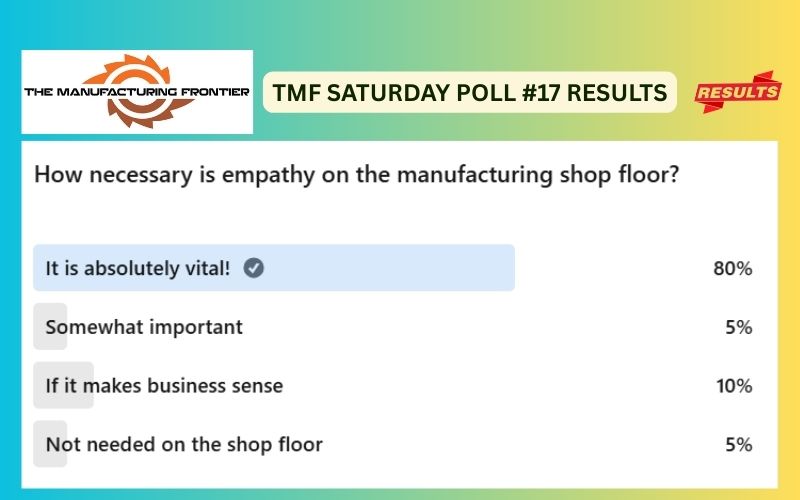
The results from our latest TMF Saturday Poll are in, and the verdict is overwhelming: Empathy isn’t just a “soft skill”—it’s a manufacturing powerhouse. When we asked how necessary empathy is on the shop floor, a staggering 80% of you declared it “absolutely vital”. Meanwhile, only 5% felt it has no place in production.
Breaking Down the Data
80%: Absolutely Vital
10%: If it makes business sense
5%: Somewhat important
5%: Not needed
Why the Shift?
For decades, the shop floor was viewed through the lens of rigid KPIs and mechanical efficiency. But as we navigate a landscape of labour shortages and rapid technological shifts, the “human element” has become our most critical asset.
Empathy translates to:
Safety & Communication: A culture where operators feel heard is a culture where risks are reported before they become accidents.
Retention: People don’t leave machines; they leave environments where they feel undervalued.
Problem Solving: High-pressure environments require psychological safety to innovate and troubleshoot effectively.
While 10% of respondents noted that empathy should “make business sense”, the reality is that empathy is the business sense. High morale correlates directly with lower downtime and higher quality output. In an industry driven by precision and hard data, it turns out the strongest link in the supply chain is how we treat one another. What’s your take? If you’re in the 80%, how do you practice empathy without losing sight of production targets? Let’s discuss in the comments.
And yes, our next poll is now open. We want to understand the importance of ‘Branding’ in the manufacturing industry. Cast your vote at the following link:
https://www.linkedin.com/feed/update/urn:li:activity:7420676797815574528
