
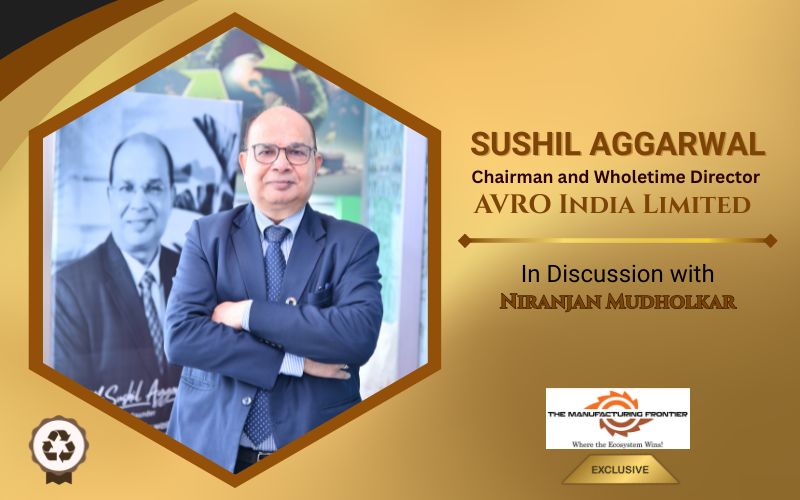
In the landscape of Indian manufacturing, the transition from a localized workshop to a nationally recognized, publicly traded powerhouse is a feat often discussed but rarely executed with such scientific precision. For AVRO India Limited, this journey has been defined by more than just market expansion; it has been an evolution of engineering philosophy. Under the leadership of Sushil Aggarwal, Chairman and Wholetime Director, AVRO India Limited, has redefined what it means to be a “moulded furniture” company by transforming into a vertically integrated polymer specialist.
Being associated in leadership capacity with several industry associations, Mr. Aggarwal sits at the intersection of policy, sustainability, and industrial grit. His vision for AVRO transcends the traditional manufacturing mould, leaning heavily into a future where automation and circularity are the twin engines of growth.
In this exclusive interview with Niranjan Mudholkar, Founder & Editor-in-Chief of The Manufacturing Frontier, Mr. Aggarwal pulls back the curtain on the technical sophisticated of AVRO’s “multi-location manufacturing ecosystem”. He details a world where high-tonnage, servo-controlled machinery and automated material handling have eliminated the variables of human error, replacing them with the relentless consistency required for national scale.
Perhaps most compelling is AVRO’s aggressive stance on backward integration. With a recycling capacity exceeding 1,000 metric tonnes per month, the company is proving that “recycled” does not mean “substandard”. Through advanced polymer engineering, utilizing controlled-temperature extrusion and molecular stabilization, AVRO is bridging the performance gap between virgin and reprocessed materials.
Mr. Aggarwal, you have successfully transitioned AVRO India from a regional unit in 2002 to a nationally recognized, publicly traded entity. How has your production infrastructure evolved to support this scale, and what role does automation play in your modern facilities?
When AVRO began operations in 2002, it was a modest regional manufacturing setup with limited moulding capacity and largely manual workflows. Over the past two decades, our production infrastructure has been re-engineered into a fully integrated, multi-location manufacturing ecosystem designed for scale, consistency, and efficiency.
Today, automation is central to how our facilities function. We operate high-tonnage, servo-controlled injection moulding machines supported by centralized raw material feeding, automated material handling, and in-line production and quality monitoring systems. These investments are not about replacing labour, but about eliminating variability in dimensions, surface finish, and structural integrity especially at high volumes.
Automation has also helped us optimize energy consumption and reduce per-unit costs, allowing us to scale nationally while maintaining manufacturing-grade precision across product categories.
Can you tell us about your plastic recycling units in terms of number of units, capacity, and location?
AVRO has made a deliberate strategic choice to invest in backward integration through plastic recycling and polymer processing.
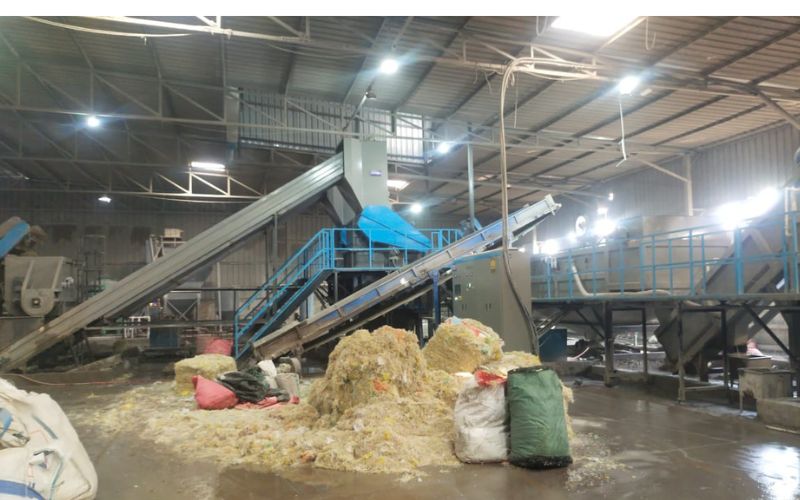
Our recycling ecosystem comprises multiple integrated recycling and compounding units located in Ghaziabad. These facilities house dedicated washing, shredding, agglomeration, extrusion, and pelletizing lines, with a cumulative processing capacity of approximately 1,000 metric tonnes per month and above.
These units are designed to handle both post-consumer and post-industrial plastic waste. Importantly, they are not positioned as standalone waste-processing units, but as a value-added polymer engineering vertical that supports our own manufacturing requirements while also supplying recycled granules and custom premix compounds to external customers.
How do you manage the supply chain for post-consumer or post-industrial waste to ensure a steady feedstock for manufacturing?
Feedstock reliability is one of the most critical challenges in recycling-led manufacturing, and it cannot be left to informal sourcing alone.
At AVRO, we operate a structured and diversified procurement model that includes aggregator networks across multiple states, institutional and industrial waste partnerships, and long-term sourcing arrangements with corporates. Quality screening begins at the origin itself, not just at the plant gate.
We place strong emphasis on segregation at source, contamination control, and moisture management. This ensures predictable melt flow behaviour and consistent processing performance during extrusion and injection moulding. Our broader objective is to convert fragmented, informal waste streams into an organized, compliant, and economically viable circular supply chain.
What specific grades or types of recycled plastics are being produced, and how do they compare structurally with virgin plastics?
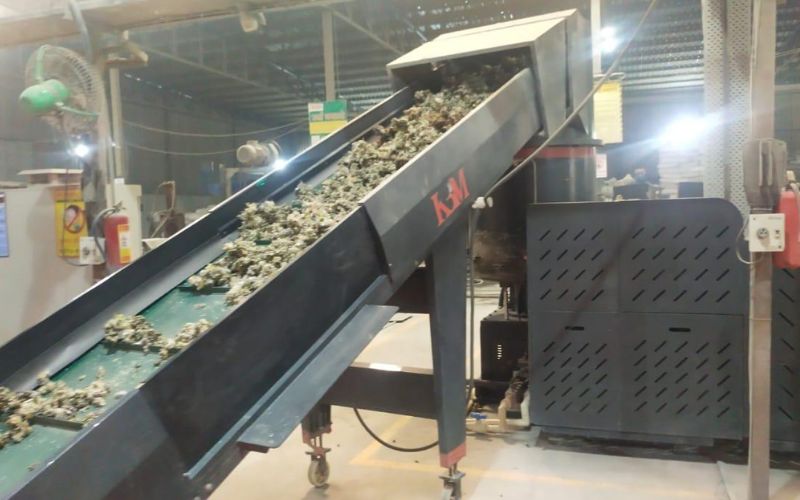
AVRO produces and processes multiple grades of engineered recycled polymers, including reprocessed Polypropylene (PP), High-Density Polyethylene (HDPE), customized premix compounds, and reinforced polymer blends.
Through controlled compounding, the use of stabilizers, impact modifiers, and mineral fillers where required, we tailor mechanical properties to meet load-bearing furniture applications. Tensile strength, flexural modulus, and Melt Flow Index (MFI) are calibrated for injection moulding consistency and structural reliability.
While virgin polymers may offer marginally higher baseline tensile values, our engineered recycled blends are designed to meet functional performance standards for durable consumer products. With proper formulation and controlled processing, the performance gap is significantly bridged, without compromising on durability or safety.
Can you elaborate on the testing and laboratory facilities at AVRO, and the innovations used to minimize polymer degradation while maintaining aesthetic finish?
Quality validation is non-negotiable for us, especially when working with recycled polymers. Our in-house laboratories are equipped for Melt Flow Index testing, tensile and elongation analysis, flexural and impact testing, UV stability checks, colour matching, drop tests, and cyclic load-bearing tests on finished furniture products.
Within our recycling units, several technical interventions are used to minimize polymer degradation. These include controlled-temperature extrusion systems, multi-stage melt filtration, degassing to remove volatiles, antioxidant and stabilizer packages, and low-shear screw designs that help preserve molecular weight.
These measures ensure that recycled polymers retain their mechanical integrity while delivering the surface finish, gloss retention, and visual consistency that customers expect from modern moulded furniture.
At AVRO, sustainability is not treated as a compliance obligation but as a structural business philosophy. Our integrated recycling and manufacturing infrastructure allows us to align cost efficiency, environmental responsibility, and engineering precision.
We believe the future of polymer manufacturing lies in intelligent recycling, automation-led production, and scientific material optimization and that is the direction in which AVRO continues to invest and evolve.
About Sushil Kumar Aggarwal
Mr. Aggarwal is the Chairman and Whole-Time Director of AVRO India Limited, one of the country’s leading manufacturers of plastic moulded furniture. He founded the company in 2002 and has led its transformation from a small regional unit into a nationally recognised organization listed on both the NSE and BSE.
A serial entrepreneur with over 52 years of business experience, Mr. Aggarwal has spent 23 years in the plastics industry and has been associated with more than 15 ventures across India in diverse sectors. His strategic leadership has defined Avro India’s vision, strengthened its manufacturing capabilities, expanded its product portfolio, and built a strong distribution network across the country. He is widely credited with positioning Avro as a high-volume, value-driven furniture brand with a clear long-term focus.
Mr. Aggarwal is a respected voice in the MSME sector. He has served as Chairman, CII (Western UP), Advisor to WASME, and National President, AIPMFMA.
Beyond business, Mr. Aggarwal is deeply committed to social causes, especially girl child education and organ donation. He has played a pivotal role in helping over 5 lakh people pledge their organs. As a strong advocate of sustainability, he is leading Avro India’s large-scale initiatives in plastic recycling and circular manufacturing, aiming to build a cleaner and more responsible future for the industry.
