

“Listen to the Veterans: They aren’t just “old school”; they are the keepers of the nuances that keep the line running when the tech fails.”
In the latest TMF Saturday Poll, we asked a question that hits close to home for anyone walking the factory floor: What is the biggest barrier manufacturing veterans face when passing “traditional knowledge” to the next generation?
The results reveal an industry at a crossroads.
The Great Balancing Act: Tech vs. Touch
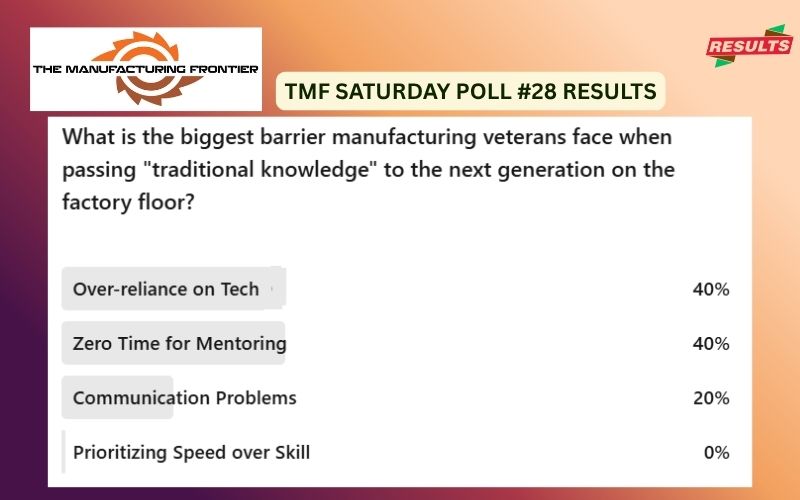
Tied at 40%, the primary culprits were Over-reliance on Tech and Zero Time for Mentoring.
It’s a fascinating irony. We live in the era of Industry 4.0, where digital twins and AI-driven maintenance are supposed to make us more efficient. Yet, 40% of you feel that this very technology is becoming a crutch. While a tablet can tell a new operator what the pressure reading is, it rarely explains the “feel” of a machine that’s about to overheat—the kind of tribal knowledge that veterans have spent decades honing.
Technology should be a bridge, not a barrier. When we lean too hard on the screen, we stop looking at the machine, and that’s when the nuances of the craft begin to erode.
The “No Time” Paradox
The other 40% pointed to a more systemic issue: Zero Time for Mentoring. In an industry obsessed with Lean and “Just-in-Time”, we’ve accidentally lean-manufactured the mentorship out of the day. If our veterans are constantly chasing production targets with no dedicated bandwidth to teach, that knowledge doesn’t get transferred—it gets retired.
We are effectively trading long-term institutional stability for short-term throughput. If we don’t bake “teaching time” into the shift schedule, we aren’t just losing skills; we’re losing our competitive edge.
The Communication Breakdown
Coming in at 20%, Communication Problems reminded us that the “generation gap” is real, but perhaps not as insurmountable as the structural barriers. Whether it’s a difference in jargon or simply different styles of learning (hands-on vs. digital), the dialogue is happening—it just needs a better platform.
Interestingly, Prioritizing Speed over Skill received 0% of the vote. This suggests that the industry does value the skill; we just haven’t figured out how to get out of our own way to let that skill be shared.
The Path Forward
The poll results are a wake-up call. To bridge the gap, we must:
Humanize the Tech: Use digital tools to document tribal knowledge, not replace the conversation.
Formalize Mentorship: Treat training as a Key Performance Indicator (KPI), not an “if we have time” luxury.
Listen to the Veterans: They aren’t just “old school”; they are the keepers of the nuances that keep the line running when the tech fails.
The Bottom Line: We have the talent, and we have the tools. Now, we just need to find the time.
What do you think? Is the lack of time the ultimate killer of the trade, or can technology eventually bridge the gap? Let’s discuss in the comments.
By the way, our next poll is open and we want to know what you think is the toughest job in the manufacturing industry. Give your answers at this link:
