

“If we want to see true ROI on advanced technology, we must stop asking how much data a system can process and start asking how easily a worker can use it to solve a problem in real-time. Complexity is a barrier; simplicity is the catalyst.”
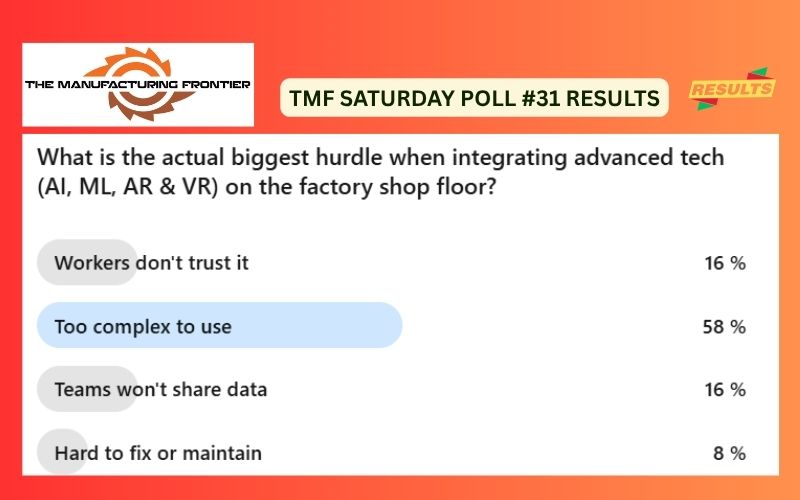
The results of our recent “The Manufacturing Frontier Saturday Poll” offer a striking reality check for the digital transformation narrative. While the industry often focuses on the “intelligence” of AI or the “immersion” of AR/VR, the data suggests that the human-machine interface is where the most significant friction occurs.
With 58% of respondents identifying “Too complex to use” as the primary hurdle, the message is clear: the most sophisticated technology in the world is a liability if it is not intuitive for the person on the shop floor.
The Usability Gap
The overwhelming majority pointing toward complexity highlights a growing disconnect between software developers and factory operators. Advanced tech is often designed in clinical environments, far removed from the high-pressure, tactile reality of a production line. When a system requires a PhD to navigate or disrupts the established flow of work, it is inevitably sidelined.
To move the needle, “industrial-grade” must become synonymous with “operator-centric”. This means simplifying dashboards, utilizing natural language processing, and ensuring that tools like AR headsets provide actionable overlays that reduce cognitive load rather than adding to it.
The Trust and Data Silo Parity
Interestingly, “Workers don’t trust it” and “Teams won’t share data” tied at 16%. While lower than the complexity barrier, these factors represent the cultural “soft” side of technology integration.
Lack of trust often stems from a fear of replacement or a lack of transparency regarding how AI makes decisions. Meanwhile, the reluctance to share data indicates that organizational silos remain a persistent challenge. Without a culture of transparency—both between departments and between leadership and the workforce—even the simplest technology will fail to find its footing.
The Maintenance Afterthought
Only 8% cited “Hard to fix or maintain” as the top hurdle. This suggests that while technical upkeep is a concern, the industry feels more confident in its ability to repair hardware than its ability to integrate complex software into the daily human workflow.
The Path Forward: Simplicity as a Strategy
The takeaway for leadership is straightforward: the success of Industry 4.0 will not be measured by the complexity of the algorithms, but by the seamlessness of their adoption. We must prioritize “low-code” or “no-code” solutions that empower the existing workforce.
If we want to see true ROI on advanced technology, we must stop asking how much data a system can process and start asking how easily a worker can use it to solve a problem in real-time. Complexity is a barrier; simplicity is the catalyst.
Our next poll is now open, and this time we are venturing into a “Fun Zone”. Cast you vote at this link.
https://www.linkedin.com/feed/update/urn:li:activity:7456190754655432704
