

“Successful automation requires a “people-first” blueprint. To unlock the future of smart manufacturing, leadership must spend less time selling the technology itself, and more time demystifying the unknown.”
In our last TMF Saturday Poll, we asked our community a critical question: What’s the biggest hurdle when your facility tries to implement advanced automation? The results paint an eye-opening picture of the modern industrial landscape, proving that the most stubborn barriers to technological progress are often human, not technical.
Here is how the votes broke down:
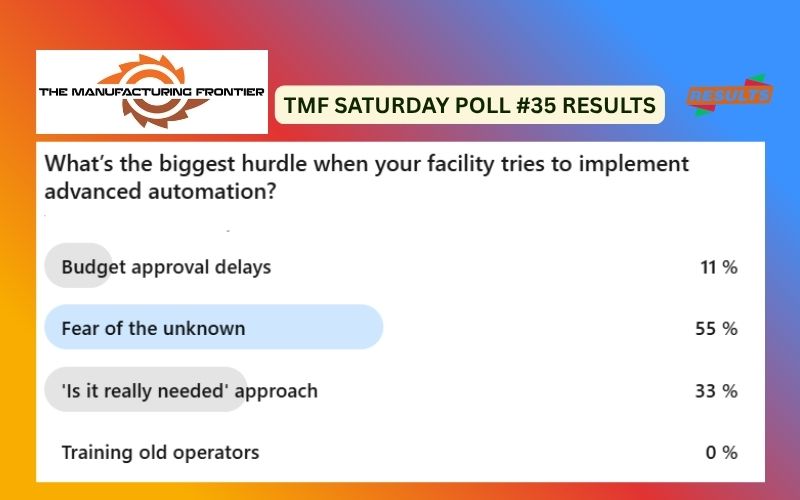
Fear of the unknown: 55% 🚀
‘Is it really needed’ approach: 33% 💡
Budget approval delays: 11% 💼
Training old operators: 0% 🛠️
Culture Over Capital
Leading the responses by a landslide was the ‘Fear of the unknown’ (55%). This highlights a profound reality for operational leaders: technology is rarely the limiting factor; workplace culture is. When sophisticated automated systems are introduced, the immediate reaction on the plant floor is often anxiety over job security, shifting roles, or a perceived loss of control. Without transparent internal communication and structured change management, fear can stall projects before a single machine is installed.
Closely following is the ‘Is it really needed’ approach (33%). This inertia stems from standard operational complacency—the classic “if it isn’t broken, don’t fix it” mentality. It reveals a clear disconnect between long-term corporate vision and daily operational realities, emphasizing that project champions must do a better job of articulating the long-term strategic value and ROI of modernization.
The Hidden Silver Lining
Interestingly, traditional obstacles scored remarkably low. Budget delays sat at just 11%, while ‘Training old operators’ received a flat 0%.
This tells us something incredibly positive about our industry: organizations are willing to deploy capital, and they have complete confidence in their veteran workforce’s capacity to upscale. Employees aren’t resistant to learning; they are simply anxious about what the future holds.
The Takeaway
Successful automation requires a “people-first” blueprint. To unlock the future of smart manufacturing, leadership must spend less time selling the technology itself, and more time demystifying the unknown.
What are your thoughts? How does your facility tackle the psychological friction of scaling automation? Let’s discuss in the comments.
By the way, our next poll is now open. And we would like to know: Which Southeast Asian country represents the biggest competition to India in terms of manufacturing growth?
Cast your vote at the link below:
https://www.linkedin.com/feed/update/urn:li:activity:7466337598832222208
