

“This decisive outcome underscores a critical reality in the shifting global supply chain landscape. As multinational corporations actively pursue “China+1” diversification strategies, Vietnam has emerged as an incredibly agile competitor. For Indian manufacturers, this isn’t just data; it is a strategic wake-up call.”
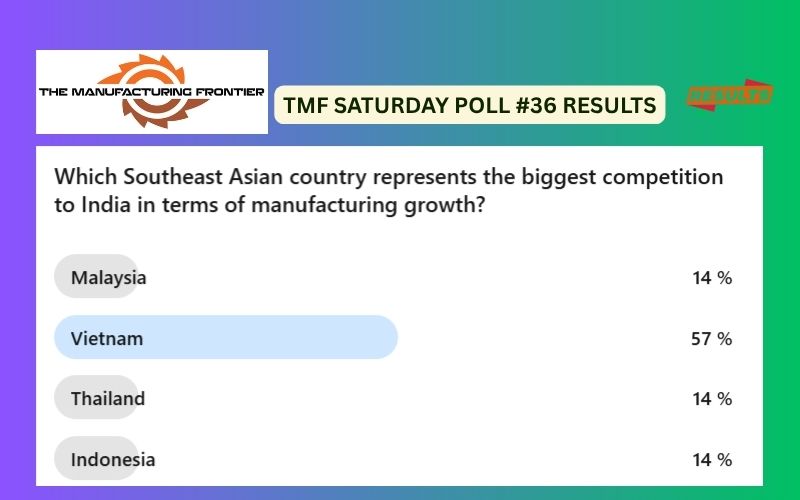
The results of our latest TMF Saturday Poll are in, and the industry has sent a remarkably clear signal. When asked which Southeast Asian nation poses the stiffest competition to India’s manufacturing growth, a resounding 57% of respondents pointed directly to Vietnam. Meanwhile, Malaysia, Thailand, and Indonesia split the remaining sentiment equally at 14% each.
This decisive outcome underscores a critical reality in the shifting global supply chain landscape. As multinational corporations actively pursue “China+1” diversification strategies, Vietnam has emerged as an incredibly agile competitor. For Indian manufacturers, this isn’t just data; it is a strategic wake-up call.
Why the Industry is Watching Vietnam
Vietnam’s massive lead in the poll reflects its rapid integration into global value chains, particularly in electronics, smartphones, and apparel. Several factors explain its current competitive edge:
Frictionless Trade: Vietnam’s aggressive pursuit of free trade agreements (FTAs), including the CPTPP and EVFTA, gives its exports a massive tax advantage in Western markets.
Streamlined Logistics: Exceptional port infrastructure and geographic proximity to existing East Asian supply hubs allow for rapid turnaround times.
Ease of Doing Business: Highly proactive government policies and clear investment incentives have made it a preferred destination for tech giants like Samsung and Foxconn.
The Indian Advantage: Scale and Deep Tech
While Vietnam has captured early momentum with its agility, India possesses structural advantages that cannot be easily replicated. Our massive domestic market offers an immediate buffer and scaling ground for manufacturers. Furthermore, initiatives like the Production Linked Incentive (PLI) schemes are successfully drawing high-tech manufacturing, especially in semiconductors, automotive, and defence, directly to Indian soil.
Where India truly differentiates itself is the convergence of manufacturing with digital technology. With a massive pool of engineering talent and a booming ecosystem centred on Industry 4.0, AI adoption, and smart factory engineering, India is uniquely positioned to lead the next generation of value-added manufacturing.
Redefining the Frontier
The competition between India and ASEAN is not a zero-sum game, but it demands relentless execution. To solidify our position as the ultimate global hub, India must continue to fast-track infrastructure development, simplify regulatory frameworks, and bridge the industry-academia gap to ensure our workforce remains highly industry-ready.
The frontier is moving fast. How should Indian manufacturing pivot to outpace Vietnam in the next three years? Let’s get the discussion started in the comments.
By the way, our next poll is now open. Cast your vote at this link:
https://www.linkedin.com/posts/tmfsaturdaypoll-digitalormanual-operationalexcellence-ugcPost-7468660182475071488-rAaQ/?utm_source=share&utm_medium=member_android&rcm=ACoAAAKdKgsBEnnsJn6AZgH975vaADYrlq_xxoI
