
“Our approach is built on three pillars: customer-centric engineering, robust manufacturing systems, and application-specific product development. We work closely with OEMs and end-users to understand evolving requirements and translate them into tailored filtration solutions.” Niranjan Kirloskar, Managing Director, Fleetguard Filters Private Limited
In modern Indian manufacturing, true leadership is measured not just by sustained market dominance, but by the agility to pre-empt disruption. For over three decades, Fleetguard Filters Private Limited (FFPL) has stood as a strong pillar of the industrial supply chain, serving as a critical enabler for heavyweight players like Tata Motors, Ashok Leyland and Cummins. Yet, as India’s industrial landscape undergoes a monumental paradigm shift – one that is propelled by digitalization, alternate powertrain architectures and the relentless pursuit of operational excellence. In fact, the definition of manufacturing itself is being rewritten!
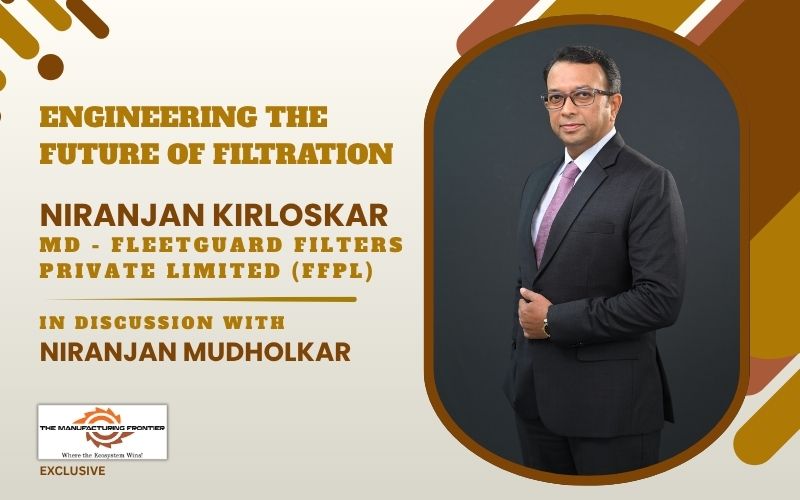
In this exclusive interview, Niranjan Mudholkar, Founder & Editor-in-Chief of The Manufacturing Frontier, sits down with Niranjan Kirloskar, Managing Director of FFPL, to decode the company’s evolution from a traditional component manufacturer into a high-tech, solutions-led engineering partner.
With revenues scaling past the impressive milestone of ₹21.75 billion, Mr. Kirloskar reveals the multi-pronged growth engines driving FFPL’s next chapter. From targeting an aggressive 20% expansion in the aftermarket segment to deploying cutting-edge digital engineering tools and simulation-driven product development, the company is proving that scale and agility can coexist. Mr. Kirloskar highlights how heavy investments in ALD and NABL-accredited laboratories have drastically shortened time-to-market, turning raw data and in-house validation into a formidable competitive advantage.
As the conversation progresses, it explores how FFPL maintains a “Single Quality Standard” across five distinct industrial hubs, its proactive stance on integrating Digital Twins into smart factories, and the strategic upskilling of its workforce to close the industry’s talent gap. Crucially, Mr. Kirloskar addresses how FFPL is navigating the green transition, engineering sophisticated thermal management and ultra-pure filtration systems tailored for electric vehicles, alternative fuels, and hydrogen fuel cells.
What emerges is a fascinating blueprint for the future of Indian industry: a narrative of a legacy market leader that refuses to rest on its laurels, choosing instead to actively engineer the very frontier it commands.
QnA
Niranjan Mudholkar: Fleetguard Filters Private Limited (FFPL) has sustained market leadership for over three decades. As the Indian industrial landscape shifts toward digitalization, how are you evolving the company’s core identity from a traditional component manufacturer to a tech-driven filtration solutions provider?
Niranjan Kirloskar: At FFPL, we believe filtration is no longer just a component, it is an enabler of equipment reliability, efficiency, sustainability, and operational intelligence. Our transformation is focused on moving beyond manufacturing products to delivering integrated filtration solutions.
We are investing significantly in advanced R&D, digital engineering tools, simulation-driven product development, automated manufacturing systems, and data-driven quality management. Through technologies such as predictive analytics, process automation, and digital validation, we are improving product performance while reducing development cycles.
At the same time, our focus remains on solving customer challenges across mobility, industrial, construction, mining, agriculture, and power generation sectors. By combining engineering expertise with digital capabilities, we are positioning ourselves as a technology-led filtration partner that supports the evolving needs of modern equipment and industries.
Niranjan Mudholkar: Scaling to ₹21.75 Billion: With revenues crossing the ₹21.75 billion mark, what do you identify as the “growth engine” for the next phase? Specifically, how will the targeted 20% expansion in the aftermarket segment impact your overall manufacturing and distribution strategy?
Niranjan Kirloskar: Our growth journey has been driven by a strong balance between OEM partnerships and a rapidly expanding aftermarket business. Looking ahead, we see three major growth engines: deeper penetration in the aftermarket, expansion into emerging industrial segments, and continued innovation in advanced filtration technologies.
The aftermarket remains a significant opportunity for us. A targeted 20% expansion in this segment will strengthen revenue diversification while allowing us to engage directly with fleet owners, workshops, retailers, and end-users. To support this growth, we are enhancing our distribution network, improving product availability, increasing inventory visibility, and leveraging digital tools to improve service levels.
From a manufacturing perspective, we are focusing on flexible capacity planning, supply chain resilience, and operational excellence to ensure we can respond quickly to market demand while maintaining the highest quality standards.
Niranjan Mudholkar: Powering giants like Tata Motors, Ashok Leyland, and Cummins places FFPL at the epicentre of the supply chain. How do you manage the complexities of being a critical enabler for such diverse sectors as mining, agriculture, and automotive simultaneously?
Niranjan Kirloskar: Managing such a diverse portfolio requires a combination of strong customer collaboration, deep application knowledge, and manufacturing agility.
Each industry has unique operating conditions and performance requirements. Mining equipment operates in highly contaminated environments, agricultural machinery faces seasonal and demanding field conditions, while automotive applications require consistent performance across varying terrains and operating cycles.
Our approach is built on three pillars: customer-centric engineering, robust manufacturing systems, and application-specific product development. We work closely with OEMs and end-users to understand evolving requirements and translate them into tailored filtration solutions.
Our pan-India manufacturing footprint, supported by a strong supply chain and advanced testing infrastructure, enables us to serve multiple industries while maintaining responsiveness, reliability, and quality.
Niranjan Mudholkar: You have heavily invested in ALD and NABL-accredited labs. Could you share how these specific capabilities have reduced time-to-market for new products and enhanced the precision of your filtration systems?
Niranjan Kirloskar: Advanced laboratory capabilities play a critical role in accelerating innovation and ensuring product reliability.
Our ALD and NABL-accredited laboratories enable us to perform comprehensive validation, contamination analysis, performance testing, and material characterization in-house. This significantly reduces dependency on external testing agencies, shortens validation timelines, and accelerates product development cycles.
These capabilities allow us to evaluate filtration efficiency, dust-holding capacity, flow characteristics, structural integrity, and durability under real-world operating conditions. As a result, we can identify potential design improvements earlier in the development process, leading to faster product launches and higher-performing filtration solutions.
Ultimately, these investments help us deliver products that meet increasingly stringent OEM and regulatory requirements while ensuring consistent field performance.
Niranjan Mudholkar: As the industry transitions toward electric and alternate fuel engines, what are the unique challenges in developing filtration solutions for these new architectures compared to traditional ICE platforms?
Niranjan Kirloskar: The transition toward electric mobility and alternate fuel technologies is reshaping the filtration landscape. While traditional internal combustion engines rely heavily on air, fuel, lube, and crankcase filtration, newer powertrain architectures introduce different challenges. Electric vehicles require thermal management solutions, battery protection systems, cabin air filtration, and filtration for cooling circuits. Hydrogen fuel cell systems require extremely high levels of purity to protect sensitive fuel cell components, while natural gas and alternative fuel engines have their own unique contamination control requirements.
The challenge lies in developing solutions that support efficiency, durability, safety, and sustainability while meeting increasingly demanding performance standards. At FFPL, we are leveraging our engineering expertise and global technology partnerships to develop next-generation filtration technologies that address the evolving needs of future mobility platforms.
Niranjan Mudholkar: Operating across five distinct industrial hubs in India presents logistical and cultural challenges. How do you ensure a “Single Quality Standard” (IATF 16949/ISO 14001) is maintained uniformly across all these locations?
Niranjan Kirloskar: Consistency is non-negotiable when serving global OEMs and industrial customers. We maintain a unified quality framework across all our manufacturing facilities through standardized operating procedures, common quality systems, rigorous audits, and centralized governance mechanisms. Every facility operates under the same quality philosophy, supported by globally recognized standards such as IATF 16949 and ISO 14001.
Digital quality monitoring systems, process controls, employee training programs, and cross-functional reviews ensure that best practices are shared across locations. Regular internal audits, management reviews, and continuous improvement initiatives help us identify opportunities for enhancement and maintain consistency regardless of where the product is manufactured.
This disciplined approach ensures that customers receive the same level of quality, reliability, and performance from every FFPL facility.
Niranjan Mudholkar: Given the rise of the Industrial Metaverse and Digital Twins, is FFPL looking at integrating these technologies into your manufacturing processes to further drive efficiency and predictive maintenance?
Niranjan Kirloskar: Digital Twins and advanced manufacturing technologies have tremendous potential to transform industrial operations, and we are closely evaluating these opportunities.
The ability to create virtual representations of manufacturing processes, equipment, and production systems can help improve decision-making, optimize throughput, reduce downtime, and enhance predictive maintenance capabilities. Such technologies also support faster process validation, capacity planning, and continuous improvement initiatives.
As part of our broader digital transformation journey, we continue to explore advanced manufacturing technologies, automation, connected systems, and data-driven operational models that can improve efficiency, quality, and responsiveness. Our objective is to create smarter factories that are increasingly agile, productive, and future-ready.
Niranjan Mudholkar: With technology changing rapidly and manufacturing becoming more advanced, “skills gap” is a major concern. How is FFPL preparing its workforce to handle the transition toward advanced engineering and data-led manufacturing?
Niranjan Kirloskar: Technology transformation can only succeed when people evolve alongside it. Therefore, workforce development is a strategic priority for us.
We are investing in continuous learning programs focused on advanced manufacturing, automation, digital technologies, quality systems, data analytics, and leadership development. Employees across functions are encouraged to upgrade their skills through structured training, certification programs, technical workshops, and cross-functional exposure.
In addition, we collaborate with academic institutions, industry experts, and technology partners to ensure our workforce remains aligned with emerging industry requirements. We are also strengthening our culture of innovation and continuous improvement so that employees actively contribute to operational excellence and business transformation.
Our goal is to build a future-ready workforce that combines strong engineering fundamentals with digital capabilities, enabling FFPL to remain competitive in an increasingly technology-driven manufacturing environment.
