

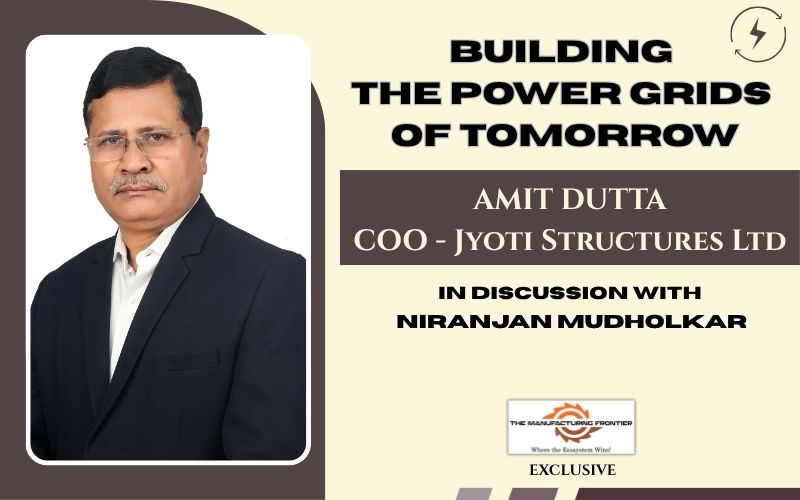
“Our focus today is on building an organization that is ready for the next phase of growth. That means strengthening coordination across manufacturing, testing and site mobilization, investing in capacity where it creates long-term value, and ensuring we consistently deliver what we commit.” Amit Dutta, Chief Operating Officer, Jyoti Structures Ltd.
Power transmission networks rarely make headlines, yet they constitute the vital arteries of modern civilization, while quietly driving industrialization, urban expansion, and the global transition toward clean energy. As power grids evolve to handle higher voltage capacities, complex HVDC corridors, and unpredictable renewable energy feeds, the burden on engineering, procurement and construction (EPC) leaders has never been greater. Delivering at this scale demands more than just capacity; it requires absolute operational discipline, technical rigor, and an innate ability to innovate amidst extreme site conditions.
Few organizations understand this mandate better than Jyoti Structures Limited (JSL). With a history defined by engineering landmarks, from executing early 500 kV HVDC packages in the late 1980s to delivering over 37,600 circuit kilometres of transmission lines and 1,800 substation bays across 50 countries, JSL stands as a cornerstone of India’s power infrastructure and a respected name in global EPC.
In a candid conversation with Niranjan Mudholkar, Founder & Editor-in-Chief of The Manufacturing Frontier, Amit Dutta, Chief Operating Officer of Jyoti Structures Ltd., delves into the strategic and operational mechanics driving the company’s next phase of expansion. Drawing from a nearly three-decade association with JSL alongside extensive global experience, Dutta outlines how JSL balances local environmental constraints with global processes.
From deploying porta-mats and drone stringing in challenging terrains to managing raw material volatility and leveraging in-house prototype testing at their Ghoti facility, Dutta provides a masterclass in resilient operational leadership. He highlights how domestic manufacturing directly fuels initiatives like Make in India and details JSL’s roadmap toward 2030, where digital tools, LiDAR technology and EHV precision converge to power sustainable economic development.
Q1. You have a nearly three-decade association with Jyoti Structures, having first joined in 1991 and now returned as COO during a pivotal phase in the company’s growth. How has that long familiarity with the organization, combined with your broader industry experience, shaped your operational priorities in this role?
Returning to Jyoti Structures after many years gave me the advantage of combining familiarity with a fresh perspective. I understood the company’s engineering strengths and culture, but I could also identify the areas where we needed to strengthen execution and build greater capacity. That allowed me to move quickly from assessment to action.
My experience across international markets has also shaped how I approach operations. Working across different geographies reinforced that while regulations and project environments vary, disciplined planning, proactive risk management and strong execution remain universal. Those are the principles I have brought back to JSL.
Our focus today is on building an organization that is ready for the next phase of growth. That means strengthening coordination across manufacturing, testing and site mobilization, investing in capacity where it creates long-term value, and ensuring we consistently deliver what we commit. As India’s transmission sector moves towards larger, more complex and technology-intensive projects, execution excellence will be our biggest differentiator. By continuing to build on that foundation, we are positioning Jyoti Structures for sustainable growth in India and international markets.
Q2. With operations spanning over 50 countries, how do you balance complexity while maintaining a global standard of excellence and adapting to the unique regulatory and geographical requirements of diverse international markets?
Managing operations across different countries requires consistency in the way we work while remaining responsive to local requirements. Engineering standards, quality management, safety systems and project monitoring follow a common approach across all our projects. Local teams then adapt execution to suit regulations, customer requirements and site conditions. This gives us visibility across every project while enabling faster decisions on the ground.
Consistency is supported by well-established systems and processes. Our ISO 9001, ISO 14001 and ISO 45001 certifications, independently verified by TÜV, define the standards for quality, safety and environmental management. Our teams are trained to these standards and are accountable for maintaining them across every geography where we operate.
Every country has its own regulatory framework, technical specifications and stakeholder expectations. Our experience of delivering projects across more than 50 countries has helped us understand these requirements well before execution begins. This allows us to plan better, manage risks early and maintain project timelines. It also strengthens our ability to deliver complex transmission projects as we continue to expand our international presence.
“Every project presents a unique set of engineering and execution challenges, requiring solutions that are tailored to the site’s specific terrain, geological conditions, and construction constraints.”
Q3. JSL is a specialist in turnkey EHV projects. What are the primary technical and logistical hurdles in delivering these projects at scale, and how does JSL mitigate the risks associated with such high-stakes infrastructure?
Higher voltage projects demand a higher degree of engineering precision at every stage. At 765 kV, structural loads are significantly greater, member connection details are more complex, foundation requirements are more challenging, and erection tolerances leave little room for variance. HVDC projects introduce further complexity around insulation coordination.
Every project presents a unique set of engineering and execution challenges, requiring solutions that are tailored to the site’s specific terrain, geological conditions, and construction constraints. Long-span crossings, constrained terrain, and complex access routes cannot be addressed with standard templates. They demand sound engineering judgement, rigorous planning, and execution strategies tailored to the realities of each project. That ability to engineer practical solutions for complex conditions is one of JSL’s core strengths.
For example, on the 400 kV transmission line we executed for Sterlite Power in Goa, the terrain presented significant access and environmental challenges. We used porta-mats and bamboo bridges to improve site access, while drone-based stringing helped us complete conductor installation efficiently with minimal environmental impact. It was a practical engineering solution that allowed the project to progress safely while addressing site-specific constraints.
“Volatility in raw material prices and global logistics has become an ongoing part of the EPC business. The focus today is on anticipating these changes early and planning projects accordingly, so their impact on execution remains limited.”
Q4. How do JSL’s integrated quality systems and manufacturing scale directly impact the long-term reliability of the national and international grids you support?
Long-term grid reliability begins with disciplined engineering, rigorous testing and consistent manufacturing. These principles have guided our work for decades, from the Chandrapur–Padghe 400 kV transmission line and the 500 kV HVDC transmission line package executed in the late 1980s to the 800 kV Anapara–Jhusi transmission line in the 1990s. The same focus on quality and execution continues to guide every project we undertake today.
Prototype testing is a critical part of this process. At our Ghoti testing facility, tower designs are validated under full design loads before they move into production. Integrated engineering, fabrication and quality checks help identify issues early and ensure consistency throughout the manufacturing process.
This disciplined approach has enabled us to deliver more than 37,600 km of transmission lines and over 1,800 high-voltage substation bays ranging from 11 kV to 765 kV. As transmission networks continue to grow in scale and complexity, these capabilities strengthen our ability to deliver reliable infrastructure that utilities can depend on for the long term.
Q5. Given the scale of your global projects, how are you navigating current volatility in raw material costs and global logistics to ensure timely project delivery without compromising on quality?
Over the past year, input costs have seen significant movement. Domestic hot-rolled coil prices increased from around ₹47 per kg in late 2025 to nearly ₹60 by May 2026, driven by the 12 per cent safeguard duty on imports, higher coking coal prices and sustained infrastructure demand.
Volatility in raw material prices and global logistics has become an ongoing part of the EPC business. The focus today is on anticipating these changes early and planning projects accordingly, so their impact on execution remains limited.
Our in-house fabrication and galvanization capabilities give us greater control over production schedules and allow manufacturing to remain closely aligned with project requirements. For international projects, procurement planning takes longer shipping timelines and logistics disruptions into account from the outset. Close coordination across procurement, manufacturing and project teams helps keep execution on track.
While procurement strategies continue to evolve with market conditions, our engineering specifications, material standards and quality requirements remain consistent across every project. This disciplined approach enables us to deliver reliable outcomes for our customers while supporting the company’s continued growth across India and international markets.
“The transmission sector is entering a phase where projects will become larger, more technically demanding and closely linked to renewable energy integration. Our focus over the next few years is on strengthening the capabilities needed to execute these projects efficiently and at scale.”
Q6. Transmission infrastructure is often described as the silent engine of economic growth. How do you see JSL’s work in electrification and substation projects acting as a catalyst for India’s Make in India and urbanisation goals?
Reliable transmission infrastructure is one of the key enablers of economic growth. Manufacturing, industrial corridors, urban expansion and renewable energy all depend on a grid that can move power efficiently from where it is generated to where it is needed.
Over the years, JSL has contributed to this foundation by delivering more than 37,600 circuit kilometres of transmission lines and over 1,800 high-voltage substation bays across India. We have also executed projects in remote and challenging locations, helping strengthen connectivity and improve access to reliable electricity where it is needed most.
As the grid becomes larger and more interconnected, substations are playing an increasingly important role in maintaining reliability and supporting the integration of renewable energy. Our capabilities across transmission lines, substations, underground cabling and OPGW installations allow us to deliver integrated EPC solutions that support this transition.
The Make in India programme has further strengthened the domestic manufacturing ecosystem for the power sector. By manufacturing towers and structural components in India and executing critical transmission infrastructure, we contribute to local supply chains, skilled employment and the expansion of the national grid. As renewable capacity continues to grow through initiatives such as the Green Energy Corridors programme, transmission infrastructure will remain central to India’s energy transition and long-term economic development.
Q7. Looking toward 2030, what are the key milestones you have set for Jyoti Structures Limited in terms of technological adoption and market expansion?
The transmission sector is entering a phase where projects will become larger, more technically demanding and closely linked to renewable energy integration. Our focus over the next few years is on strengthening the capabilities needed to execute these projects efficiently and at scale.
On the technology front, we will continue to adopt digital tools that improve engineering, planning and project execution. Technologies such as drones, LiDAR, digital project monitoring and advanced engineering solutions are already supporting better decision-making on complex projects. Our approach is to adopt technology where it delivers measurable improvements in safety, quality and execution efficiency.
From a market perspective, we see significant opportunities in high-voltage transmission, HVDC corridors, renewable energy evacuation projects and the growing substation segment. Alongside expanding our presence in India, we will continue to build on our experience across international markets where our engineering capabilities and execution track record are well established.
Ultimately, our objective is to strengthen Jyoti Structures’ position as a trusted EPC partner for technically complex transmission infrastructure by continuing to invest in engineering excellence, manufacturing capability and disciplined project execution.
