

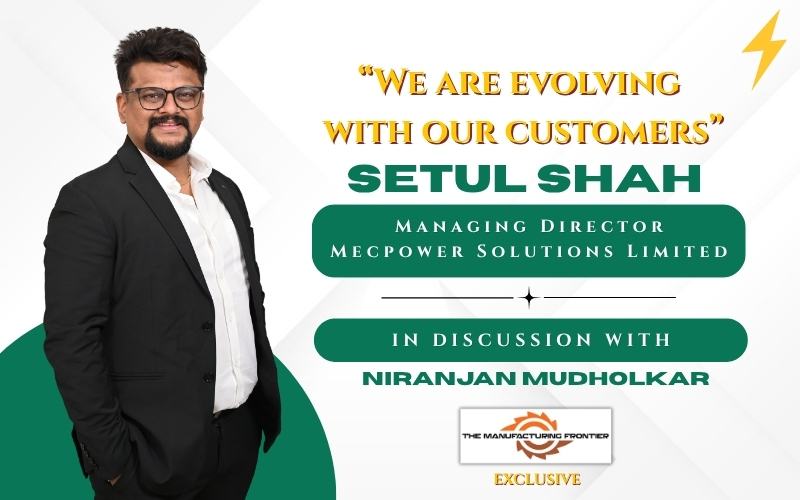
“Beyond manufacturing, I see Mecpower becoming a more integrated energy management and infrastructure partner. Building the asset is one part of the opportunity; managing and optimizing its performance throughout its lifecycle is equally important.” Setul Shah, Managing Director, Mecpower Solutions Limited
For decades, the conversation surrounding industrial solar adoption was deceptively simple: put panels on a roof, shave peak demand, and trim monthly utility expenses. Today, that playbook is no longer sufficient. Modern industrial enterprise operations are grappling with complex, multi-layered energy ecosystem challenges, ranging from severe price volatility and power quality issues to strict decarbonization mandates and complex capital allocation models.
This structural market evolution has pushed progressive clean-energy providers to fundamentally reconsider their value proposition. Leading this shift is Mecpower Solutions Limited. Under the leadership of Managing Director Setul Shah, Mecpower has organically evolved from a traditional solar EPC player into an integrated energy infrastructure partner, driven directly by the expanding, real-time demands of its industrial clientele.
In this insightful conversation with Niranjan Mudholkar, Founder & Editor-in-Chief of The Manufacturing Frontier, Mr. Shah sheds light on the strategic thinking behind Mecpower’s key growth vectors. He explains how moving into Independent Power Producer (IPP) frameworks, open-access models, and Battery Energy Storage Systems (BESS) addresses holistic industrial energy needs rather than just daytime power generation.
As clean energy moves from basic cost mitigation to a strategic driver of manufacturing reliability and competitiveness, this interview offers an insightful look into the future of industrial energy management.
QnA
Mecpower has steadily evolved from conventional industrial solar EPC into a comprehensive clean-energy infrastructure partner. What core market shifts or operational bottlenecks experienced by industrial clients drove this strategic pivot?
The ambition to build Mecpower into an integrated energy infrastructure company was always there, but in many ways, our clients pushed us in that direction before we consciously decided it ourselves.
Earlier, the conversation was largely about reducing electricity costs through solar. But as we worked deeper with industrial customers, we saw that their energy challenges had become much broader, from price volatility and grid reliability to peak-demand management, sustainability and capital allocation.
Solar addresses an important part of that equation, but not the entire challenge. Customers increasingly wanted support with how they source, store, finance and optimize energy. That naturally led us beyond traditional solar EPC into IPP and open-access solutions, BESS and related energy infrastructure.
In many ways, the shift wasn’t a strategy drawn up on a whiteboard. We chose to evolve with our customers.
With the rise of Independent Power Producer (IPP) models and open-access renewable projects, how are you structuring solutions that balance CapEx against long-term operational savings?
It starts with understanding the customer’s energy and financial objectives. There isn’t a one-size-fits-all approach.
Larger, well-capitalized organizations may prefer to own the asset because they can capture greater long-term savings. Mid-sized manufacturers, on the other hand, may prefer an OpEx model to avoid putting significant capital into energy infrastructure.
Group-captive open access offers another route, allowing customers to benefit from lower energy costs without taking on the full capital burden of ownership.
With BESS, we are also seeing more interest in OpEx models because storage remains relatively capital intensive. Ultimately, the right structure depends on the customer’s balance sheet, growth priorities and risk appetite, while also accounting for changes in open-access regulations and economics.
Mecpower recently signed an MoU with the Government of Gujarat for a ₹160 crore, 5 GWh Battery Energy Storage System (BESS) assembly facility at Karjan. What makes Karjan the ideal hub for this facility, and what is the execution timeline?
Karjan made strategic and operational sense for us. It is close to our Vadodara base, which allows us to leverage our existing engineering, project management and technical capabilities.
Gujarat also has a strong industrial ecosystem, logistics connectivity and an increasingly developed clean-energy supply chain, making it a natural location for a facility of this scale.
We are currently at the MoU stage and are progressing through land finalization, detailed engineering and implementation planning. Our intent is to move efficiently through these stages and execute the facility in line with market demand.
The 5 GWh capacity will cater to both utility-scale projects and Commercial & Industrial (C&I) applications. How do you expect the demand split to evolve between grid-scale integration and private industrial captive usage over the next 3 to 5 years?
In the near term, I expect grid-scale projects to lead on volume, driven by large storage tenders and renewable-plus-storage projects.
However, I see C&I becoming increasingly important over the next three to five years. As battery costs evolve and industries place greater emphasis on peak-demand management, grid reliability and energy cost optimization, storage will increasingly become part of their core energy strategy.
So, my expectation is that grid-scale will drive the initial volume, while C&I could become the more sustained, relationship-driven opportunity over time.
How does this Karjan BESS assembly unit contribute to India’s broader ambition of self-reliance (Atmanirbhar Bharat) in clean-energy hardware and advanced energy storage systems?
It’s important to look at the energy-storage value chain realistically. What we’re building at Karjan is focused on assembly, system integration, R&D and the software layer around the asset.
The larger self-reliance gap still exists upstream, particularly in cell manufacturing and raw-material supply chains. That’s a much bigger challenge than what this facility alone is designed to address.
What we can contribute is reducing dependence on fully built imported systems while developing local engineering, integration and after-sales capabilities in Gujarat. It will also create skilled employment and strengthen India’s clean-energy manufacturing base.
It may not solve the entire value-chain challenge, but it is a meaningful piece of the puzzle.
As factories become smarter and digitally connected, how is Mecpower embedding AI-driven energy management software (EMS) and predictive analytics into its BESS and solar assets?
Our objective is to make energy infrastructure increasingly intelligent and responsive to how a facility actually operates.
Every industrial customer has a different generation pattern and consumption pattern. Solar generation varies through the day, while a factory’s load depends on production schedules, shifts and peak demand.
By bringing these patterns together through an Energy Management System, we can optimize when solar energy is used, when the battery is charged or discharged, and how energy is managed based on the facility’s actual requirements.
As predictive analytics becomes more sophisticated, historical and real-time data can help anticipate energy requirements and improve operating decisions.
Ultimately, a smart energy solution should deliver not just more data, but better decisions about how energy is generated, stored and consumed.
Looking ahead over the next five years, what major milestones or new clean-technology fronts will define Mecpower’s next phase of growth?
Our immediate priority is to establish and scale our BESS assembly facility in line with market demand. Building strong execution capabilities in energy storage will be an important foundation for our next phase.
Beyond manufacturing, I see Mecpower becoming a more integrated energy management and infrastructure partner. Building the asset is one part of the opportunity; managing and optimizing its performance throughout its lifecycle is equally important.
Wattency will play an important role here as an intelligent asset management platform, bringing greater visibility and performance management to clean-energy assets.
Over the longer term, we also see an opportunity to selectively participate in the ownership and operation of hybrid renewable-plus-storage assets.
So, over the next five years, I see Mecpower evolving across three layers: building energy infrastructure, intelligently managing those assets, and selectively owning and operating them.
