

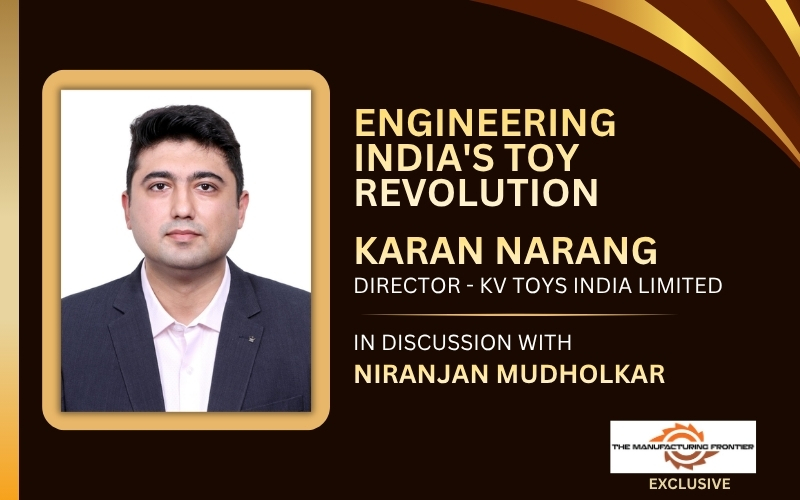
“A significant amount of progress has been achieved in India in developing its toy manufacturing industry, through quality standards, imports policy, and efforts for manufacturing and exports. The next step must be to create a globally competitive environment.” Karan Narang, Director of KV Toys India Limited
India’s toy manufacturing landscape is experiencing a structural transformation. As consumption expands rapidly beyond tier-1 metros into tier-2, tier-3, and rural hubs, domestic manufacturers face the dual challenge of ensuring hyper-local product availability while maintaining razor-sharp price-point economics. In this in-depth conversation, Niranjan Mudholkar, Founder & Editor-in-Chief of The Manufacturing Frontier, speaks with Karan Narang, Director of KV Toys India Limited, to examine how the three-generation enterprise is reshaping its end-to-end manufacturing and logistics engine.
Mr. Narang offers a candid perspective on managing a 600+ SKU portfolio, detailing how the company integrates real-time channel demand with flexible shop-floor scheduling to eliminate costly stockouts and overproduction. He sheds light on the rising influence of quick-commerce on packaging and product design, the pragmatic balance between automation and skilled labor, and the critical need for localized tooling, raw materials, and shared testing infrastructure. Mr. Narang highlights why speed-to-market, uncompromised BIS-grade quality, and policy consistency remain the ultimate building blocks for establishing India as a world-class toy manufacturing hub.
QnA
KV Toys already has a footprint across 25+ states and UTs with over 1,400 wholesalers. As demand shifts beyond major metros into Tier-2, Tier-3, and rural hubs, how is that changing your core manufacturing and supply chain strategy on the ground?
KV Toys’ expansion into Tier-2, Tier-3 and rural markets is fundamentally changing the way we think about manufacturing and distribution. These markets offer significant headroom for toy consumption, but success depends on availability, affordability and the ability to replenish quickly.
Our strategy is therefore built around a wider and more responsive distribution network, supported by robust manufacturing operations. Today, we serve more than 1,400 general trade customers and 30+ modern trade customers across India. This enables us to serve all major pin codes including Tier 2 and Tier 3 and rural markets in India.
We are also paying greater attention to price-point engineering. Products at ₹99 and ₹199, for example, require tight control over material consumption, packaging, freight and manufacturing costs. As our reach expands, demand visibility at the distributor and retailer level is becoming increasingly important. We are strengthening sales analytics and inventory planning so that manufacturing is increasingly driven by market demand rather than simply historical production cycles.
The objective is clear: make quality toys consistently available across India while keeping them affordable.
Expanding deep into regional markets usually exposes supply chain bottlenecks. What infrastructure or logistical adjustments has KV Toys made to ensure consistent product availability across such a wide distribution network?
KV Toys has built a strong distribution network by serving both general trade and modern trade. Today, we cater to more than 1,400+ general trade customers and 30+ modern trade customers, giving us a broad geographical footprint and direct visibility into market demand.
As our network expands into Tier-2, Tier-3 and rural markets, the emphasis is increasingly on inventory visibility, efficient replenishment and better coordination between manufacturing, warehouses, distributors and retailers.
Our portfolio of more than 600 SKUs across multiple categories also requires a differentiated approach to inventory management. High-velocity products need faster replenishment, while slower-moving products need tighter inventory control.
We are therefore strengthening production planning, warehouse management, dispatch discipline and SKU-level demand monitoring. Our strong consumer insights help us identify regional preferences and prioritize products accordingly.
The objective is to ensure that our manufacturing network and logistics infrastructure are not simply designed for scale, but for availability at the right price point and in the right market.
For a mass-market toy business, availability itself is a competitive advantage, particularly when serving a highly fragmented retail landscape.
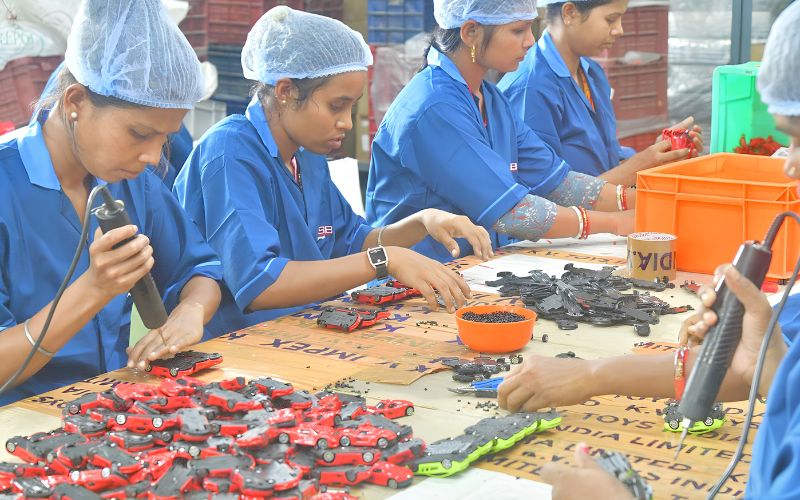
Domestic manufacturing in India has historically faced challenges regarding raw material supply, high-quality tooling and component sourcing. How resilient is the local supply chain today for scaling up production to meet nationwide demand?
Having been in the Indian toy industry for three generations, we have seen the domestic manufacturing ecosystem evolve significantly. India today has much stronger capabilities across plastics, packaging, tooling and several components than it did in the past.
At KV Toys, we actively work with Indian suppliers wherever capabilities are available at competitive cost and quality. A resilient domestic ecosystem is particularly important because toy manufacturing requires flexibility, frequent product development and the ability to respond quickly to changing consumer preferences. At the same time, some specialised materials, components and tooling capabilities continue to have limited domestic availability. The opportunity therefore is not simply to replace imports, but to develop deeper capabilities across the entire value chain.
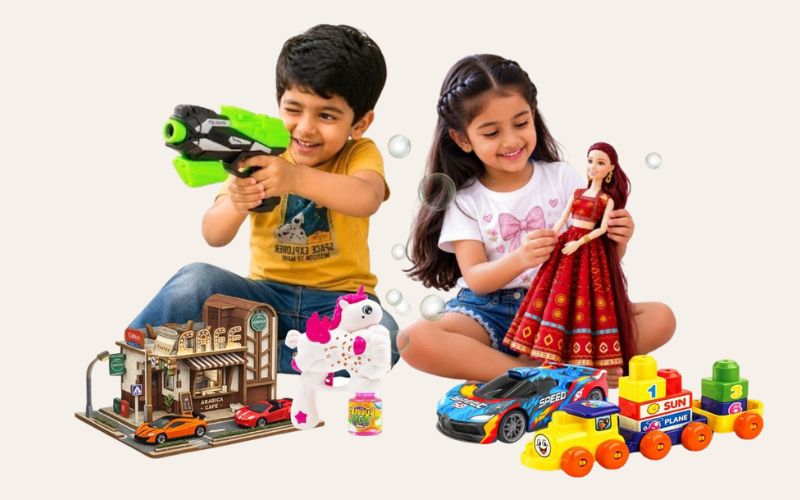
With more than 600 SKUs across multiple categories, including plastic, metal, wooden, board games and STEM toys, our requirements are diverse. This experience gives us a practical understanding of where the domestic ecosystem is strong and where further investment is required.
We believe India can significantly strengthen its position by developing competitive capabilities in tooling, components, materials and testing infrastructure, creating a more integrated ecosystem for both domestic consumption and exports.
Product lifecycles in the toy industry are shrinking rapidly, driven by trends and changing kid preferences. What does it take from a mould manufacturing, design, and assembly standpoint to shorten product development cycles from concept to shelf?
In the toy business, speed is gradually becoming a competitive differentiator. Customers’ tastes and preferences tend to evolve quickly, and for any product to remain relevant, it cannot be too slow getting from the drawing board to the shelves. This is the reason why at KV Toys we are striving to reduce the time frame between spotting the need in the marketplace, conceiving the product, and eventually making it available to customers.
A key advantage is our understanding of the Indian mass-market consumer. We work closely across design, sourcing, manufacturing, sales and marketing teams so that commercial considerations such as price point, manufacturability, packaging and expected volumes are considered at the beginning rather than after the product has been developed.
We are also increasingly leveraging existing moulds, components and manufacturing capabilities wherever possible to reduce development time and investment.
Our objective is to create a more agile product engine where successful concepts can be scaled quickly, while underperforming concepts can be modified or discontinued without excessive inventory or tooling costs.
For KV Toys, innovation is therefore not only about new ideas—it is also about the speed with which those ideas reach consumers.
Retailers today expect high inventory turnover and rapid replenishment. How do you align demand forecasting with shop-floor scheduling to avoid overproduction or costly stockouts?
Managing the conflicting risks of having too much stock and not having enough stock are the major issues in a dynamic consumer business. At KV Toys, we are increasingly integrating sales information with production planning. Our distributor, general trade, modern trade and e-commerce channels provide different demand signals, and these need to be interpreted rather than treated uniformly.
We are focusing on SKU-level visibility, particularly for high-velocity products, while also identifying slow-moving and non-moving inventory early. This helps us prioritize manufacturing capacity toward products where demand is strongest.
Shop-floor scheduling is then aligned with these priorities, taking into account mould availability, production capacity, raw material availability, minimum production quantities and dispatch requirements.
This is to enable the transition from reactive production planning to a more data-driven approach to replenishment.
Predictions can never be absolutely accurate, especially considering that this is a category driven by festivals, innovations and shifts in customer trends. This means that having flexibility is of equal importance. We would like our manufacturing facilities to be able to react to unexpected demand without building up unnecessary inventories.
Quality and safety standards are non-negotiable. How do you embed quality assurance directly into high-volume assembly lines without creating operational friction?
Quality and safety cannot be treated as a final-stage inspection in the toy industry. They have to be embedded throughout the manufacturing process, particularly as volumes increase.
At KV Toys, we are strengthening quality controls across the product lifecycle—from material selection and moulding to assembly, finishing, packaging and final dispatch.
Supplier and manufacturing-partner evaluation is an important part of this process. Compliance with applicable Indian and international standards is also becoming increasingly important as Indian toy manufacturers look beyond the domestic market. Requirements such as BIS, EN71, SEDEX, etc can involve detailed controls around materials, mechanical safety, chemical composition, labelling and traceability.
However, the challenge is to make sure that quality systems maintain consistency, whether the production levels grow or products are produced by several partners. Therefore, we concentrate on standardized specifications, quality control and testing and documentation, while constantly enhancing the capabilities of suppliers.
For KV Toys, however, safety is an absolute priority. Scale must not be achieved at the cost of product quality. On the contrary, we strongly believe that developing quality systems is crucial for Indian toy makers to gain consumer trust and succeed on the international market.
Scaling a wide product range requires balancing automation with manual assembly. How is KV Toys deploying advanced manufacturing technologies to address this issue?
At KV Toys, we see significant opportunities in areas such as automated or semi-automated assembly, injection moulding process optimization, quality inspection, packaging and production monitoring. These technologies can improve consistency, reduce wastage and increase productivity.
We are also increasingly looking at technology from an information perspective. We can take advantage of good production data, inventory visibility, and SKU-level analytics to enable better decision making around capacity optimization, procurement, and replenishment.
The biggest advantage that India has is that despite being labour-intensive, manufacturing remains financially feasible especially for goods that need assembly and finishing. This is the reason why automation does not mean replacing the labour but rather combining the expertise of the labor force with the technology.
As a result, with increased levels of automation, Indian manufacturers will eventually be able to compete based on four important parameters which include consistency, cost, speed, and scale of manufacturing.
Quick Commerce (Q-Commerce) is redefining consumer buying habits in India, shifting toys into the domain of impulse buying, instant gifting, and urgent purchases. How is this channel altering how you think about product design, packaging and unit sizing?
Technology and automation will play an increasingly important role in the next phase of India’s toy manufacturing growth. However, for a category such as toys, automation needs to be economically relevant and aligned with the product and volume profile. Quick commerce is creating a new consumption occasion for toys. Traditionally, toys were largely purchased through general trade, modern retail or planned shopping trips. Quick commerce introduces an element of convenience and impulse into the category.
This is influencing how we think about product assortment, price points, packaging and even product dimensions. Products need to be easy to understand from a digital image, attractive on a small screen and suitable for quick fulfilment.
The ₹99 and ₹199 price points are particularly relevant because they lend themselves well to impulse-led purchases. Packaging also becomes important because it has to communicate the product proposition immediately without the consumer physically handling the toy.
From a supply-chain perspective, unit size and packaging efficiency matter because quick-commerce fulfilment centres have limited storage space. Compact, efficiently packed products can improve both storage and logistics economics.
We therefore see quick commerce not simply as another sales channel, but as a channel that can influence product development itself. Going forward, we expect digital-first product discovery and rapid fulfilment to become increasingly important in the toy category.
What policies or ecosystem support will be most crucial for Indian toy makers looking to scale sustainably?
A significant amount of progress has been achieved in India in developing its toy manufacturing industry, through quality standards, imports policy, and efforts for manufacturing and exports. The next step must be to create a globally competitive environment.
The most important opportunity is in building capacity within India in all aspects of manufacturing, including tooling, components, plastics, electronics, packaging, and special manufacturing processes, which will result in lower lead times, better price competitiveness, and reduced dependence on fragmented supply chains.
Additionally, policies must address the issues of providing access to finance and technology for manufacturers, especially tooling, automation, testing, and product development. Shared testing and prototyping facilities would prove to be extremely useful for small manufacturers.
Export competitiveness is another important area. Indian companies need support not only in manufacturing but also in meeting international certification, testing, design and market-access requirements.
Last but not least, policy consistency is of paramount importance. Manufacturers invest in moulds, machines, people, and capacity on multi-year timeframes. India has an option of turning itself from just a domestic toys market into an important manufacturing and sourcing hub in the world. It can be made happenable through building up a more consistent ecosystem and consistent policies.
