


“This poll is a reflection of current realities—a clear signal that the quickest route to defect reduction isn’t a massive capital investment in new equipment, but a strategic, focused investment in quality systems and the people who run them.”
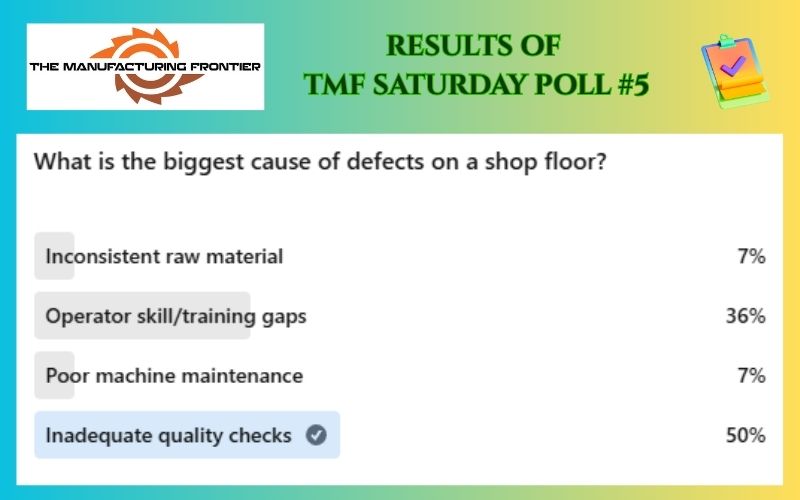
The results of the 5th TMF Saturday Poll deliver a stark and actionable message to the industry. By asking, “What is the biggest cause of defects on a shop floor?”, the poll has clearly pinpointed the areas demanding immediate and strategic attention. The overwhelming majority of votes focused around two critical, human- and process-centric factors: Inadequate quality checks (50%) and Operator skill/training gaps (36%). Combined, these two categories account for a staggering 86% of the perceived root causes of manufacturing defects, underscoring a prevailing industry sentiment that quality failures are largely self-inflicted and controllable.
The Unseen Enemy
The fact that ‘Inadequate quality checks’ secured a dominant 50% of the vote is perhaps the most concerning finding. It suggests a fundamental weakness in the final line of defence against defects. This is not just about the number of inspection points; it speaks to the sophistication, placement, and relevance of the quality management system itself. In a hyper-competitive global market, manufacturers are under immense pressure to increase throughput and reduce lead times. This often leads to a “speed over thoroughness” mindset where quality checks are viewed as a bottleneck rather than an essential value-add.
The “inadequate” label points to several potential failures:
Reactive Testing: Reliance on end-of-line testing instead of proactive, in-process controls (Statistical Process Control or SPC).
Technological Lag: Quality tools might be outdated, relying on manual or subjective inspection where automated, vision-based, or non-destructive testing is needed.
Process Integration: A lack of robust poka-yoke (mistake-proofing) mechanisms that prevent the defect from occurring in the first place, rather than just detecting it.
This finding serves as a powerful reminder that detecting defects costs money, but preventing them saves a business. The 50% vote is an industry-wide call to re-evaluate every check, every gauge and every standard operating procedure (SOP) within the quality assurance system.
The Human Element: Training as the Core Investment
Securing the second-largest share, ‘Operator skill/training gaps’ at 36%, highlights the enduring and crucial role of the workforce. While talk of Industry 4.0 and automation dominates headlines, this vote confirms that human competency remains the engine of quality. A poorly trained operator can misunderstand tolerances, miscalibrate machinery, use incorrect tools, or fail to follow sequence, resulting in predictable and recurring defects. The 36% vote suggests that many manufacturers may be treating training as a one-time onboarding expense rather than a continuous investment. In an era of increasing product complexity and faster technological change, training must be dynamic and continuous.
This includes:
Upskilling for Digital Tools: Training operators on the new HMI (Human-Machine Interface) screens, data collection systems, and predictive maintenance alerts.
Root Cause Analysis: Equipping shop floor personnel with the skills to not just spot a defect, but to understand why it occurred and to contribute to a sustainable solution.
Standardization of Work: Ensuring every operator performs a task the same way every time, minimizing variation and, consequently, defects.
Investing in training is not merely a cost; it’s an insurance policy against the variability that plagues manufacturing quality.
The Minor Players: A Misplaced Focus?
Interestingly, the traditional culprits, ‘Inconsistent raw material’ (7%) and ‘Poor machine maintenance’ (7%), received the lowest votes. While these factors are undeniably critical, their low standing suggests that, in the perception of the manufacturing community, they are either better managed (e.g., strong vendor management and sophisticated preventive maintenance schedules are now standard practice) or they are secondary symptoms—poor maintenance, for instance, is often a management oversight that could fall under a broader “training/process gap.”
The low 7% vote for raw material consistency is particularly telling in an age of increased supply chain scrutiny. It suggests that while supply chains are volatile, the internal process failures are still the dominant cause of defects making it to the final product.
Charting the Future Frontier
The TMF poll provides a clear, data-driven mandate. The Manufacturing Frontier of Quality is no longer defined solely by the material or the machine; it is defined by process rigor and human capability.
To move forward, the industry must implement the following changes:
Shift from Detection to Prevention: Invest heavily in implementing real-time quality monitoring and process interlocking to build quality into the product from the first stage.
Elevate the Operator: Establish recurring, robust training programs tied to performance metrics and product changes, formally recognizing the operator as the first-line quality control manager.
This poll is a reflection of current realities—a clear signal that the quickest route to defect reduction isn’t a massive capital investment in new equipment, but a strategic, focused investment in quality systems and the people who run them.
