

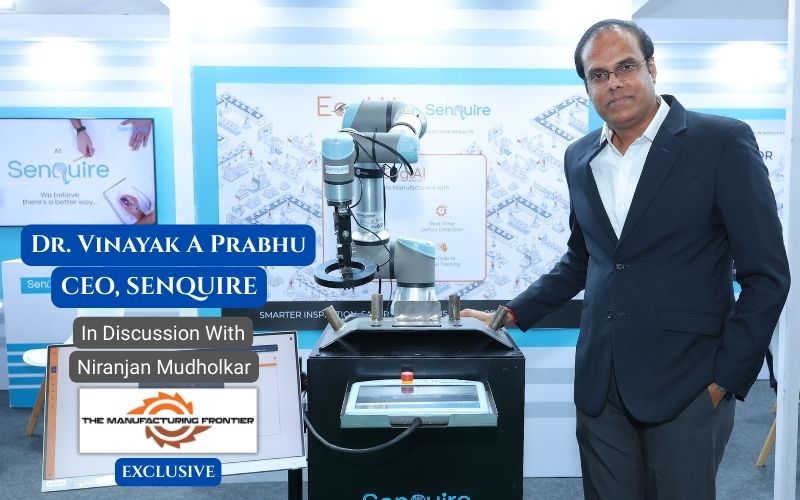
“It is not feasible to manually inspect tens of thousands of parts per day with a high degree of accuracy. Human fatigue and errors lead to inconsistent quality. This is where automated inspection machines, like those from Senquire, provide the necessary high speed and precision.” Dr. Vinayak A Prabhu, CEO, Senquire
Can you describe the solutions Senquire is showcasing at the Automation Expo?
At this year’s expo, we are displaying several AI-powered inspection and quality control solutions. As a company, we are agnostic to the industry sub-sector, so our solutions can be applied across a range of manufacturing areas—from automotive and auto ancillaries to FMCG, food processing, and pharmaceuticals.
Our primary solutions use vision and AI to inspect parts. This involves imaging parts and using AI to analyze each image for defects. We can detect both surface defects and dimensional defects at high speeds, ranging from 250 to 900 parts per minute.
We also have an inspection solution designed for high-mix, low-volume production. In these scenarios, it’s often more efficient to move the inspection to the part rather than moving the part to the inspection machine. Our solution uses a trolley-mounted cobot that can be brought to the part, which is especially useful for heavy, large, or 3D-contoured items. The robot manoeuvres a camera around the part to detect defects. This is a product we are excited to have launched at the Automation Expo.
Additionally, we are showcasing a magnetic particle inspection solution for crack detection. This is for metallic parts—typically forged, cast, or sintered—with minute surface cracks that are not visible to the naked eye. The solution works by magnetizing the parts and spraying them with magnetic particles, which get lodged in the cracks. When exposed to a UV light, these particles glow a fluorescent green, making the cracks visible. To our knowledge, we are one of the first in the world to offer a UV light-based magnetic particle inspection system.
Was the magnetic particle inspection solution developed in India?
Yes, the solution was entirely designed, developed, and researched here in India. Now that we have market traction, we are standardizing the machines for broader production.
“Another crucial trend is moving beyond just identifying defects to eliminating them entirely. Our solutions don’t just sort parts as “okay” or “not okay”. We provide a detailed quality control report that can be analyzed by quality and manufacturing teams.”
Which key industry sectors is Senquire currently focusing on?
We are currently focusing on four main sectors:
Automotive and Auto Ancillaries,
FMCG (Fast-Moving Consumer Goods),
Food Processing and Packaging,
Pharmaceutical Processing and Packaging.
Given the boom in the Indian manufacturing sector, what key areas must the industry focus on to become a “factory of the world”?
One of the most significant trends we see is the demand for 100% inspection. Historically, companies would use sample-based inspections. For example, you might produce 10,000 parts but only inspect 100. If a defect was found in any of the 100, the entire lot of 10,000 would have to be scrapped, which resulted in a massive loss for the manufacturer. Now, with 100% inspection, OEMs are guaranteed that every part they receive is free of defects.
This shift has made manual inspection obsolete because it is not feasible to manually inspect tens of thousands of parts per day with a high degree of accuracy. Human fatigue and errors lead to inconsistent quality. This is where automated inspection machines, like those from Senquire, provide the necessary high speed and precision.
Another crucial trend is moving beyond just identifying defects to eliminating them entirely. Our solutions don’t just sort parts as “okay” or “not okay”. We provide a detailed quality control report that can be analyzed by quality and manufacturing teams. By using this data to identify the root causes of defects, companies can work to eliminate them and move towards the ultimate goal of zero-defect manufacturing. This shift in focus from quantity to quality is a critical step for India’s manufacturing sector.
