

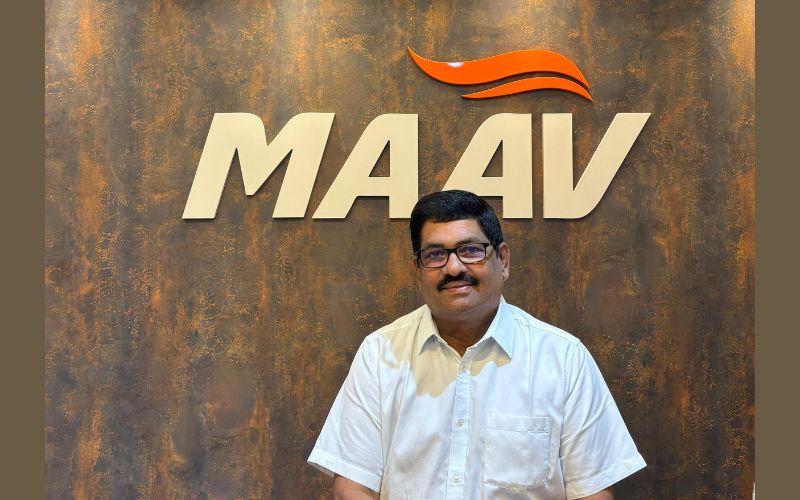
“India’s circular economy moment isn’t arriving because it’s fashionable. It’s arriving because the numbers, the pressures, and the realities of manufacturing are aligning.” Madhusudhan Agalpady, Founder & Managing Director, Maav Industries
In 2026, recycling will stop being discussed as an environmental add-on and start being treated as a core manufacturing decision. Not because it sounds responsible, but because it increasingly makes operational and economic sense. For Indian manufacturers, recycling is fast becoming a way to manage risk, stabilize inputs, and stay competitive in a market shaped by tighter regulation and fragile supply chains.
India generates close to 10 million tonnes of plastic waste every year, yet only a limited share enters organized recycling systems. At the same time, manufacturers continue to face volatility in virgin raw material prices, exposure to global oil markets, and dependence on imports. These two pressures are now converging. Waste is no longer just a disposal problem, and raw material sourcing is no longer a given. Recycling sits at the intersection of both.
Policy has accelerated this moment, but it didn’t create it. Extended Producer Responsibility norms are pushing accountability beyond production and sales, demanding traceability and proof of recycling. Compliance costs are real, and enforcement is becoming more structured. Still, regulation alone doesn’t explain why manufacturers are investing in recycling infrastructure or long-term recycled inputs. The stronger driver is predictability. When material supply becomes uncertain, control matters more than cost optimization.
This is where recycled materials are quietly changing how factories think. Virgin plastics fluctuate with energy markets and geopolitics. Recycled materials, when processed with discipline, offer something manufacturers value deeply: consistency over time. The shift underway is not philosophical. It’s practical. Recycling is being evaluated less as a sustainability initiative and more as an input strategy.
Quality perceptions are also being reset. Recycled material has long been treated as inherently inferior, suitable only for low-end or disposable products. That assumption is eroding. Better segregation, washing, and process control have made it possible for recycled plastics to perform reliably in durable applications. The real question manufacturers are asking now isn’t whether recycled materials can work, but where they can be trusted at scale without compromising performance.
India’s industrial heartlands will determine how far this transition goes. Circular economy narratives often focus on startups or policy announcements, but manufacturing clusters are where circularity either succeeds or fails. These regions already combine waste generation, logistics, labour, and demand. When recycling happens close to production, circularity becomes a loop rather than a concept.
There’s also a structural employment dimension that deserves attention. Recycling-led manufacturing creates work across collection, processing, quality control, and production, often rooted in regional economies. As India expands manufacturing capacity, circular models offer a way to grow without proportionally increasing environmental stress or raw material dependency.
None of this is simple. Recycling at scale is operationally demanding. Feedstock is inconsistent, logistics are fragmented, and returns are slower than conventional manufacturing. But that complexity is exactly why this shift is real. The companies committing to recycling today aren’t chasing headlines; they’re building resilience.
India’s circular economy moment isn’t arriving because it’s fashionable. It’s arriving because the numbers, the pressures, and the realities of manufacturing are aligning. In 2026, recycling will matter less for what it represents and more for what it enables: manufacturing that is stable, local, and built to last.
The author is Madhusudhan Agalpady, Founder & Managing Director, Maav Industries
