

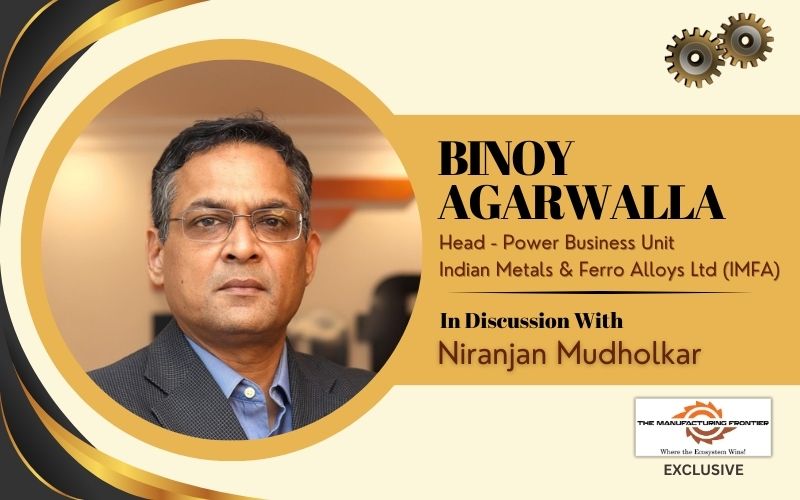
“IMFA is re-engineering its power strategy around efficiency, circular energy use, and phased decarbonization. By converting smelting off-gas into power, waste is transformed into a reliable energy resource.” Binoy Agarwalla, Head – Power Business Unit, Indian Metals & Ferro Alloys Ltd (IMFA)
In the energy-intensive world of ferro chrome production, the margin for error is razor-thin. As Binoy Agarwalla, Head of the Power Business Unit at IMFA, highlights in this insightful exchange with Niranjan Mudholkar, Founder & Editor-in-Chief, The Manufacturing Frontier (TMF), the integrity of a furnace depends entirely on the “quality” and “continuity” of its power supply. Even a momentary flicker can destabilize operations, making robust captive thermal power not just an advantage, but a necessity.
However, IMFA is proving that operational stability and decarbonization are not mutually exclusive. The strategy outlined here is a masterclass in energy diversification. By integrating circular practices—such as converting CO-rich furnace off-gas into electricity—and layering in 110 MW of renewable capacity through long-term PPAs, IMFA is effectively lowering its carbon intensity without unanchoring its baseload. This “calibrated” transition acknowledges the intermittency of renewables while aggressively pursuing a cleaner footprint.
Ultimately, Mr. Agarwalla illustrates that the future of heavy manufacturing lies in “re-engineering” the power mix—transforming waste into a resource and ensuring that the growth of the ferro alloy sector is as sustainable as it is reliable.
How does captive power generation safeguard continuous ferro chrome furnace operations?
Ferro chrome furnaces operate under continuous, high-load conditions and are sensitive to power interruptions or fluctuations. To meet this requirement, we rely on a robust captive power backbone anchored by a 200 MW coal-based thermal power plant at Choudwar. Captive generation ensures operational reliability, enables better cost control, and provides insulation from grid instability, all of which are critical for maintaining stable furnace operations.
How do short power interruptions affect furnace integrity in ferro chrome manufacturing, and why does this make captive thermal power critical?
Ferro chrome furnaces depend on uninterrupted and quality power. Even momentary power disruptions can destabilise furnace conditions and reduce output. Captive thermal power is therefore indispensable, providing the uninterrupted electricity.
How are off-gas–based power plants helping ferro chrome producers cut coal use and advance circular energy practices?
Ferro chrome producers are embedding circular energy practices by converting CO rich furnace off gas into power. At IMFA, this delivers around 5 MW at our Choudwar Complex, directly displacing coal and improving energy efficiency. An upcoming 8.7 MW off gas-based Power plant at our upcoming green field project at Kalinganagar will further improve energy efficiency and reduce the carbon intensity of our power portfolio.
How is IMFA using onsite solar to complement thermal power and lower their carbon footprint?
IMFA operates a 4.55 MW onsite solar power plant at our Therubali Complex to complement the thermal base load. While solar power cannot substitute continuous power requirements, it offsets daytime thermal generation, reducing emissions and lowering the overall carbon footprint.
How do long-term renewable PPAs support both capacity expansion and the transition to a greener, more predictable power mix in the ferro chrome sector?
Long term renewable PPAs underpin capacity expansion while accelerating the transition to a cleaner power mix. IMFA has tied up 110 MW of renewable capacity under 25-year PPAs of 70 MW with JSW Green Energy and 40 MW with AMPIN Energy to support its greenfield project and acquisition at Kalinganagar. These contracts embed decarbonization into growth plans while ensuring long term price stability.
What are the biggest challenges of integrating renewables into continuous ferro chrome operations, and how are they being addressed?
The primary challenge in integrating renewables into ferro chrome operations is managing intermittency against the need for uninterrupted power. This is addressed through a diversified energy portfolio that combines captive thermal generation, off-gas-based power, onsite solar, long-term renewable PPAs and supply from DISCOM. While thermal, off-gas plants and DISCOM supply anchor round the clock reliability, renewables are being scaled up in a calibrated manner to support long term decarbonization without compromising operational continuity.
How is IMFA rethinking power strategies to reduce carbon intensity without compromising operational reliability?
IMFA is re-engineering its power strategy around efficiency, circular energy use, and phased decarbonization. By converting smelting off-gas into power, waste is transformed into a reliable energy resource. This is complemented by long-term renewable PPAs and onsite solar, enabling a gradual shift to cleaner energy while safeguarding uninterrupted operations. Together, these measures are reducing the carbon intensity of ferro chrome production without compromising operational reliability.
