

“The outcome delivered a perfect split, revealing a “Dual Engine” driving daily motivation, while placing short-term incentives surprisingly low on the priority list.”
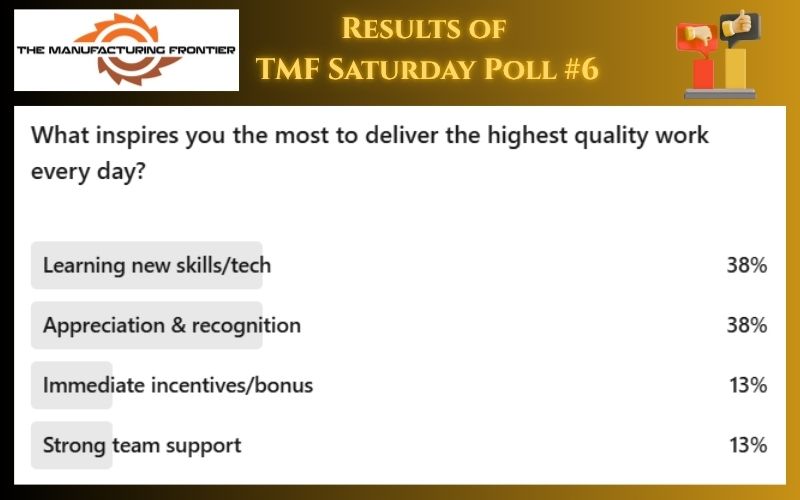
Last Saturday, we asked a fundamental question that cuts to the heart of operational excellence: “What inspires you the most to deliver the highest quality work every day?”
The results of this poll—shared by shop floor professionals across the industry—were not only fascinating but provide a powerful mandate for how modern manufacturing leadership must approach talent management and continuous improvement.
The outcome delivered a perfect split, revealing a “Dual Engine” driving daily motivation, while placing short-term incentives surprisingly low on the priority list.
The Unbreakable Tie: Capability Meets Identity (38% + 38%)
The most striking finding was the dead heat between the top two drivers:
Learning new skills/tech: 38%
Appreciation & recognition: 38%
This tie in scores shows that the shop floor professional’s motivation is fundamentally split between Capability and Identity.
- The Drive for Capability (Learning new skills/tech)
The fact that 38% of respondents are primarily motivated by learning is a direct reflection of the rapid pace of Industry 4.0 adoption. For a professional whose job is undergoing digitization—from using tablets for inspections to managing interconnected CNC machines—staying relevant is the new job security.
This is not passive learning; it is an active, intrinsic desire to master the tools of the trade and avoid obsolescence. When professionals prioritize skilling, they are signaling two key things to the organization:
A commitment to future relevance: They see their role evolving and want the competence to meet new challenges.
The desire for greater autonomy: Better skills lead to fewer errors, higher quality, and the ability to take on more complex, value-added tasks. This is the foundation of genuine empowerment.
- The Power of Identity (Appreciation & recognition)
The equally strong desire for appreciation confirms that shop floor work, often seen as purely technical, is profoundly human. The professional is not just a hand on the line; they are a valuable source of expertise.
Recognition is not merely a feel-good gesture; it is organizational validation. It tells the individual that their consistent effort, problem-solving prowess, and dedication to quality are seen, understood, and valued by leadership.
This finding challenges the old-school notion that “no news is good news”. Professionals want a continuous feedback loop that reinforces their identity as an expert and a critical contributor to the company’s success. Without this recognition, even highly skilled workers can suffer from burnout and disengagement.
The Secondary Drivers: The Baseline of Work (13% + 13%)
The low share of votes for the other two options provides perhaps the most instructive insight, particularly for HR and Finance departments.
Immediate Incentives/Bonus (13%)
This low score emphatically rejects the traditional assumption that a quick cash bonus is the primary motivator for sustained high-quality work. Money is a Hygiene Factor—it is essential to prevent dissatisfaction, but it rarely inspires long-term excellence.
If pay is unfair, people leave. But once pay is deemed fair, motivation is driven by Motivator Factors (like recognition and growth). The 13% suggests that most professionals are already at a baseline of acceptable compensation, and their focus has shifted entirely to intrinsic rewards. Leadership needs to understand that quality cannot be bought on a daily basis; it must be cultivated through culture.
Strong Team Support (13%)
This is the most counter-intuitive result. While manufacturing is highly collaborative, team support was not chosen as the primary inspiration. This could be interpreted in two ways:
The Baseline Assumption: In a well-run factory, strong team support is already a daily reality and therefore not seen as an extraordinary source of inspiration, but rather a necessary condition for working.
Individual Accountability: The question asked what inspires you (singular). The primary drive to deliver high-quality work begins with individual competence (38%) and the resulting desire for personal validation (38%), which supersedes collective encouragement.
Actionable Takeaways for Manufacturing Leaders
The poll results offer a clear roadmap for driving quality and performance:
Invest in Dual Infrastructure: For every rupee spent on improving automation, spend an equal amount on the human development pipeline (training) and the cultural pipeline (recognition programs).
Formalize Skill-to-Reward Pathways: Link every new certification or skill acquired directly to career progression, autonomy on the shop floor, and formal titles, not just a one-time bonus.
Prioritize Visibility over Velocity: Leaders must make the effort to visibly acknowledge successes. Implementing simple daily or weekly huddles to highlight who solved a tough problem, not just what the problem was, is critical.
The new manufacturing professional is motivated by mastery and meaning. By simultaneously investing in their competence and validating their contribution, leaders can truly unlock the path to World-Class excellence.
TMF Saturday Poll #7 is now open:
Cast your vote here: https://www.linkedin.com/feed/update/urn:li:activity:7390304885596114944
