

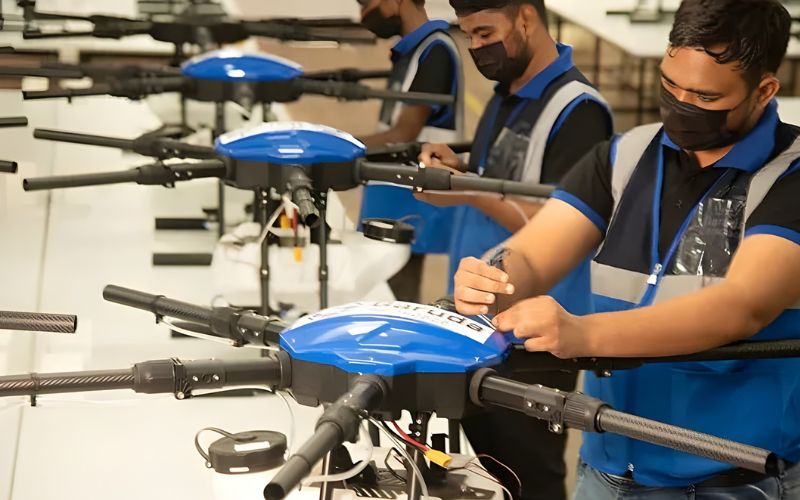
“As we move deeper into the era of Manufacturing 5.0, drone manufacturing will evolve from industrial automation to industrial intelligence—factories that learn, adapt, and innovate in real time. The fusion of human creativity with AI precision will make drone production faster, cleaner, and infinitely more responsive to global needs.” Agnishwar Jayaprakash, Founder and CEO, Garuda Aerospace
There is a revolution happening in the drone manufacturing landscape, driven by the emerging principles of Manufacturing 5.0—a paradigm that brings together human expertise and intelligent automation. What we’re witnessing is a fundamental shift from the purely automated logic of Industry 4.0 toward a human-centric, resilient, and sustainable model that enhances, rather than replaces, human potential. For the unmanned aerial vehicle (UAV) sector, this evolution is defining the next frontier of scalable, flexible, and globally competitive drone production.
From Automation to Collaboration: The Shift Toward Manufacturing 5.0
Industry 4.0 laid the digital foundation for smart factories—interconnected systems that use IoT, robotics, and AI for seamless automation. Yet, as production became smarter, an unintended gap emerged: human creativity and adaptability were often sidelined. Manufacturing 5.0 corrects this imbalance by redefining the relationship between humans and machines—not as competitors but as collaborators.
In drone manufacturing, this means replacing automation for efficiency with automation for empowerment. Human workers oversee creative problem-solving, design optimization, and quality assurance, while collaborative robots (cobots) take charge of repetitive, high-precision assembly or hazardous operations. This human-machine partnership is not just about speed; it’s about building smarter, safer, and more flexible production ecosystems.
Human-Centric Design Meets Smart Manufacturing
Unlike traditional automation frameworks, Manufacturing 5.0 places human intelligence at the center of the process. In UAV assembly lines, skilled technicians and engineers work alongside AI-guided robotic systems that can learn from human interventions. For instance, when a technician adjusts a component alignment on a drone, the AI records the correction, learns from it, and automatically improves future assembly runs.
This kind of adaptive learning environment ensures that innovation is not just programmed—it’s continuously refined through human insight. Moreover, by reducing cognitive load and physical strain, Manufacturing 5.0 creates a safer and more engaging workspace, enabling technicians to focus on innovation rather than monotonous labour.
The result is smarter drones built by smarter systems—where the combined intelligence of humans and machines translates to higher-quality UAVs, better reliability, and faster go-to-market timelines.
Digital Twins: Reinventing Precision in Drone Production
One of the defining technologies of Manufacturing 5.0 is the digital twin—a virtual replica of a physical product or system. In drone manufacturing, digital twins allow engineers to simulate, monitor, and optimize every stage of the UAV lifecycle—from design and prototyping to assembly and flight testing.
Imagine a digital twin of a drone production line that predicts assembly errors, simulates airflow dynamics, or detects potential stress points before a single part is built. This predictive capability dramatically reduces waste, rework, and production downtime. It also enables hyper-customization, allowing manufacturers to design drones tailored for specific industries—be it agriculture, surveillance, logistics, or disaster response.
Digital twins also play a critical role in sustainability and lifecycle management. By tracking material usage, energy consumption, and performance data, manufacturers can optimize resource utilization and extend drone lifespan—key goals in the Manufacturing 5.0 era.
AI and Data: The Intelligent Backbone of Manufacturing 5.0
The heartbeat of Manufacturing 5.0 lies in data—collected, analyzed, and transformed into actionable insights by artificial intelligence (AI) and machine learning (ML). In drone manufacturing, AI algorithms predict component failures, optimize inventory, and even generate design suggestions based on field performance feedback.
For example, when drones deployed in agriculture report sensor malfunctions due to environmental exposure, AI systems can feed this information back into the design process—suggesting improved materials or protective casings. This closed-loop innovation cycle ensures that every batch of drones is better than the last, not just through human iteration but through continuous digital learning.
Moreover, AI-driven analytics enables predictive maintenance of manufacturing equipment, ensuring that the production line runs efficiently with minimal unplanned downtime—a crucial factor when scaling drone output to meet surging domestic and global demand.
Scalability Through Modular and Flexible Manufacturing
Traditional manufacturing setups struggle to adapt to rapid design changes or surges in demand. Manufacturing 5.0 introduces modular production systems, where reconfigurable robotic cells and AI-controlled assembly stations can be quickly adapted for different drone models or production scales.
This modularity is vital in the drone industry, where innovation cycles are short and customization is key. A factory that produces 500 quadcopters for precision agriculture one month can, with minimal retooling, switch to assembling 300 fixed-wing drones for mapping or logistics the next. Such flexibility ensures agility in production and cost efficiency at scale, aligning perfectly with India’s ambitions to become a global drone manufacturing hub.
Sustainability and Resilience: Core Tenets of the 5.0 Factory
Manufacturing 5.0 is as much about values as it is about technology. It prioritizes environmental stewardship, resource efficiency, and circular manufacturing—factors that are particularly relevant to drone manufacturing, given the industry’s dependence on lightweight composites, batteries, and electronics.
Factories of the future integrate renewable energy systems, waste recycling loops, and sustainable material sourcing. Additive manufacturing (3D printing) minimizes material waste and enables on-demand production of complex drone components, cutting logistics emissions. AI systems also track carbon footprints across the supply chain, enabling manufacturers to meet regulatory and ESG (Environmental, Social, and Governance) commitments.
Resilience, too, is built into the DNA of Manufacturing 5.0. By decentralizing production and leveraging cloud-based manufacturing ecosystems, companies can adapt to global disruptions—whether it’s supply chain bottlenecks, raw material shortages, or geopolitical challenges—without halting production.
Workforce Empowerment: The Human Edge of Drone Manufacturing
At the heart of Drone Manufacturing 5.0 is the empowered workforce. The factory floor is no longer dominated by manual labour but by skilled technologists, programmers, and system integrators who manage human-robot collaboration. Upskilling programs in mechatronics, AI integration, and quality analytics are transforming traditional assembly operators into multi-skilled drone manufacturing specialists.
This evolution also bridges the gap between engineering education and industrial practice. Academia-industry collaborations are creating training ecosystems that prepare young professionals for roles in drone design, robotics, and smart manufacturing—fueling both innovation and employability in India’s technology-driven economy.
India’s Opportunity: Leading the Global Drone Manufacturing Revolution
India’s rapid strides in drone regulation, production-linked incentives (PLI), and startup-led innovation place it at a unique inflection point. The vision of Atmanirbhar Bharat aligns seamlessly with the principles of Manufacturing 5.0—self-reliance powered by technological advancement and human ingenuity.
Drone manufacturers across India are increasingly adopting AI-enabled production planning, robotic assembly cells, and digital quality management systems, laying the foundation for globally competitive UAV manufacturing ecosystems. These advancements not only enhance efficiency and scale but also signal India’s transition from a drone importer to a drone exporter—a critical milestone in positioning the nation as a global leader in aerial technology.
The Road Ahead: Intelligent Factories, Smarter Skies
As we move deeper into the era of Manufacturing 5.0, drone manufacturing will evolve from industrial automation to industrial intelligence—factories that learn, adapt, and innovate in real time. The fusion of human creativity with AI precision will make drone production faster, cleaner, and infinitely more responsive to global needs.
In this vision, the factory is not a static production unit but a living ecosystem of knowledge and adaptability. Every human insight, every machine adjustment, and every byte of data contribute to an ever-improving loop of design and execution.
The rise of Drone Manufacturing 5.0 represents more than just an industrial revolution—it is a philosophy of progress, one where people and technology co-create the future. As we look ahead, this synergy will define not only the next chapter of UAV innovation but also the broader transformation of manufacturing itself—where machines empower humans, sustainability drives growth, and intelligence shapes the skies of tomorrow.

The author is Agnishwar Jayaprakash, Founder and CEO, Garuda Aerospace
