

“With the India Semiconductor Mission and dedicated PLI schemes, the nation is successfully attracting investments from giants like Micron and Tata Electronics. By 2026, many of these initial investments will transition from ground-breaking ceremonies to full-scale production, significantly reducing our import dependency.”
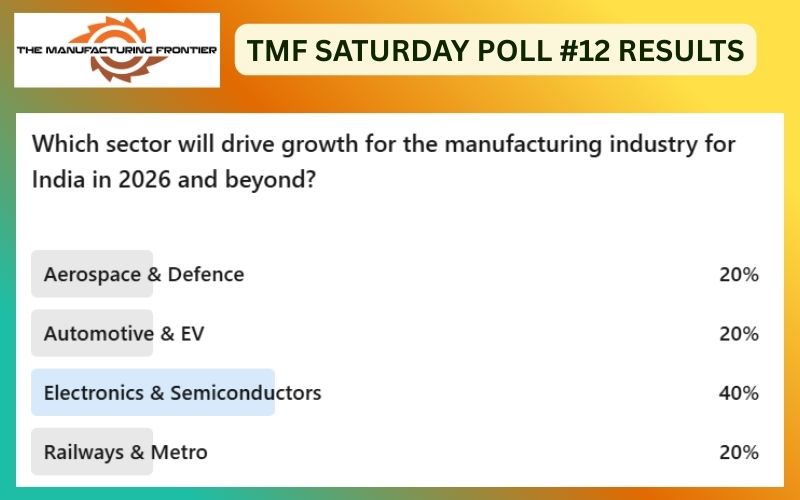
The results of the latest TMF Saturday Poll are in, and the verdict is very interesting: Electronics & Semiconductors are expected to be the primary engine of India’s manufacturing growth in 2026 and beyond, securing a commanding 40% of the vote. While Aerospace & Defence, Automotive & EV, and Railways & Metro each garnered a respectable 20%, the spotlight remains firmly on the “silicon heart” of modern industry.
This consensus reflects a profound structural shift in the Indian economy. We are moving beyond the era of simple assembly toward a future defined by high-tech value creation.
The Semiconductor Surge
The poll results align with aggressive market projections. India’s semiconductor market is on a trajectory to reach $64 billion by 2026, nearly tripling its value in just a few years. This isn’t just about chips for smartphones; it’s about the foundational components required for 5G, IoT, and the data centres that will power the next decade of AI-led innovation.
With the India Semiconductor Mission and dedicated PLI schemes, the nation is successfully attracting investments from giants like Micron and Tata Electronics. By 2026, many of these initial investments will transition from ground-breaking ceremonies to full-scale production, significantly reducing our import dependency.
A Symphony of Sectors
While Electronics takes the lead, the “20% club” – Aerospace, Automotive, and Railways – reveals a beautifully balanced industrial ecosystem. Each of these sectors is, in fact, becoming a major consumer of the very electronics the poll predicts will dominate.
Automotive & EV: The shift to Electric Vehicles is turning cars into “computers on wheels”.
Aerospace & Defence: With over ₹7 lakh crore in cleared projects, the focus is shifting toward indigenous avionics and high-tech defence electronics.
Railways & Metro: The expansion of Vande Bharat fleets and 1,000 km of new Metro lines relies heavily on advanced signaling and propulsion systems.
The Road Ahead: 2026 and Beyond
The upcoming years will be defined by Value Addition. For India to hit its goal of a $1 trillion manufacturing sector, the industry must evolve from an “assembler” to a “component creator” and to being a design & engineering hub. The poll results suggest a collective confidence that we are finally building the “mid-stack” capabilities—the sensors, logic chips, and advanced materials—that have historically been our missing link.
As we look toward 2026, the message is clear: India’s manufacturing story is no longer just about scale; it’s about sophistication.
The next TMF Saturday Poll is now open. Give your vote at the following link:
https://www.linkedin.com/posts/the-manufacturing-frontier_indianautomotive-ice-regulations-activity-7407993158724214784-08zQ?utm_source=share&utm_medium=member_desktop&rcm=ACoAAAKdKgsBEnnsJn6AZgH975vaADYrlq_xxoI
