

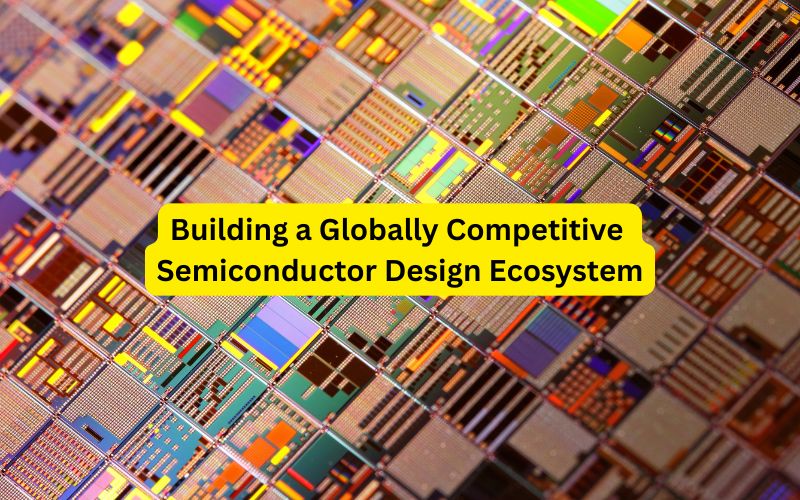
“Key programmes and agencies provide end-to-end backing—from incentivizing chip design and manufacturing to developing skilled talent and fostering open-source microprocessor architectures.”
India’s semiconductor ecosystem is being strengthened through a coordinated institutional framework that combines policy leadership, investment support, capacity building, and indigenous technology development. Key programmes and agencies provide end-to-end backing—from incentivizing chip design and manufacturing to developing skilled talent and fostering open-source microprocessor architectures—ensuring India’s progression toward a self-reliant and globally competitive semiconductor design ecosystem.
Ministry of Electronics and Information Technology (MeitY): MeitY leads national semiconductor initiatives, provides policy direction, and anchors schemes. It also coordinates institutional and industry partnerships to strengthen India’s chip design and manufacturing ecosystem. MeitY has announced the Design Linked Incentive (DLI) Scheme; aims to offset the existing disabilities in India’s domestic semiconductor design industry. It seeks to help Indian companies move up the semiconductor value chain.
Semicon India Programme (SIM): With an outlay of ₹76,000 crore, the programme supports investments in semiconductor and display manufacturing as well as the design ecosystem. The DLI Scheme operates under this programme, ensuring end-to-end backing for design, fabrication and productisation. C-DAC, a premier R&D organization of the MeitY, is responsible for implementation of the DLI Scheme as Nodal Agency.
Chips to Startup (C2S) Programme: C2S is an umbrella capacity building programme initiated at academic organizations spread across the country to generate 85 thousand number of industry-ready manpower at B.Tech, M.Tech, and PhD levels specialized in semiconductor chip design.
Microprocessor Development Programme: The Microprocessor Development Programme, initiated at C-DAC, IIT Madras and IIT Bombay has resulted into design, development and fabrication of open-source architecture-based family of microprocessors viz. VEGA12, SHAKTI13 and AJIT microprocessors as a step towards self-reliance.
Together, these institutional initiatives create a robust foundation for India’s semiconductor ambitions, enabling startups, MSMEs, and academic institutions to innovate and scale. By bridging the gap from research to productization, they are driving self-reliance, enhancing global competitiveness, and positioning India as a strategic player in the global semiconductor landscape.
Source: PIB
