

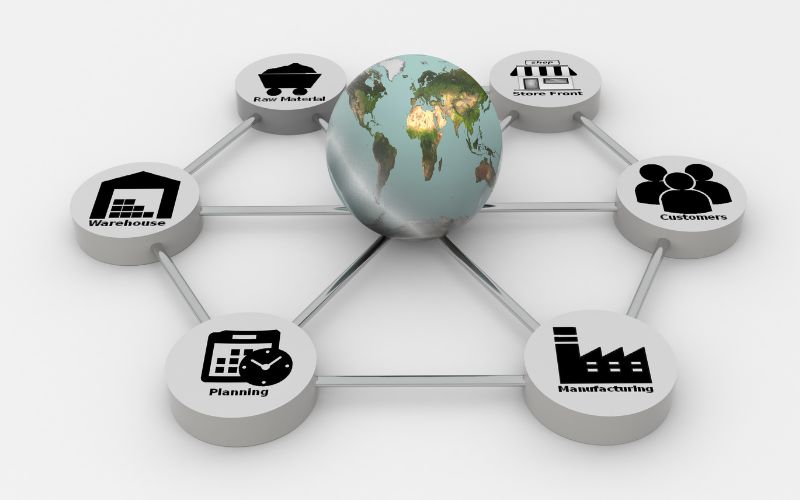
“When suppliers, manufacturers, and logistics partners share real-time data, production can align to actual demand rather than guesswork. Inventory buffers shrink. Lead times compress. Disruptions get caught earlier, before they cascade into production delays or missed shipments.” Dibyanshu Tripathi, Co-Founder and CEO, Hexalog
India’s manufacturing story is at an inflection point. The cost-led growth phase is maturing. What comes next depends on one thing: whether the supply chain infrastructure can keep pace with the ambition.
The headline numbers are encouraging. PLI schemes have delivered ₹7.5 lakh crore in production, ₹3.2 lakh crore in investments, and 11.5 lakh direct jobs by 2025. Apple, Samsung, and Foxconn have expanded manufacturing operations in India. Mobile phone exports have grown 775%, crossing ₹1 trillion in just five months of 2025. The global “China+1” diversification is real, and India is capturing a meaningful share of it.
But the supply chain underneath this growth story has not kept pace. And that gap will determine whether this momentum compounds or stalls.
The Structural Problem Is Still There
India’s logistics costs remain at 13–14% of GDP, compared to a global average of 8%. Only around 20% of MSMEs have successfully integrated into digital supply chain platforms. Supply chain networks remain highly fragmented, with poor coordination among suppliers, transporters, and distributors reducing visibility and inflating costs across the value chain.
For large anchor manufacturers, this is a manageable inefficiency. For the MSMEs that supply them and which account for 30% of GDP and 45% of exports, it is an existential constraint. MSMEs lack the shipment volumes to negotiate preferential logistics rates, and integrating backend systems with major marketplaces remains complex and resource-intensive. Most still run procurement, inventory, and logistics on spreadsheets and phone calls.
This is the ceiling on Indian manufacturing’s next phase of growth. Not capital. Not labour. Not policy intent. The connective tissue between suppliers, manufacturers, and logistics partners.
What Integration Actually Delivers
The shift from fragmented to connected operations is not an IT project. It is a strategic reorientation with measurable commercial outcomes.
When suppliers, manufacturers, and logistics partners share real-time data, production can align to actual demand rather than guesswork. Inventory buffers shrink. Lead times compress. Disruptions get caught earlier, before they cascade into production delays or missed shipments.
India’s Unified Logistics Interface Platform — a government-built digital system integrating data from over 30 logistics systems across 10 central ministries had facilitated over 1.6 billion API transactions by August 2025, with over 930 private companies registered on the platform. The Logistics Data Bank 2.0, launched in September 2025, now enables real-time container tracking across international waters with live congestion heatmaps. The national infrastructure for integration exists. The question is whether industry moves fast enough to use it.
The Policy Tailwind Is Real — But Not Sufficient on Its Own
India’s logistics cost has dropped to 7.97% of GDP by some measures, a meaningful improvement, though methodologies vary and the work is far from done. The government’s National Logistics Policy, Dedicated Freight Corridors, PM Gati Shakti, and multimodal logistics parks are all designed to reduce the structural cost of moving goods.
These are necessary conditions. They are not sufficient ones. Infrastructure alone does not create integration. Companies have to invest in the systems, processes, and partnerships that connect them to the wider ecosystem.
India’s logistics technology market is expected to reach $7–8 billion by 2026. The tools are available, scalable, and increasingly affordable. The bottleneck is not access it is adoption, particularly among the MSME tier that underpins the entire manufacturing base.
The MSME Gap Is the Real Risk
Here is the uncomfortable truth: you can build world-class anchor manufacturing capacity, and still lose global contracts, if the supplier ecosystem feeding it cannot deliver consistency, traceability, and visibility.
Global buyers whether sourcing electronics, pharmaceuticals, or auto components increasingly demand digital documentation, ESG compliance records, and real-time inventory visibility. MSMEs that cannot provide supplier diversity, compliance records, or real-time inventory visibility are at risk of losing premium contracts.
The integration gap is therefore not just an operational problem for individual businesses. It is a systemic risk to India’s positioning as a reliable global manufacturing partner. Solving it requires platform-level thinking shared infrastructure that brings smaller suppliers into the digital supply chain without requiring each of them to build capability from scratch.
Three things stand out as decisive
Real data flow across tiers. Visibility needs to extend beyond tier-one suppliers. Most disruptions originate deeper in the chain at tier two or tier three where data sharing is weakest and digital adoption is lowest. Integration that stops at the first tier is incomplete.
MSME on-ramps that actually work. Technology adoption fails when the implementation burden falls entirely on resource-constrained smaller players. The successful models will be platforms that deliver value from day one, with low integration friction and shared infrastructure costs.
Treating integration as a board-level priority. For too long, supply chain integration has been treated as an operational matter. In a world where global buyers are making sourcing decisions based on supply chain performance data, it is a competitive strategy question. Leadership teams that do not own it will be outcompeted by those that do.
India has the manufacturing ambition, the policy framework, and the market positioning to become a genuine global production hub. Manufacturing FDI rose 18% year-on-year in FY 2024–25, reaching $19 billion. The demand signal from global partners is clear.
The supply chain integration work is the bridge between the opportunity and the outcome. Build it deliberately, or watch the gap widen just as the window opens.
The author is Dibyanshu Tripathi, Co-Founder and CEO, Hexalog
