
“The automotive sector is undergoing one of the biggest transformations in its history and component manufacturers must evolve accordingly. UCAL has already taken important steps in expanding beyond conventional mechanical products into electronic engine management systems, ECUs and other advanced mobility solutions.” Adithya Jayakar, Joint Managing Director, UCAL Ltd
Background
The automotive world is currently undergoing a profound transformation. As the industry shifts from traditional internal combustion engines toward software-defined mobility and electrification, legacy manufacturers face a critical crossroads: how to preserve decades of hard-earned engineering trust while moving at the breakneck speed of a tech startup.
Few companies embody this balancing act better than UCAL Ltd. Founded in 1959, UCAL has spent over sixty years establishing itself as a cornerstone of precision manufacturing. However, the roadmap for the next decade requires more than just mechanical excellence; it demands a digital-first DNA.
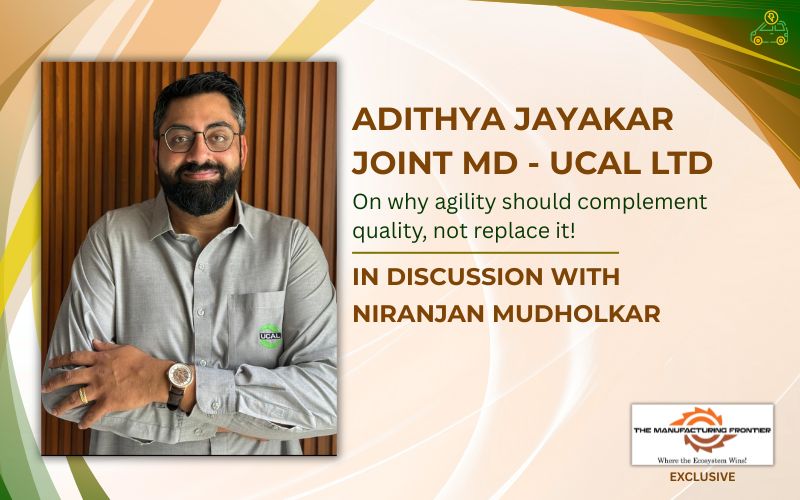
In this exclusive interview, Niranjan Mudholkar, Founder & Editor-in-Chief of The Manufacturing Frontier, sits down with Adithya Jayakar, Joint Managing Director of UCAL Ltd, to discuss the strategic reinvention of a legacy brand. Having started his own journey at the company as an intern, Jayakar brings a unique “shop-floor-up” perspective to the leadership suite.
From scaling global exports with partners like Cummins and FCA to transitioning the product portfolio from carburettors to ECUs and EV-centric power electronics, Mr. Jayakar outlines a roadmap where traditional engineering discipline meets Industry 4.0 innovation.
Join us as we explore how one of India’s most respected automotive names is navigating the “green energy” revolution and preparing for a future defined by integrated, intelligent mobility solutions.
Q&A
Niranjan Mudholkar: Having started your journey at UCAL as an intern a decade ago, how has your “ground-up” experience influenced your current approach to leading a legacy brand that dates back to 1959?
Adithya Jayakar: My journey at UCAL has been deeply immersive and extremely valuable because I have had the opportunity to understand the organization from the shop floor upwards. Starting as an intern gave me firsthand exposure to manufacturing operations, quality systems, vendor ecosystems, customer expectations and most importantly, the people who form the backbone of the company.
When you spend time across functions instead of entering directly into leadership, you develop a more balanced perspective on decision-making. Today, while working on strategic growth initiatives, I remain very conscious of operational realities. It helps me appreciate both long-term vision and execution-level challenges.
UCAL’s legacy since 1959 has been built on engineering discipline, reliability and customer trust. My approach is to preserve these foundational strengths while creating a culture that is more agile, technology-oriented and globally competitive. I believe the next phase of growth for legacy automotive companies will come from combining traditional manufacturing excellence with innovation-led thinking.
Niranjan Mudholkar: UCAL has been synonymous with quality for over six decades. How do you balance maintaining that traditional reputation for reliability with the high-speed agility required by today’s software-defined mobility era?
Adithya Jayakar: In the automotive industry, quality and reliability can never be compromised, irrespective of how quickly technology evolves. At UCAL, our philosophy is that agility should complement quality, not replace it.
The mobility ecosystem today is evolving towards software-defined vehicles, connected systems and electrification. This requires significantly faster development cycles, greater integration between electronics and mechanical systems, besides closer collaboration with OEMs during the product development stage.
To adapt to this transition, we are investing in advanced testing capabilities, digital engineering tools and cross-functional product development teams. We are also strengthening our electronics and embedded systems capabilities while maintaining the robust quality standards that customers associate with UCAL.
Our legacy gives us credibility, but our future competitiveness will depend on how effectively we can innovate while continuing to deliver dependable products at scale.
Niranjan Mudholkar: Your product list ranges from mechanical components like oil pumps and carburettors to advanced EMS and ECUs. What is the strategic roadmap for transitioning your manufacturing focus toward more electronics-heavy and EV-centric components?
Adithya Jayakar: The automotive sector is undergoing one of the biggest transformations in its history and component manufacturers must evolve accordingly. UCAL has already taken important steps in expanding beyond conventional mechanical products into electronic engine management systems, ECUs and other advanced mobility solutions.
Our roadmap involves a gradual but focused transition toward electronics-heavy and EV-oriented products while continuing to support existing ICE platforms, which will remain relevant for several years, especially in emerging markets.
We are actively investing in R&D, automation and partnerships that strengthen our capabilities in power electronics, control systems and energy-efficient mobility solutions. We also see significant opportunities in hybrid technologies, intelligent actuators and integrated systems that bridge mechanical engineering with electronics.
Rather than viewing this as a complete shift away from our legacy strengths, we see it as an evolution of our engineering DNA. The future automotive ecosystem will increasingly require integrated solutions and UCAL intends to position itself strongly in that space.
Niranjan Mudholkar: Currently, exports account for a small portion of your overall turnover. As you lead New Business Development, what are your key strategies for increasing UCAL’s global footprint, particularly with international partners like FCA and Cummins?
Adithya Jayakar: Expanding our global footprint is one of the important strategic priorities for UCAL. International markets today are looking for reliable, cost-efficient and technologically capable suppliers and Indian manufacturers are increasingly being recognised for these strengths.
Our approach is centred around three key areas. First, we are deepening engagement with existing global customers and partners by enhancing our engineering and delivery capabilities. Relationships with companies such as FCA and Cummins provide us with valuable opportunities to demonstrate our quality and scalability on an international platform.
Second, we are focusing on product diversification aligned with global mobility trends, especially in emission control, fuel management systems and EV-related technologies. This helps us remain relevant across different geographies and regulatory environments.
Third, we are investing in process digitisation, manufacturing efficiency and global quality certifications to make UCAL a stronger long-term partner for international OEMs and Tier 1 suppliers. Over time, we expect exports to contribute a significantly larger share of our business.
Niranjan Mudholkar: Given the complexities of the automotive sector, how is UCAL leveraging digital innovation to create a more transparent and “future-ready” ecosystem for your Tier 1 partners and vendors?
Adithya Jayakar: Digital transformation is becoming essential across the automotive value chain, not just within manufacturing facilities but across the entire supplier ecosystem. At UCAL, we are increasingly adopting digital tools to improve visibility, efficiency and responsiveness.
We are working on enhancing real-time data integration across production, inventory management, quality monitoring and vendor coordination. This allows better forecasting, faster decision-making and improved traceability throughout the supply chain.
For Tier 1 customers and vendors, transparency and reliability are critical. Digital platforms help create stronger collaboration by enabling better communication, predictive planning and performance monitoring. We are also exploring Industry 4.0 technologies, automation and analytics-driven manufacturing systems to improve operational efficiency and consistency.
Ultimately, the goal is to create a connected ecosystem where engineering, manufacturing and supply chain operations work seamlessly together to meet the rapidly evolving demands of the automotive industry.
Niranjan Mudholkar: If you look five years ahead, where do you see the most significant growth for UCAL—in traditional mechanical components, or in the burgeoning field of digital and green energy innovation?
Adithya Jayakar: Over the next five years, I believe the strongest growth opportunities will emerge from digital mobility and green energy innovation. Electrification, intelligent vehicle systems and sustainability-focused technologies are clearly reshaping the global automotive landscape.
That said, traditional mechanical components will continue to remain an important part of the business, particularly in certain segments and developing markets where ICE platforms will still have a substantial presence. The transition will be gradual rather than abrupt.
For UCAL, the real opportunity lies in leveraging our manufacturing expertise and engineering heritage to participate meaningfully in the next generation of mobility solutions. We see strong potential in electronics integration, energy-efficient systems, EV components and smart vehicle technologies.
The automotive industry is entering a highly dynamic phase, and companies that can successfully combine precision manufacturing with innovation and adaptability will be best positioned for long-term growth. UCAL intends to be one of those companies.
