

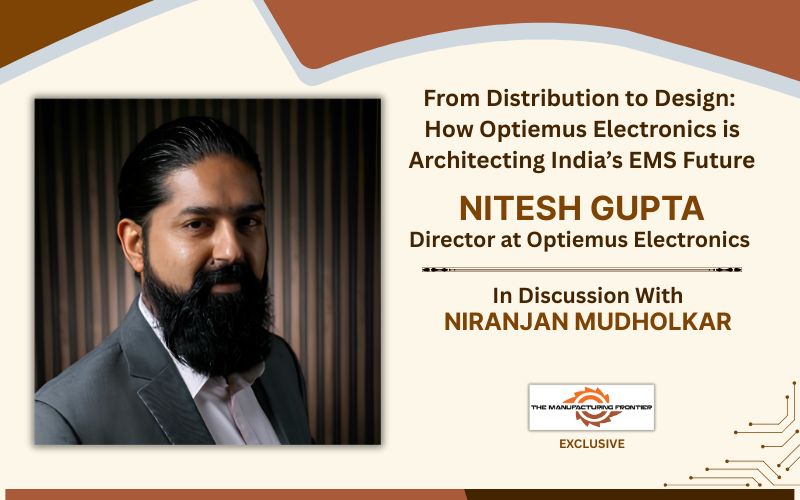
“The distribution background still influences our strategy. It keeps us close to customer expectations and market timing. Manufacturing is not only about capacity; it is about helping brands shorten time-to-market, localize responsibly, and build supply chains that can serve India and, over time, global demand.” Nitesh Gupta, Director at Optiemus Electronics Limited
India’s journey toward becoming a global electronics manufacturing powerhouse is no longer a distant ambition; it is a live, unfolding reality. At the heart of this metamorphosis are homegrown entities that have evolved from legacy distribution models into sophisticated, end-to-end Electronics Manufacturing Services (EMS) players. Among those leading this charge is Optiemus Electronics Limited, an organization that has seamlessly transitioned its deep-rooted market intelligence into a robust manufacturing backbone.
In this exclusive interview, Niranjan Mudholkar, Founder & Editor-in-Chief, sits down with Nitesh Gupta, Director at Optiemus Electronics Limited, to deconstruct the company’s strategic evolution. With decades of insight into consumer demand and brand dynamics, Optiemus has carved a niche that goes beyond mere capacity building. Their approach—rooted in the philosophy of “Delivering Excellence”—is one where operational agility, rigorous quality standards and digital-first factory floors converge.
From the technical intricacies of miniaturized IoT and wearable manufacturing to the broader impact of policy interventions like the PLI scheme, the conversation touches upon the critical pillars of modern electronics production. It explores how Optiemus is balancing the dual demands of domestic consumption and global export, and how it is utilizing advanced automation and data-driven intelligence to ensure it remains not just a participant, but a pioneer in the global electronics value chain.
As Indian manufacturers move toward higher value-add operations and deeper design involvement, insights from industry leaders like Nitesh Gupta offer a vital roadmap. Join us as we explore how Optiemus is building the infrastructure, confidence and resilience required to turn India into the world’s next great electronics hub.
QnA
Niranjan Mudholkar: Optiemus Electronics has undergone a huge transformation, evolving from a device distributor into a prominent, end-to-end Electronics Manufacturing Services (EMS) player. How has this strategic shift reshaped your internal capabilities, and how does your background in distribution influence your long-term manufacturing strategy?
Nitesh Gupta: Stepping into the manufacturing is a natural progression when you have spent decades understanding devices, brands, channels, and consumer demand from close quarters.
Distribution gave us an early view of how technology categories evolve in India, how global brands evaluate partners, and where gaps exist in local capability that experience shaped our move into EMS and establishing Optiemus Electronics with a very practical mindset: manufacturing has to be reliable, cost-disciplined, quality-led, and responsive to market cycles. At its core, this philosophy is reflected in our commitment to Delivering Excellence across every stage of the manufacturing value chain. Internally, this has meant building capabilities across NPI [New Product Innovation], SMT [Surface Mount Technology], manual insertion, board-level testing, final assembly, testing, packaging, reliability labs, warehousing, traceability, and real-time production data systems. Our facilities today support categories such as mobile devices, hearables and wearables, telecom products, IT hardware, IoT, and automotive electronics.
The distribution background still influences our strategy. It keeps us close to customer expectations and market timing. Manufacturing is not only about capacity; it is about helping brands shorten time-to-market, localize responsibly, and build supply chains that can serve India and, over time, global demand.
“The demand environment today is very different from what it was even a few years ago. Brands are looking for manufacturing partners who can scale with speed, maintain process discipline, and deliver consistent quality across multiple product categories.”
Niranjan Mudholkar: With technical expertise, efficient engineering, and manufacturing excellence at your core, how is Optiemus physically and operationally scaling its capacity in Noida to keep pace with the massive parallel surge in both domestic and global demand?
Nitesh Gupta: The demand environment today is very different from what it was even a few years ago. Brands are looking for manufacturing partners who can scale with speed, maintain process discipline, and deliver consistent quality across multiple product categories.
Understanding this change in market demand, at Optiemus Electronics, we are scaling our Noida operations in a structured and capability-led manner. We operate three manufacturing units in Noida. Our infrastructure includes Final Assembly, Testing and Packaging (FATP) lines across units, fully automated Surface Mount Technology (SMT) lines and Manual Insertion (MI) capability, board-level testing, reliability testing, and controlled warehousing systems. This also gives us the flexibility to manage multiple SKUs and product categories simultaneously, enabling faster product transitions, controlled ramp-ups, and the ability to respond quickly to changing customer demand without compromising on quality or process discipline.
Alongside infrastructure expansion, we continue to invest in workforce capability, process automation, and digital manufacturing systems to strengthen operational efficiency and support sustainable long-term growth. These investments enable us to scale responsibly while maintaining the quality, traceability, and reliability standards expected by global and Indian brands.
For us, scaling is about creating a manufacturing backbone that can support faster product transitions, higher reliability, localization, and the confidence global and Indian brands expect from an Electronics Manufacturing Services (EMS) partner.
“Over the years, we have developed deep relationships with global Original Design Manufacturers (ODMs), Independent Design Houses (IDHs), component suppliers, and technology partners. This has helped our teams understand international working cultures, New Product Introduction (NPI) expectations, sourcing discipline, and the pace at which modern product development cycles operate.”
Niranjan Mudholkar: Strategic global alliances are increasingly vital to establishing India’s credibility on the world stage. How is Optiemus leveraging global partnerships to position itself as a trusted, world-class OEM/ODM base for international brands?
Nitesh Gupta: For India to become a serious electronics manufacturing base, global confidence has to be earned through execution. International brands look for quality systems, process maturity, supply-chain reliability, engineering support, and protection of business-critical information.
Optiemus Electronics has built its approach around these fundamentals. Over the years, we have developed deep relationships with global Original Design Manufacturers (ODMs), Independent Design Houses (IDHs), component suppliers, and technology partners. This has helped our teams understand international working cultures, New Product Introduction (NPI) expectations, sourcing discipline, and the pace at which modern product development cycles operate.
The confidence placed in us by leading brands such as Nothing, OnePlus, realme, Oppo, Qubo, Xiaomi, Jio, Paytm, Pinelabs, Ai+ Smartphones and TP-Link reflect the growing maturity of India’s electronics manufacturing ecosystem. Through these partnerships, we have built expertise across multiple categories, including mobile devices, hearables and wearables, telecom and networking products, automotive electronics, IoT devices, IT hardware and smart enterprise hardware and integrated industrial solutions, while consistently delivering on quality, scale, and time-to-market expectations.
For Optiemus Electronics, the aim is to support brands across manufacturing readiness, localization, engineering support, compliance, quality, traceability, and supply-chain flexibility. That is how India will move from being an alternative manufacturing location to becoming a dependable and strategic part of the global electronics value chain.
“As categories become smarter and more connected, manufacturing partners will need deeper engineering involvement.”
Niranjan Mudholkar: Wearables, hearables, and IoT connected devices have shifted from niche electronics to massive manufacturing segments. What unique manufacturing, testing, and engineering challenges do these compact, highly dense devices present compared to traditional electronics like smartphones?
Nitesh Gupta: Compact electronics look simple to the consumer, but from a manufacturing perspective they can be, in some respects, more demanding than larger devices. The challenge is that every millimetre matters, and performance expectations are very high.
Hearables, wearables, and Internet of Things (IoT) devices bring together miniature Printed Circuit Boards (PCBs), batteries, antennas, sensors, acoustic components, charging systems, firmware, and compact mechanical assemblies. This creates challenges in component placement, Radio Frequency (RF) performance, acoustic testing, battery safety, thermal behaviour, cosmetic finish, and long-term reliability. Small variations in assembly can affect user experience, connectivity, charging, sound quality, or product life.
This is where our Surface Mount Technology (SMT) capability, Board-Level Testing (BLT), RF calibration, in-production testing, product ageing areas, and reliability labs become critical. These devices require tighter process controls and more frequent checkpoints across the manufacturing flow. Testing is not limited to whether a product turns on; it must validate functionality, durability, safety, acoustics, electrical performance, and real-world usage conditions.
As categories become smarter and more connected, manufacturing partners will need deeper engineering involvement.
“India’s young, tech-first consumers are shaping both what we build and how quickly we build it. They are early adopters, but they are also value-conscious, so they expect products that combine strong design, reliable performance, useful innovation, and accessible pricing.”
Niranjan Mudholkar: India is home to a massive, young, tech-first consumer base. How is the fast-evolving appetite of this demographic influencing your product roadmap, innovation cycles, and the types of electronics categories you are prioritizing for the future?
Nitesh Gupta: India’s young, tech-first consumers are shaping both what we build and how quickly we build it. They are early adopters, but they are also value-conscious, so they expect products that combine strong design, reliable performance, useful innovation, and accessible pricing.
This has directly influenced the categories we prioritize. Hearables and wearables continue to be one of our most dynamic areas, and we have manufactured over 25 million units in this space. The pace of product iteration has also accelerated, with growing demand for features such as active noise cancellation, AI-enabled experiences, real-time health monitoring, and voice intelligence.
Beyond this, we are seeing strong momentum in IoT-led categories, including smart home devices, connected payment hardware, and other India-specific connected products. Our broader portfolio now spans mobile devices, hearables and wearables, telecom and networking products, automotive electronics, IoT devices, IT hardware and smart enterprise hardware and integrated industrial solutions.
For us, this means shorter product cycles, faster transitions from prototype to mass production, and a stronger focus on New Product Introduction and R&D. We work closely with brands on controlled pilot builds, Design for Manufacturing inputs, and rapid scale-up so they can respond quickly to shifting consumer demand.
Ultimately, our roadmap is shaped by categories where India has strong domestic demand today and clear potential for global competitiveness tomorrow.
“The PLI framework effectively accelerated investments that might otherwise have taken significantly longer to materialize. It provided the confidence to commit capital towards emerging and high-growth categories such as telecom products and IT hardware, while simultaneously strengthening our capabilities in mobile device manufacturing.”
Niranjan Mudholkar: The Production Linked Incentive (PLI) scheme and ongoing policy interventions have been major catalysts for the industry. From an on-the-ground perspective at Optiemus, how has policy support altered your investment timelines and helped level the playing field against global competitors?
Nitesh Gupta: The PLI scheme has been a genuine inflection point, not just as a financial incentive, but as a strong confidence signal to global brands that India is committed to becoming a world-class electronics manufacturing hub.
From our perspective, the impact has been multi-layered. Across the Optiemus ecosystem, we now hold PLI across three strategic categories—mobile phones, telecom and networking products, and IT hardware. This has enabled us to take a long-term view on investments, expand manufacturing infrastructure, add advanced production capabilities, strengthen quality and reliability systems, and build the scale required to support multiple product categories under one manufacturing umbrella.
The PLI framework effectively accelerated investments that might otherwise have taken significantly longer to materialize. It provided the confidence to commit capital towards emerging and high-growth categories such as telecom products and IT hardware, while simultaneously strengthening our capabilities in mobile device manufacturing. In many ways, it has helped create the conditions necessary for Indian manufacturers to invest ahead of demand and build globally competitive capabilities.
Importantly, PLI has also helped narrow the competitiveness gap with established manufacturing destinations. As a result, India’s strengths in engineering talent, a large domestic market, supply-chain agility, and supportive policy frameworks are increasingly being recognised by global brands. The trust placed in us by brands such as realme, Nothing, TP-Link, OnePlus, Jio, and others reflects the growing confidence in India’s manufacturing capabilities and its role in the global electronics value chain.
More importantly, these policy interventions are helping India transition from being primarily a consumption market to becoming a globally relevant manufacturing destination, creating a stronger foundation for localization, innovation, and export-led growth.
“Our Manufacturing Execution System, which we refer to as the OEL Manufacturing Centre, is the backbone of our factory intelligence. It operates on a Track > Trace > Effectuate model, integrating production machines and testing equipment with our IT systems, including SAP S/4 HANA, for real-time production data synchronization.”
Niranjan Mudholkar: Advanced automation, AI, and smart manufacturing are no longer optional. How are these digital-twin, automated, and AI-driven technologies currently reshaping the factory floors at Optiemus to improve yield and efficiency?
Nitesh Gupta: Manufacturing efficiency at OEL is anchored in a core principle that every process step must be traceable, measurable, and improvable in real time. That philosophy shapes how we approach automation and digital infrastructure.
Our Manufacturing Execution System, which we refer to as the OEL Manufacturing Centre, is the backbone of our factory intelligence. It operates on a Track > Trace > Effectuate model, integrating production machines and testing equipment with our IT systems, including SAP S/4 HANA, for real-time production data synchronization.
On the SMT side, our eight fully automated lines include in-line 3D Solder Paste Inspection, 3D Automated Optical Inspection, and X-Ray inspection, all of which feed quality data back into the production workflow. This allows teams to identify deviations earlier, improve yield, reduce rework, and strengthen process consistency.
Beyond automation, we are increasingly leveraging advanced analytics for production monitoring, process optimization, quality trend analysis, and predictive interventions. By analyzing machine and production data in real time, teams can identify potential deviations earlier, reduce downtime, improve yield, and enhance overall equipment effectiveness.
Ultimately, our investments in smart manufacturing, automation, and data-driven decision-making reflect our commitment to Delivering Excellence. By continuously enhancing quality, efficiency, traceability, and operational agility, we are building manufacturing capabilities that meet global standards while supporting India’s vision of becoming a globally competitive electronics hub. Our long-term objective is not merely to manufacture products in India, but to contribute to building a resilient and future-ready electronics ecosystem that spans design, components, manufacturing, and innovation.
