

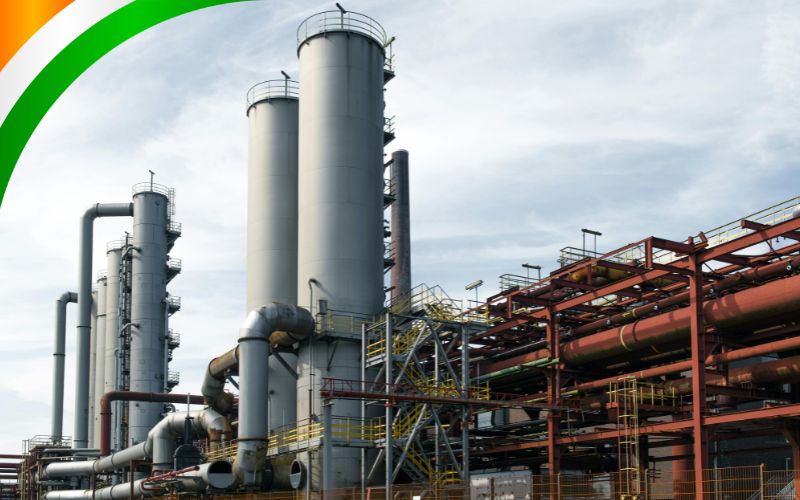
“The future engineering company will help convert pilot plants into commercial facilities. It will support technology validation, process optimization and industrial scale-up. It will bring together scientists, operators, fabricators and investors within a common framework.” Aashutosh Aggarwal, CEO, Simon India Limited
When India discusses its industrial ambitions, the conversation often revolves around manufacturing output, infrastructure investments, energy security, or technology adoption. Rarely do we discuss the institutions that quietly bring these ambitions to life.
Engineering, Procurement and Construction (EPC) companies have traditionally occupied that space. They have been the organizations entrusted with converting ideas into assets, drawings into plants, and capital into productive capacity. Yet, as India enters a new phase of industrial development, the role of EPC firms is undergoing a profound transformation.
The EPC company of the future cannot remain merely an executor of projects.
It must become a creator of knowledge, a partner in innovation, and a contributor to national capability building.
Major Industrial Shifts
India today stands at the crossroads of three major industrial shifts. The first is the continued expansion of core sectors such as fertilizers, chemicals, refining and petrochemicals. The second is the emergence of energy transition industries including green hydrogen, green ammonia, biofuels and carbon management. The third is the rapid integration of digital technologies into engineering and manufacturing.
Together, these shifts present an opportunity that extends far beyond project execution.
For decades, India has successfully built world-scale industrial facilities. We have created some of the largest fertilizer complexes, refineries and manufacturing assets in the world. However, a significant portion of the underlying technologies powering these facilities has originated elsewhere.
In sectors such as sulphuric acid, phosphoric acid, ammonia and several specialty chemical processes, India has largely remained a technology adopter rather than a technology creator.
There is nothing inherently wrong with learning from the world’s best technologies. In fact, it has accelerated India’s industrial growth. However, a nation aspiring to become a global manufacturing leader must eventually progress beyond adoption.
Next chapter of India’s industrial story
The next chapter of India’s industrial story must be about ownership of knowledge.
As engineers, we often ask ourselves a simple question: Why should India only build plants based on imported know-how when it possesses the scientific talent, industrial base and entrepreneurial spirit required to develop its own technologies?
The answer lies in creating stronger bridges between research, engineering and industry.
At Simon India, this belief is shaping our long-term vision. While our foundation remains rooted in engineering and project execution, our aspiration extends much further. We are working towards building India-centric intellectual property in fertilizers, chemicals and energy transition sectors areas that are strategically important for the country’s economic and environmental future. This is not about replacing global technologies overnight. It is about creating a parallel ecosystem where Indian innovation can mature, scale and eventually compete globally.
The reality is that technology development does not happen in isolation.
A laboratory can discover a process. A researcher can prove a concept. But transforming an idea into a commercially operating plant requires a different set of capabilities. It requires process engineering, equipment design, scale-up expertise, operational understanding, risk management and execution discipline.
This is where engineering organizations can play a transformational role.
Historically, EPC companies entered the picture after the technology was already established. Going forward, they must participate much earlier in the innovation cycle.
The future engineering company will help convert pilot plants into commercial facilities. It will support technology validation, process optimization and industrial scale-up. It will bring together scientists, operators, fabricators and investors within a common framework.
In many ways, EPC firms are uniquely positioned to become the missing link between research and commercialization.
Taking a collaborative approach
At Simon India, we have consciously strengthened our engagement with research institutions, domain experts and technology ecosystems because we believe India’s next generation of industrial breakthroughs will emerge through collaboration rather than isolation.
The challenges facing the world today energy security, decarbonization, resource efficiency and sustainable manufacturing cannot be solved by any single stakeholder.
They require partnerships. They require industry and academia to work together. They require engineers and scientists to speak the same language. They require execution capabilities to sit alongside innovation capabilities.
This collaborative approach becomes even more important in emerging sectors such as green hydrogen, green ammonia, carbon capture and sustainable fuels. These industries are still evolving globally. Standards are being defined. Business models are being tested. Technologies are competing for scale.
India has a unique opportunity to participate not merely as a consumer of these technologies but as a contributor to their development. Achieving this objective will require a new mindset within the engineering community.
Engineering excellence can no longer be measured only by successful project delivery. It must also be measured by the ability to create intellectual property, improve processes, reduce costs, enhance sustainability and generate knowledge that can be replicated across industries.
Role of digitalization
Equally important is the role of digitalization.
Artificial intelligence and advanced engineering tools are reshaping how projects are designed and executed. Routine activities that once consumed significant engineering effort are increasingly being automated. This creates an opportunity for engineers to focus on higher-value activities such as innovation, optimization and problem-solving.
The true promise of AI in engineering is not replacing engineers.
It is enabling engineers to become more creative. It is enabling organizations to capture institutional knowledge, accelerate decision-making and improve project outcomes.
For India, this combination of engineering expertise, digital capability and indigenous innovation could become a powerful competitive advantage.
The country’s industrial future will not be defined solely by how many plants we build.
It will be defined by whether those plants embody Indian innovation. It will be defined by whether the technologies powering them are developed, adapted and improved within our own ecosystem. It will be defined by whether engineering companies become contributors to intellectual capital rather than only physical capital.
As we look ahead, I believe the most successful EPC organizations will be those that evolve from contractors into strategic partners, from project executors into knowledge creators, and from infrastructure builders into nation builders.
India’s industrial ambitions are large.
Its technological aspirations must be even larger.
The opportunity before us is not simply to participate in India’s growth story.
It is to help write it.
The author is Aashutosh Aggarwal, CEO, Simon India Limited
