

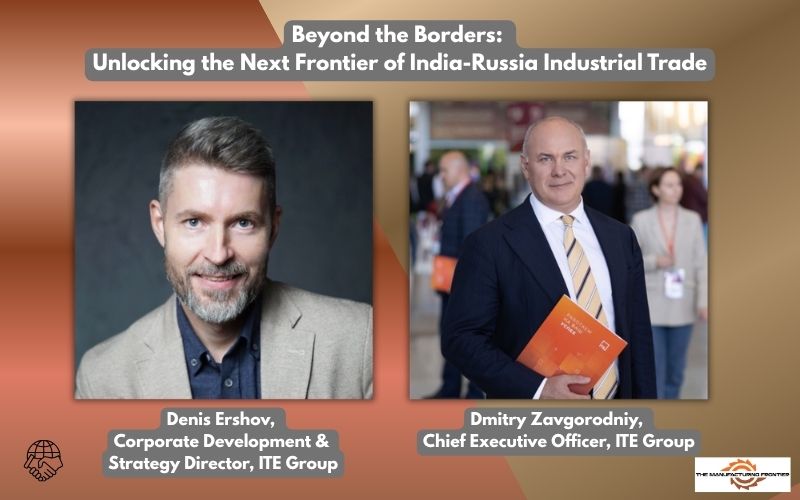
“Russia’s annual demand for machinery stands at approximately $2.7 billion, whereas Indian exports currently account for roughly $100 million. The appetite spans both specialized heavy equipment with embedded electronics and general manufacturing machinery.” Denis Ershov, Corporate Development and Strategy Director, ITE Group
“India’s regional industrial clusters represent distinct specialized hubs, from engineering in Pune and Gujarat to technology in Bengaluru and pharma-manufacturing in Hyderabad. To harness this depth, ITE Group is actively collaborating with leading export promotion councils and industry associations to help enterprises across India scale their presence throughout Eurasia.” Dmitry Zavgorodniy, CEO, ITE Group
The global trade map is undergoing a historic realignment, and the Eurasian corridor is emerging as one of its most dynamic frontiers. Against the backdrop of the ‘ITE Roadshow – Beyond the Borders’ held in Mumbai recently, Niranjan Mudholkar, Founder & Editor-in-Chief of The Manufacturing Frontier (TMF), had a candid interaction with Denis Ershov, Corporate Development and Strategy Director, ITE Group. Towards the conclusion of the dialogue, Dmitry Zavgorodniy, CEO, ITE Group, also joined to provide high-level perspectives on bilateral trade corridors and multilateral expansion. As one of the world’s leading organizers of B2B exhibitions and industry forums, ITE Group has been steadily cementing ties across major emerging markets.
Following a landmark five-year agreement with ApexBrasil, the Group has intensified its engagement in India through strategic associations with the Services Export Promotion Council (SEPC), the Federation of Indian Export Organisations (FIEO), and the Federation of Indian Chambers of Commerce & Industry (FICCI). The conversation yielded sharp, pragmatic insights into how Indian manufacturers can transition from occasional exporters to entrenched players in Russia and the broader Commonwealth of Independent States (CIS).
The Market Realignment
Addressing the 4.5% anomaly across roughly 300 categories mapped by the Indian government where Indian manufacturing possesses competitive scale and Russia exhibits massive import demand, India currently holds an estimated 4.5% market share. For an industrial powerhouse operating alongside an economy actively diversifying its supplier base, this figure highlights significant room for growth. Mr. Ershov pointed out that the gap does not stem from a deficit in manufacturing capability, but rather from procedural and commercial hurdles.
Navigating cross-border payment mechanisms, logistics routes, and regulatory compliance continues to absorb substantial time and bandwidth for Indian enterprises.
Since 2022, the wholesale exit of legacy Western suppliers has catalysed a sweeping restructuring of Russia’s procurement ecosystem. While China expanded its footprint swiftly, Russian industrial buyers are actively seeking supply chain diversification to avoid single-source dependencies, which places India at the top of their priority list for balanced quality and cost efficiency.
Further, the addressable market extends well beyond Russia itself. The broader CIS economic space represents nearly 300 million consumers, supported by personal income growth averaging 10% to 15% annually over the past few years while expanding the purchasing power for quality-engineered goods and consumer products alike.
Four Industry Focus Areas
While defence historically dominated bilateral trade narratives, industrial diversification is rapidly redefining the commercial relationship. Mr. Ershov identified four non-defence sectors primed for exponential scale:
Pharmaceuticals & Active Pharmaceutical Ingredients (APIs): Beyond finished dosage formulations, Russia relies on imports for approximately 90% to 95% of its active ingredients and raw materials, offering an immediate opening for India’s bulk drug manufacturers.
Food & Agro-Processing: Russia’s agricultural imports now exceed its exports. Indian food products have already gained strong visibility across Russian supermarket shelves and digital marketplaces, establishing consumer familiarity that suppliers can readily build upon. Consumer Goods, Home Furnishings & Textiles: In consumer verticals, Indian companies hold a distinctive edge that transcends price competitiveness. Brand identities rooted in natural ingredients, Ayurvedic formulations, and design-led home furnishings resonate strongly with Russian buyers seeking authentic alternatives.
Machinery & Industrial Capital Equipment: Russia’s annual demand for machinery stands at approximately $2.7 billion, whereas Indian exports currently account for roughly $100 million. The appetite spans both specialized heavy equipment with embedded electronics and general manufacturing machinery.
Crucial Strategic Factor for Capital Goods
Russian industrial buyers do not simply purchase machines; they purchase uptime. Indian machinery manufacturers must evaluate whether they can guarantee local servicing, documentation, rapid spare-parts availability, and responsive field support before entering the market. Without an operational service framework, capital equipment cannot gain sustained traction.
From Validation to Localization
Addressing how Indian manufacturing leaders should structure their international expansion, Ershov cautioned against rushing into heavy, capital-intensive investments right off the bat. Instead, he advocated for a disciplined, evolutionary journey.
Phase 1 — Market Validation: Start with targeted exploratory visits to meet potential buyers, assess product-market fit, and understand local unit economics. Trust is not built overnight; direct relationship-building is paramount.
Phase 2 — Partner Identification: Build robust distribution and channel partnerships to handle early transaction batches, import clearance, and compliance handling.
Phase 3 — Strategic Commitment: Once volumes are validated and commercial rules are fully mastered, companies can evaluate deeper engagements—including local warehousing, dedicated after-sales networks, joint ventures, or localized assembly. Notably, more than 150 Indian businesses are actively trading across these target sectors, with an increasing number establishing localized entities.
To de-risk this path, modern exhibitions must function as end-to-end market entry platforms rather than transactional booth rentals. By pairing year-round digital platforms like ITE Connect, which facilitates 365-day matchmaking—with targeted, pre-scheduled buyer meetings on the ground, enterprises arrive with their logistics, distribution roadmaps, and commercial partners pre-qualified.
The Multilateral Outlook
Joining the dialogue, ITE Group CEO Dmitry Zavgorodniy underscored that the strategic alignment between India and Eurasia is moving in lockstep with the broader BRICS+ economic architecture. Following high-level discussions in New Delhi, Mr. Zavgorodniy emphasized that ITE’s cross-sector portfolio, which spans more than 30 annual events across 20 core industries, serves as an operational bridge for this multilateral vision.
Logistically, trade channels between the two regions are maturing. Stable transit corridors operating through the Far East and the International North-South Transport Corridor (INSTC) south route have noticeably compressed delivery schedules, offering dependable alternatives to traditional European routes. Mr. Zavgorodniy also noted that India’s regional industrial clusters represent distinct specialized hubs, from engineering in Pune and Gujarat to technology in Bengaluru and pharma-manufacturing in Hyderabad. To harness this depth, ITE Group is actively collaborating with leading export promotion councils and industry associations to help enterprises across India scale their presence throughout Eurasia.
For Indian manufacturing leaders, the message from the Mumbai roadshow is crystal clear: Eurasian supply chains are in an active state of reconfiguration. Those who invest early in compliance, build dependable after-sales infrastructure, and take a methodical approach to partnership will find one of the most receptive industrial markets of the decade.
