
“We are a growth-focused company that consistently invests in capacity expansion. Over the years, we have identified new projects, commissioned and stabilized them, and subsequently expanded their capacities to meet India’s growing demand.” Maulik Patel, Chairman & Managing Director, Epigral Limited
The global chemical industry is reaching a strategic inflection point. Vulnerabilities in concentrated supply hubs, coupled with surging domestic consumption, have accelerated the race for import substitution and self-reliance across India’s industrial landscape. Capturing this pivot demands more than incremental capacity; it requires bold portfolio diversification, aggressive process-driven R&D and green-led chemical manufacturing.
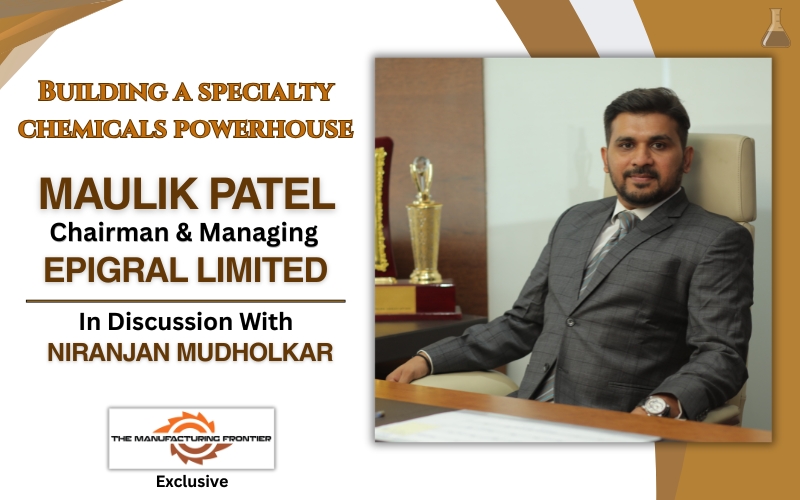
At the forefront of this shift is Epigral Limited, executing a deliberate transition from a pure-play chlor-alkali producer into an advanced specialty chemicals powerhouse. From pioneering bio-based Epichlorohydrin to building the world’s largest single-location CPVC resin facility, Epigral is systematically closing critical intermediate gaps. In this exclusive conversation with Niranjan Mudholkar, Founder & Editor-in-Chief of The Manufacturing Frontier (TMF), Maulik Patel, Chairman & Managing Director of Epigral Limited, discusses scaling world-class manufacturing, deploying AI for operational excellence, and laying the groundwork to double revenues through high-value specialty chemistries.
QnA
The global chemical landscape is undergoing a structural realignment as supply chains seek resilience beyond traditional centres. How well-positioned is India’s chemical and specialty chemicals industry to capture this shift, and what critical capabilities must Indian manufacturers scale to become preferred global partners?
Yes, the global chemical landscape is changing and countries that are fully dependent on imports are vulnerable. Also in terms of demand globally India is the only country where demand is growing much faster. So current capacities that India have are at small scale but considering the global situation, India’s demand and export opportunities will grow. Indian chemical manufacturers have to enter into various such chemicals; both in bulk and specialty chemicals which has good demand and globally no new facilities are coming up and strong demand for the product in the domestic market. So strong R&D, process-driven R&D to improve efficiency and setting up sizeable capacity to meet India and global demand. Along with that Government of India has to focus on creating strong infrastructure for transportation of chemicals and reducing logistic costs as well as focus on creating chemical regions like Dahej PCPIR region to have basic infrastructure for chemical segment to set up plants and expand faster
India has historically relied on imports for several key chemical intermediates and specialty value chains. How do you see backward integration and domestic import-substitution initiatives strengthening India’s manufacturing ecosystem, and where is Epigral actively bridging these critical supply chain gaps?
India is importing many chemicals as the demand for the product is increasing faster as compared to rise in manufacturing set up on account of limitations in infra. However, since last few years there are many such chemicals where India started manufacturing domestically to cater local demand also catering to global markets. So, India has started that journey and slowly increasing the market share; however, pace is slow and we see this trend gradually growing.
At Epigral we focus on catering to growing demand in India and reducing imported dependence, contributing to GOI initiative of Atmanirbhar Bharat and Make in India initiative. Epigral is India’s first company to manufacture Epichlorohydrin and Chlorotoluenes Value Chain. Epigral is the largest manufacturer of CPVC Resin in India. Prior to Epigral coming in the CPVC space, 95% of the demand was met through imports. In future too we have plans to enter into such chemicals to meet the domestic demand.
Since taking over as Chairman & Managing Director in 2017, Epigral has evolved from a chlor-alkali producer into a diversified specialty chemicals company. What philosophy has guided this transformation, and how do you balance basic chemicals with high-value specialty products?
We started with Chlor-Alakli business but our focus was always on diversified chemicals. Diversification is the key for any business for consistent growth and that is our key philosophy. We have diversified our product basket and hence now we cater to different new customers and also to newer industries. This diversification helps us to navigate through tough times and being more resilient. Till 2019 our 100% of revenue was coming from Chlor-Alkali business and as of FY2026 around 52% revenue was coming from Derivatives & Specialty business. As we are expanding into further Derivatives & Specialty with newer products, this 52% will go to around 70% by FY2028 and it will further increase from there. Also, we see many chemicals where there is huge potential in India and demand is growing, so there is plenty of opportunities available to grow.
Epigral commissioned India’s first Epichlorohydrin plant using 100% renewable bio-based glycerol. What were the key technical and commercial challenges, and how does this strengthen Epigral’s global positioning?
Technically, our manufacturing process is greener than the traditional propylene-based method. It generates less waste and consumes less water and energy, making it more environmentally friendly. It is also commercially viable, as several industries increasingly prefer greener alternatives to crude oil-based products. This gives Epigral a competitive advantage in both domestic and global markets.
Having established India’s largest CPVC resin plant and expanded into CPVC compound manufacturing, how is Epigral addressing the growing domestic demand? Are there plans for further capacity expansion?
India’s demand for CPVC pipes is rising, driven by growth in residential construction and the replacement of old plumbing systems. Demand from plumbing applications alone is expected to grow at a CAGR of 12–13%, reaching approximately 5 lakh tonnes by 2030.
Beyond residential plumbing, applications such as fire sprinkler systems and industrial piping are also expected to gain traction, further increasing demand.
Epigral initially established a 30 KTPA plant, expanded it to 75 KTPA, and is now doubling its capacity to 150 KTPA. Once completed, it will become the world’s largest CPVC resin manufacturing facility at a single location. The expanded capacity is expected to be absorbed by growing domestic demand. Even then, India is likely to continue importing CPVC resin, as domestic production will remain insufficient to meet the country’s overall requirements.
How is Epigral leveraging digital technologies, automation, predictive maintenance, and process analytics to enhance manufacturing efficiency, safety, and operational excellence?
We use the latest machinery and regularly upgrade our systems to improve production efficiency and reduce waste. We also use AI across plant operations, sales, procurement, and project management to analyze data, identify patterns, and support timely, informed business decisions.
Regular maintenance is a key priority, helping us ensure continuous and efficient plant operations. This also supports our goal of remaining a low-cost manufacturer and improving profitability.
We follow strict safety protocols, conduct regular employee training, and continuously update our safety systems to prevent accidents. Since its inception, Epigral has not experienced any major accidents at its plant.
Sustainability today extends beyond green raw materials. What initiatives has Epigral implemented around resource efficiency, effluent treatment, Zero Liquid Discharge (ZLD), and by-product utilization to support responsible manufacturing?
Sustainability for us goes beyond using green raw materials; it runs through resource efficiency, effluent management, and by-product utilization across our operations.
On resource efficiency, we have driven initiatives like recovering steam condensate, reusing backwash and ion-exchanger water, and rainwater harvesting, together saving over lakhs KL of water. Treated wastewater from our plant goes through multi-stage treatment before discharge to GIDC’s common facility and treated sewage water is reused for irrigation and our green belt.
On waste, we have cut sludge generation in caustic soda production from 62 kg/MT to 23 kg/MT by replacing barium carbonate with a Sulphate Removal System, and we recirculate fly ash back into our own boilers and to cement and brick makers – putting tonnes back into the circular economy instead of landfilling it.
On by-products, switching ECH manufacturing from propylene to glycerin cut CO2 emissions by over 60%, wastewater by 20-40 times, and byproducts by 7-10 times – turning a cleaner input into a cleaner process end-to-end.
Looking ahead to the end of this decade, what is your vision for Epigral, and what milestones would define its journey towards becoming a globally recognized benchmark for Indian manufacturing excellence?
We are a growth-focused company that consistently invests in capacity expansion. Over the years, we have identified new projects, commissioned and stabilized them, and subsequently expanded their capacities to meet India’s growing demand.
The investments made so far, along with the planned capex of ₹600 crore for the Epoxy Resin and Multipurpose Plant, will create the asset base required to potentially double our FY2026 revenue. These facilities are expected to be ready by the end of the next financial year.
These investments will further diversify our business, reduce concentration risks, and support consistent growth. Going forward, the Derivatives and Specialty Chemicals segment is expected to contribute more than 75–80% of our business.
For future expansion, we are already exploring new chemistries with strong demand and growth potential that are currently largely import-dependent. This is aligned with our past strategy and provides us with a clear roadmap for sustained growth.
