

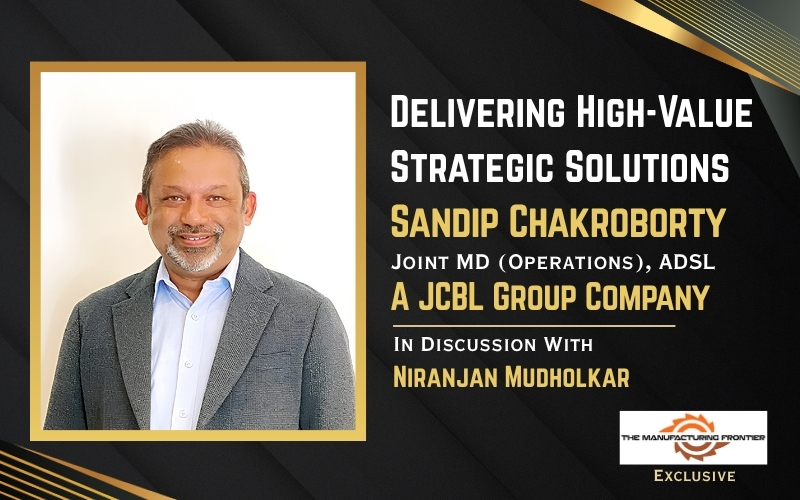
“I see a clear shift in the CV and mobility ecosystem from build-to-print manufacturing towards engineering-led solutions. Over the next five years, customers will increasingly expect suppliers to take greater ownership of engineering, design optimization, material selection, validation and application development.” Sandip Chakroborty, Joint Managing Director (Operations), ADSL, A JCBL Group Company
India’s commercial vehicle and mobility sectors are undergoing a structural shift. The traditional playbook of simply building to print is being replaced by a mandate for deep technical ownership, advanced material selection, and rigorous validation. As original equipment manufacturers and strategic sectors like defence and green energy demand specialized, mission-critical applications, the competitive differentiator has decisively shifted from basic fabrication capacity to comprehensive solution development.
In this exclusive interview, Sandip Chakroborty, Joint Managing Director (Operations), ADSL, A JCBL Group Company, sits down with Niranjan Mudholkar, Founder & Editor-in-Chief of The Manufacturing Frontier, to unpack JCBL South’s strategic evolution into a high-value powerhouse. Chakroborty shares critical insights on serving top-tier global and domestic OEMs, navigating the zero-compromise demands of defence manufacturing, and capitalizing on emerging frontiers across data centres, green energy, and advanced machining.
QnA
You have successfully guided the organization through an evolution from its roots as JCBL (South) into a professional engineering solutions powerhouse with record, year-over-year revenue growth. What were the core pillars of your strategy during this transformative phase?
When we began this transformation, we were very clear that JCBL South had to move beyond being seen simply as a manufacturing setup. The opportunity was to build an engineering-led business with stronger capabilities and greater value at every stage of execution.
That transformation was built on three pillars: engineering capability, operational excellence and customer trust. We evolved our portfolio towards specialized solutions such as engineered containers, defence trailers, low-bed trailers and ballistic-protection solutions for firing ranges.
For me, the real measure of this transformation is not just the revenue growth, but the capability we have built behind it. Our focus has been to move from manufacturing to engineered solutions and establish JCBL South as a scalable, high-value engineering business within the JCBL Group.
JCBL South is known for leveraging global expertise alongside deep local knowledge. As a leader with over 26 years of experience across the technology and mobility sectors, how do you balance global engineering benchmarks with the unique cost and operational realities of the Indian market?
India’s engineering advantage lies in combining global benchmarks with a strong understanding of local realities. Our approach at JCBL South is global standards with Indian engineering economics.
We benchmark ourselves to international standards for quality, safety, durability and engineering, while designing and manufacturing with a strong focus on localization, cost optimization and supply-chain competitiveness.
In defence and other specialized applications, cost cannot come at the expense of reliability. Our principle is simple: engineer for performance, manufacture for efficiency and deliver value.
Your portfolio includes deep-rooted relationships with Indian heavyweights like Tata Motors, Ashok Leyland, and Eicher, alongside global premium brands like Volvo, Scania, and Mercedes-Benz. How do you tailor your engineering and delivery capabilities to satisfy such a diverse spectrum of OEM standards?
Our OEM portfolio spans a wide range of requirements, and we work very closely with each customer from the design stage to understand their specific technical and quality expectations before we move into production.
For engineered containers and trailers, we manage all aspects of the process, from design, material selection, fabrication and welding to dimensional accuracy, testing and final inspection. The product and process may vary depending on the customer, but the quality standards we work to remain consistent.
Specifications can change from customer to customer. Our approach to quality does not.
The Indian manufacturing landscape is shifting from traditional build-to-print models to high-value, engineering-led solutions. Where do you see the CV and mobility ecosystem heading over the next five years in terms of this engineering maturity?
I see a clear shift in the CV and mobility ecosystem from build-to-print manufacturing towards engineering-led solutions. Over the next five years, customers will increasingly expect suppliers to take greater ownership of engineering, design optimization, material selection, validation and application development.
This direction is particularly relevant for JCBL South, because our products are already application-driven rather than commodity products. The opportunity ahead is to move further into complex, specialized and high-value engineered solutions, particularly across defence, logistics and strategic applications.
There is a distinct, rising demand for highly customized, special application vehicles in India. What specific technical capabilities has JCBL South developed to address these niche, high-complexity requirements efficiently?
The growing demand for specialized vehicles is being driven by very specific operational needs, and this is an area where JCBL South has developed strong expertise in engineering and manufacturing customized heavy-duty structures.
We have built capabilities in engineered containers, defence trailers, low-bed trailers and ballistic-protection solutions for firing ranges. These applications require skillset in structural design, heavy fabrication, precision welding, material selection, load bearing design, surface treatment and stringent quality inspection.
The real strength is to bring those capabilities together to understand the operational requirement and translate that into a fit-for-purpose engineered product.
Partnering with BEML and the Ministry of Defence requires meeting incredibly stringent quality, durability, and security benchmarks. How has JCBL South elevated its engineering and manufacturing protocols to serve India’s strategic Defence needs?
Defence manufacturing demands zero compromise on reliability, durability, quality and traceability. At JCBL South, this has meant strengthening our engineering validation, welding and fabrication controls, material traceability, inspection, testing and documentation.
Our defence products are designed around the actual operating environment and mission requirement, rather than simply being manufactured to a drawing. This ensures that engineering decisions remain aligned with the demands of the application.
For us, defence is a strategic business area, and our objective is to build indigenous engineering capability for India’s defence and security requirements.
What is the next big milestone or untapped market segment that you are eyeing for JCBL South in the next two years?
Over the next two to three years, our focus at JCBL South is on deepening our presence in high-growth, specialized segments while building greater depth in our engineering capabilities.
In the green energy and data centre sectors, we are already aligned with major players for requirements such as e-houses and engineered containers. The demand in these segments is significant, and our next priority is to expand our engagement and scale with these customers.
In defence, we have already developed products such as armoured cabins, containerised firing ranges, hydraulic platform loading systems and heavy drop systems. The opportunity now is to build further on these capabilities.
