
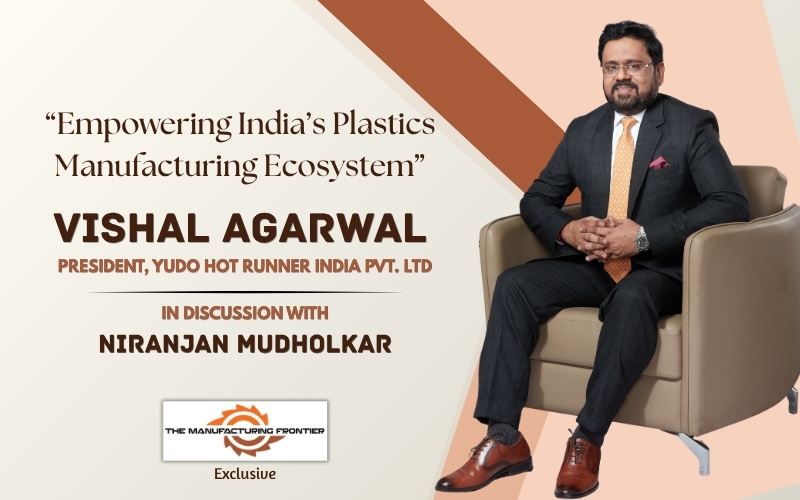
“Looking ahead to the next decade, the alignment of global technology with local manufacturing will be one of the most important enablers of India’s journey toward becoming a truly self-reliant and advanced manufacturing hub.” Vishal Agarwal, President at Yudo Hot Runner India Pvt. Ltd.
As automotive OEMs adapt to the electrification curve, packaging sectors demand sustainable high-cavity output, and medical devices require uncompromising process control, the need for agile, high-precision tooling capabilities has never been greater. Amidst this evolution, staying competitive requires more than just meeting market demand; it demands anticipating where the ecosystem is heading next. And that’s exactly what Yudo is doing in India.
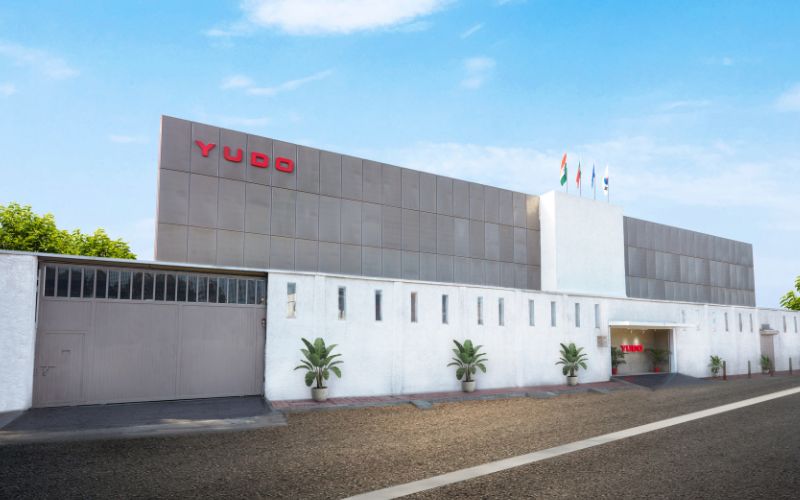
In this exclusive conversation with Niranjan Mudholkar, Founder & Editor-in-Chief, The Manufacturing Frontier, Vishal Agarwal, President at Yudo Hot Runner India Pvt. Ltd., reveals the strategic blueprint driving the company’s latest milestone: the launch of a state-of-the-art 40,000 sq ft facility in Vasai. Beyond doubling production capacity from 190 to nearly 400 systems per month, the move establishes Vasai as one of YUDO’s nine global R&D centres, bringing design, simulation, localized engineering and testing completely under one roof.
Furthermore, as the first company in its segment to secure four critical ISO certifications (ISO 9001, 27001, 14001, and 45001), YUDO India is setting a new benchmark for quality, data security, operational safety, and ESG compliance. Mr. Agarwal shares how this alignment of “global technology and local manufacturing” is cutting down lead times, reducing total cost of ownership and providing the technological backbone for a self-reliant India.
Q&A
Yudo India has achieved a significant milestone by becoming the first company in its segment to hold four critical ISO certifications (9001, 27001, 14001, and 45001). How does this comprehensive compliance framework alter your competitive advantage in the Indian market?
This achievement is far more than a set of certificates on the wall as it fundamentally strengthens how we compete, and partner with customers in India.
By becoming the first company in our segment to hold all four critical ISO certifications including ISO 9001 (Quality Management), ISO 27001 (Information Security), ISO 14001 (Environmental Management), and ISO 45001 (Occupational Health & Safety), we have created a comprehensive, integrated compliance framework that covers quality, data security, sustainability, and workplace safety under one roof.
In the Indian market, this delivers several clear competitive advantages:
Trust and differentiation: Customers which are especially in automotive, medical, packaging, and electronics are increasingly demand rigorous, auditable standards. Being the first in our space to hold this complete set positions Yudo India as a lower-risk, more reliable technology partner.
Operational excellence: These systems force continuous improvement across every process. The result is more consistent product quality, faster response times, better process control, and reduced variability directly translating into higher productivity and lower total cost of ownership for our customers.
Sustainability and ESG alignment: ISO 14001 and 45001 demonstrate that we take environmental responsibility and employee safety seriously. This resonates strongly with global OEMs and progressive Indian manufacturers who are under pressure to meet ESG goals and regulatory requirements.
Information security: In an era of connected manufacturing and smart factories, ISO 27001 gives customers confidence that their designs, data, and intellectual property are protected when they work with us.
Local credibility with global standards: It reinforces that our India operations meet the same high benchmarks as Yudo’s global network, while being deeply rooted in the Indian manufacturing ecosystem.
Ultimately, this framework does not just help us win more business it helps us keep customers longer by delivering measurable reliability, sustainability and peace of mind. It is a tangible expression of our commitment to being a long-term technology partner for India’s plastics industry.
“Shorter lead times, stronger local technical support, and the ability to iterate quickly with customers give us a clear advantage in an environment where project timelines are compressed and performance expectations continue to rise.”
The new 40,000 sq ft facility in Vasai effectively doubles your domestic production capacity from about 190 to nearly 400 systems per month. What specific macroeconomic shifts or demand surges in the Indian manufacturing landscape triggered this massive investment?
This expansion was driven by clear and sustained shifts in India’s manufacturing landscape. Growing demand across key sectors particularly automotive, which remains our largest market, along with packaging, medical, and PVC combined with customers’ increasing expectations for shorter delivery timelines and higher service levels, made it essential to scale up our domestic capacity. At the same time, the broader push toward localization and the Make in India vision reinforced the need for world-class hot runner systems that are engineered and built in India for the Indian market, rather than relying heavily on imports.
The new 40,000 sq ft facility in Vasai more than doubles our production capacity from around 180–190 systems per month to nearly 400, allowing us to meet a significantly larger share of domestic demand from within the country. By bringing design, R&D, simulation, manufacturing, assembly, and testing under one roof, the plant becomes one of Yudo’s nine global R&D centres and strengthens India’s position within our worldwide network. This investment enables faster deliveries, localized engineering support, and globally benchmarked quality, while reinforcing our commitment to supporting India’s emergence as a self-reliant and advanced manufacturing hub.
Yudo commands close to 70% of the automotive hot runner segment in India. As automotive tooling requirements evolve with the rise of EVs and lightweighting, how will the new Vasai facility help you maintain and build upon this dominant market share?
Our leadership position of close to 70% in the automotive hot runner segment in India is the result of more than 25 years of consistent focus on quality, reliability, and deep customer partnerships. As the industry evolves with the rapid rise of electric vehicles and the push for lightweighting, the requirements are becoming more complex demanding higher precision, the ability to process advanced materials, multi-material and multi-colour solutions, and tighter control over cycle times and scrap.
The new Vasai facility is central to how we will protect and further strengthen this position. By more than doubling our domestic production capacity and integrating design, R&D, simulation, manufacturing, assembly, and testing under one roof, we can respond much faster to the changing needs of automotive OEMs and tier suppliers. Local engineering and testing capabilities allow us to develop and validate India-specific solutions for battery housings, structural components, pre-coloured parts, and other EV-critical applications while maintaining global quality benchmarks.
Shorter lead times, stronger local technical support, and the ability to iterate quickly with customers give us a clear advantage in an environment where project timelines are compressed and performance expectations continue to rise. In short, Vasai enables us to stay close to the market, innovate at the speed the automotive industry now demands, and continue earning the trust that has made us the preferred partner for the majority of India’s automotive hot runner requirements.
“While automotive remains our largest and strongest segment, packaging, medical, and PVC have always been important pillars of our business, and the new Vasai facility gives us the capacity and operational flexibility to scale them more aggressively.”
While automotive is your largest market, you also serve packaging, medical, and PVC segments. How will the increased capacity under the new roof help you aggressively scale your footprint in these non-automotive sectors?
While automotive remains our largest and strongest segment, packaging, medical, and PVC have always been important pillars of our business, and the new Vasai facility gives us the capacity and operational flexibility to scale them more aggressively. With domestic production now rising from roughly 180–190 systems a month to nearly 400, we are no longer constrained by earlier capacity limitations and can dedicate greater resources, engineering bandwidth, and faster delivery commitments to these growing sectors.
In packaging, the demand for thin-wall, high-cavity, and sustainable solutions continues to rise; the expanded manufacturing and local R&D capabilities allow us to respond quickly with systems that reduce material waste and cycle time. In medical, where precision, cleanliness, and process consistency are non-negotiable, the integrated design-to-testing environment under one roof strengthens our ability to deliver validated, high-reliability solutions with shorter lead times. For PVC and related applications, localized production and engineering support help us offer more cost-effective and application-specific systems tailored to Indian processing conditions.
By bringing global technology and local manufacturing together at scale, the Vasai plant enables us to serve a larger share of demand across all these segments from within India improving responsiveness, reducing dependence on imports, and positioning Yudo as a true multi-sector technology partner rather than primarily an automotive specialist. This balanced growth strengthens our overall market presence and supports the broader plastics manufacturing ecosystem.
The Vasai plant is now one of Yudo’s nine global R&D centres. How does having design, simulation, and testing all under one roof accelerate your product development lifecycle for Indian customers?
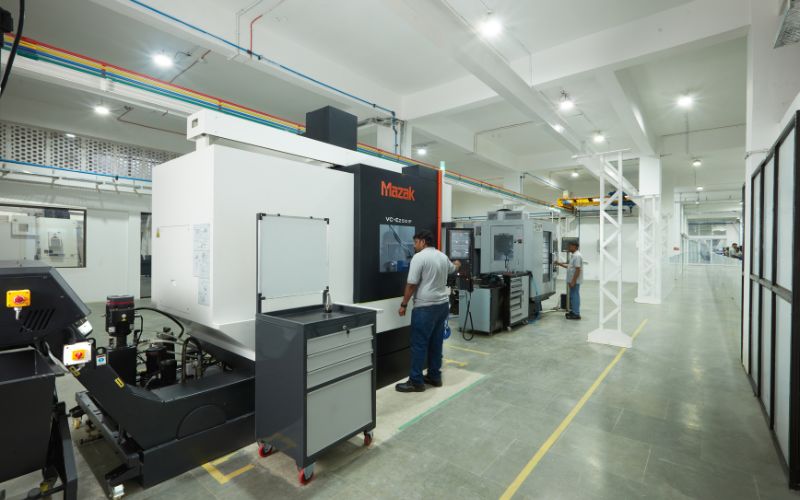
Having design, simulation, manufacturing, assembly, and testing all under one roof at the Vasai facility fundamentally shortens and strengthens our product development lifecycle for Indian customers. In the past, iterations often involved coordination across multiple locations and time zones, which added lead time and complexity. Now, our engineers, designers, and testing teams work side by side, enabling real-time collaboration, faster problem-solving, and quicker validation of concepts against actual manufacturing conditions.
This integrated setup allows us to take an application-specific requirement whether it is a complex automotive component, a thin-wall packaging solution, or a high-precision medical part and move rapidly from design and simulation to prototype, testing, and final production readiness. Local simulation and testing capabilities mean we can optimise flow, thermal performance, and material behaviour for Indian processing conditions and resins, rather than relying solely on global templates. The result is shorter development cycles, higher first-time success rates, and solutions that are both globally engineered and finely tuned to the needs of the Indian market.
For our customers, this translates into faster project turnarounds, reduced risk, and greater confidence that the systems they receive will perform reliably from day one. By making Vasai one of Yudo’s nine global R&D centres, we have placed advanced product development capability right at the heart of India’s plastics industry.
“In essence, our customers now benefit from globally engineered technology that is developed, built, and supported closer to home resulting in quicker availability, greater responsiveness, and better long-term economic value.”
By shifting from global reliance to localized engineering support and in-country R&D, what immediate advantages are your customers experiencing regarding lead times and total cost of ownership?
The shift from global reliance to localized engineering support and in-country R&D is already delivering tangible benefits to our customers in both lead times and total cost of ownership. With design, simulation, manufacturing, and testing now integrated under one roof at Vasai, we can respond to enquiries, customize solutions, and deliver systems significantly faster than before. Projects that earlier involved longer international coordination cycles are now handled with greater speed and agility, helping customers meet tighter project timelines and reduce the risk of production delays.
On the cost side, localized manufacturing and engineering lower logistics expenses, minimize import-related duties and uncertainties, and reduce the need for costly expedited shipments or inventory buffers. Faster technical support and on-ground troubleshooting further cut downtime and improve overall equipment effectiveness. When combined with the inherent material and energy savings that high-performance hot runner systems deliver, customers experience a meaningfully lower total cost of ownership over the life of the system.
In essence, our customers now benefit from globally engineered technology that is developed, built, and supported closer to home resulting in quicker availability, greater responsiveness, and better long-term economic value.
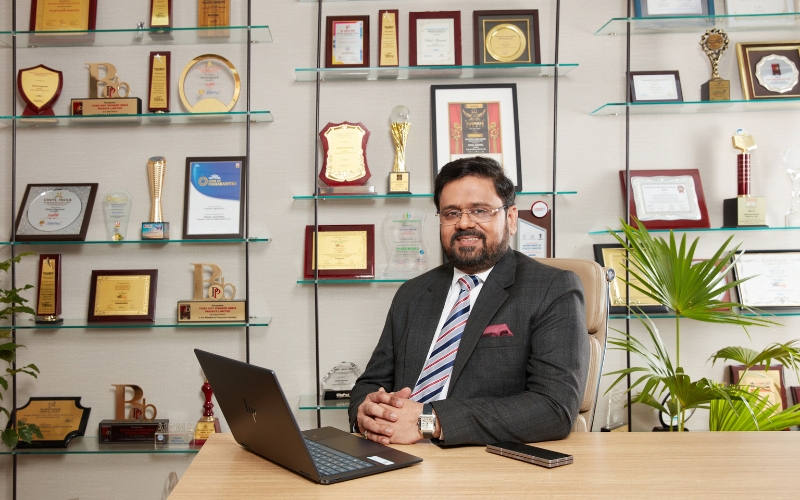
With 25 years of history in India, Yudo is the oldest operating company in this space. Looking ahead to the next decade, how do you see the alignment of “global technology and local manufacturing” shaping India’s journey toward becoming a truly self-reliant, advanced manufacturing hub?
With more than 25 years in India, Yudo has been a consistent participant in the evolution of the country’s plastics and tooling ecosystem, and we are proud to be the oldest company still operating in this specialized space. Looking ahead to the next decade, the alignment of global technology with local manufacturing will be one of the most important enablers of India’s journey toward becoming a truly self-reliant and advanced manufacturing hub.
Global technology brings proven engineering excellence, advanced materials knowledge, simulation capabilities, and continuous innovation that Indian manufacturers need to compete at the highest levels. Local manufacturing and in-country R&D, on the other hand, ensure that these technologies are adapted to Indian conditions, delivered faster, supported more effectively, and scaled in line with domestic demand. When the two come together, as we are doing at Vasai, the result is not just import substitution, but the creation of genuine technological capability within India.
Over the coming years, this model will help strengthen the broader plastics manufacturing ecosystem by reducing dependence on overseas supply chains, accelerating the adoption of high-precision and sustainable processes, and building deeper engineering talent on the ground. It will also enable Indian companies to meet increasingly sophisticated requirements from automotive, packaging, medical and other sectors while remaining globally competitive. In our view, self-reliance is not about isolation; it is about combining the best of global knowledge with strong local execution. That is the path we believe will define India’s progress as an advanced manufacturing nation in the decade ahead.
