
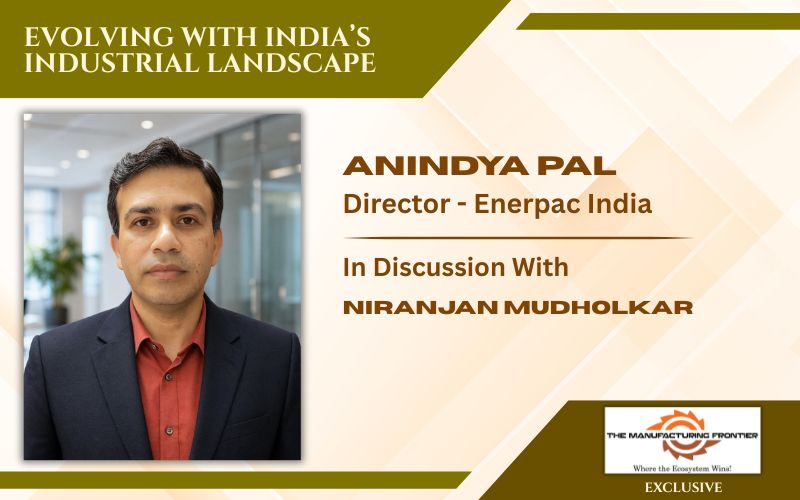
The industrial and infrastructural landscape of modern India is a testament to an unprecedented era of engineering ambition. The nation is no longer just building; it is scaling new heights of industrial complexity. At the heart of this transformation lies a critical, yet often unseen, force: high-precision hydraulics. In this exclusive conversation with Niranjan Mudholkar, Founder & Editor-in-Chief, The Manufacturing Frontier, Anindya Pal, Director of Enerpac India, sheds light on how a century-old global titan is reinventing itself to become the backbone of India’s infrastructure revolution.
For decades, Enerpac was synonymous with the “catalogue sale”—a provider of world-class tools to distributors. However, as India’s projects have grown in scale, so too has Enerpac’s role. Mr. Pal talks about a strategic shift from being an industrial supplier to being a core engineering partner. This shift is also evident in the company’s “Make in India” philosophy. Far from using localization as a tool for cost arbitrage, Enerpac is now positioning its Bangalore facility as a global centre of excellence. By adhering to the same rigorous testing protocols used in Europe and the Americas, Enerpac India is proving that “Made in India” can be a global benchmark for quality, backed by a seamless global warranty that supports Indian OEMs on the world stage.
Perhaps most compelling is the company’s embrace of the digital frontier. As Mr. Pal explains, the future of heavy lifting is not just about raw power, but about intelligent, data-driven control. Through the integration of PLC automation and BIS-certified cordless technology, Enerpac is addressing the modern industry’s most pressing demands: safety, ergonomics, and documented precision.
As India prepares for a five-year horizon of intense expansion, Enerpac is doubling down on its local footprint, expanding its network into Tier-2 industrial hubs and transitioning its entire global manufacturing for tensioning tools to Indian soil. This interview offers a rare glimpse into the mechanics of progress, revealing how precision tools and local ingenuity are quite literally lifting the future of the nation.
Interview Q & A
Niranjan Mudholkar: I am very keen to understand how Enerpac India is evolving from being a tool provider to a strategic partner for the several infrastructure projects currently underway in India. Enerpac is a century-old global brand, but looking at your evolution over the last two decades in India, a period of incredible growth and industrial complexity, how has the organization adapted to better serve this market?
Anindya Pal: Enerpac is a global premier brand for high-force precision hydraulic tools. Looking back at the last 20 years, the most striking shift has been our position in the customer’s decision-making process. Traditionally, Enerpac operated as an organization that sold to distributors. Today, we have evolved to selling through distributors.
Previously, the relationship was purely transactional and catalogue-driven. Now, we collaborate with our channel partners to work directly with end-users. This allows us to understand their specific pain points and safety requirements, enabling us to provide tailor-made solutions. To support this, we have developed local application engineering and custom-built solution capabilities right here in India. As India builds taller bridges, longer spans, wind towers, and heavier process equipment, Enerpac has stepped up to provide engineered lifting, positioning, and bolting solutions to major organizations across infrastructure, defence, power and heavy manufacturing.
Niranjan Mudholkar: When you refer to “customized solutions”, are these tailored to specific customers or specific projects?
Anindya Pal: They can be both. For instance, a customer might have a unique problem requiring standard tools to be tweaked with specific add-ons to make the job easier. We have built the local capability to handle those modifications.
Regarding projects, take large-scale infrastructure like bridge building. These involve heavy lifting where standard products might not perfectly fit. A project might require a modification in the load-carrying capacity or the height of a tool. We customize those parameters as the need arises.
Niranjan Mudholkar: Since you mentioned localization, could you elaborate on the “Make in India” aspect? There is significant momentum around making in India for the global market. What is Enerpac’s strategy here?
Anindya Pal: There is a common misconception that “Make in India” is solely about cost-cutting. For Enerpac globally, making in India is a strategic manufacturing capability upgrade. The products we manufacture here are built to international standards and exported to the Americas, Europe, and APAC countries.
Every raw material—from seals to precision components—is sourced to Enerpac’s global standards. There is no relaxation in quality just because a product is sourced locally for the Indian market. One of our greatest advantages is our global warranty. If an Indian OEM buys an Enerpac tool, they can take it anywhere in the world and be assured of a service partner and warranty support.
Niranjan Mudholkar: So, essentially, the quality, service, and warranty remain identical regardless of where the Enerpac product is manufactured?
Anindya Pal: Absolutely. We maintain the same global testing protocols, including pressure testing and load verification using our in-house 1,000-ton press. We maintain full documentation and traceability. In March, Enerpac India achieved ISO 9001:2015 and ISO 45001:2018 certifications. Our goal is to ensure every product reinforces the high standards Enerpac is known for worldwide.
Niranjan Mudholkar: Regarding your advanced offerings, such as the cordless hydraulic solutions sold in the US and Europe, how are these technologies being adapted for Indian standards and remote locations like mining sites?
Anindya Pal: Digital transformation is a key pillar of our global growth. We have invested substantially in “e-tools” for torquing and tensioning jobs on pressure vessels, flanges, and structural connections where audit documentation is vital.
For example, our synchronous lifting controllers provide real-time monitoring of differential loads across all lift points, ensuring complex multi-lifts are seamless and safe. When we launched our battery-operated torque wrenches in India, we ensured the batteries received BIS (Bureau of Indian Standards) certification. As a New York Stock Exchange-listed company, transparency and adherence to local laws are paramount. Locally, we also design custom solutions by integrating standard hydraulics with PLC automation, HMI, and SCADA systems, depending on the level of digital control the customer requires.
Niranjan Mudholkar: Could you share a case study where you created a specific solution for an Indian customer?
Anindya Pal: Certainly. Consider the application of hydraulic presses in manufacturing. A basic example involves pressing bushings into gearboxes. These bushings have a tolerance fit requiring massive hydraulic force to push them into the perfect position repeatedly and accurately.
We took our standard presses and integrated them directly into the customer’s assembly lines. We incorporated all the hydraulics and electronics into an automated system. We added logic where a timer dictates the operation, and data regarding the number of operations is stored. This transformed a standalone tool into a seamless, automated manufacturing system.
Niranjan Mudholkar: In this era of rapid digital transformation, how is Enerpac leveraging technology to optimize maintenance and operational efficiency for customers?
Anindya Pal: Safety and ergonomics are now primary concerns for every industry. In remote locations or when working at heights, customers need convenient, cord-free methods to increase productivity while keeping operators safe. Our battery-powered tools were developed for exactly this. Instead of dragging long cords or hoses, an operator carries a self-contained tool and a spare battery to a remote site. This improves speed, precision, and safety simultaneously.
Niranjan Mudholkar: There is a lot of buzz about Artificial Intelligence in the industry. Does Enerpac envision using AI in its solutions?
Anindya Pal: Well, we have already begun incorporating AI into our internal processes, with pilot projects in sourcing and assembly operations. While we haven’t integrated AI into the tools themselves yet, that is the natural next step. We are currently building the digital infrastructure so that every lift or operation can be recorded and analysed. For now, the focus is using AI to improve our internal efficiencies and deliver products to customers faster.
Niranjan Mudholkar: Many technology firms establish “Technology Centres” in India where customers can collaborate and test solutions. Does Enerpac have a similar facility?
Anindya Pal: We have something even more established: the Enerpac Training Academy, which has been active for over 10 years. We have trained over 500 professionals there. It serves as a showroom where customers get hands-on experience and a training hub for our distributors, service centre personnel, and end-users on how to use, service, and repair our products. We also encourage our channel partners to open authorized service centres that act as localized mirrors of this academy.
Niranjan Mudholkar: Looking at a five-year horizon, what are Enerpac’s priorities for the Indian market?
Anindya Pal: We are focusing on three main areas. First, we are deepening our distribution network, particularly in Tier-2 industrial regions, by adding more authorized service centres and trained partners. Second, we are expanding our team of application engineers to strengthen our local capability for complex, heavy-lifting projects.
Finally, we are significantly expanding our Indian manufacturing footprint. We already produce standard and aluminium cylinders in Bangalore for both the domestic and export markets. Moving forward, we are investing in making India the global hub for Enerpac’s tensioning tool manufacturing. The entire global supply for these tools will soon come from our Bangalore facility.
Niranjan Mudholkar: Is there anything else you’d like to add?
Anindya Pal: Only that there is a deep legacy to the Enerpac brand, dating back to 1910. There is a bit of Enerpac in everyday life. Whether it is a steel plant, oil and gas, cement, power, defence or food and beverage, wherever there is machinery that requires precise, fast maintenance, there is an Enerpac tool nearby. We are proud to be an essential part of India’s industrial landscape.
