

“The manufacturing facilities we are expanding today at Savli and Kalol are being designed with the process flexibility to accommodate LH2 production lines as that market scales. India’s ambition to become a green hydrogen hub finds a ready industrial partner in INOX India.” Deepak Acharya, CEO of INOX India Limited
India’s industrial momentum is facing a massive, multi-billion-dollar macroeconomic bottleneck. With nearly 85% of its crude oil tied to volatile global imports and over 70% of domestic freight heavily reliant on road transport, the country’s logistical backbone is exposed to severe economic and environmental strains. As the manufacturing sector accelerates, finding a cleaner, cost-efficient, and sustainable alternative to diesel is no longer a forward-looking choice—it is a national economic imperative.
Enter Liquefied Natural Gas (LNG) and the next generation of cryogenic technology. Long dismissed by sceptics as a mere temporary “bridge fuel”, LNG is rapidly emerging as the definitive destination fuel for heavy commercial mobility over the next decade. Propelled by favourable total cost of ownership (TCO) parity, a 25% reduction in CO2 emissions, and a compressed adoption curve across India’s golden quadrilaterals, the transition from diesel to gas is unfolding at an unprecedented pace.
At the absolute vanguard of this energy paradigm shift is INOX India Limited (INOXCVA). From delivering advanced fuel tank systems to global automotive OEMs to pioneering distributed “Mini LNG Terminals” along India’s coastline, the company is actively injecting nodes of energy independence straight into the country’s logistics ecosystem. Crucially, by securing the prestigious IATF 16949 automotive certification, INOX India has proven that its ruggedized, vacuum-insulated engineering can withstand both the brutal ambient temperatures of the subcontinent and the strict benchmarks of the global export market.
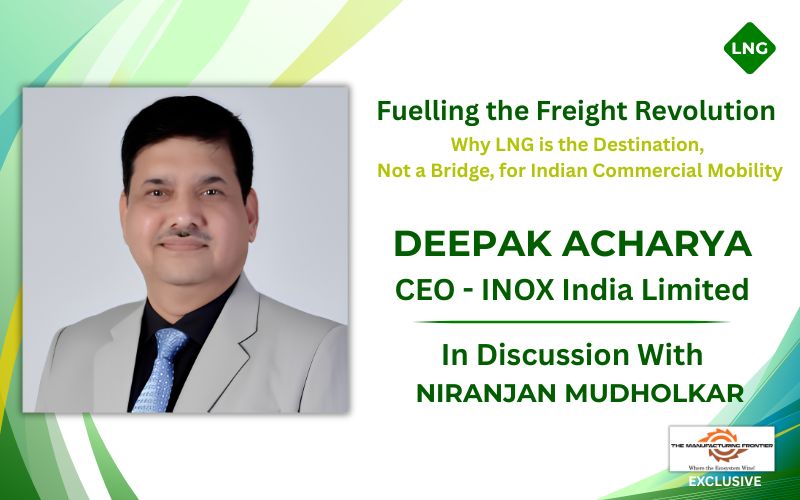
In this deep-dive interview, Niranjan Mudholkar, Editor-in-Chief of The Manufacturing Frontier, sits down with Deepak Acharya, CEO of INOX India Limited. Together, they decode the hard economics of fleet transition, the breakthrough material science preventing gas venting on Indian roads, and how the massive cryogenic infrastructure being built today is inherently “future-proofed” to pioneer India’s eventual leap into the green hydrogen economy.
QnA
Niranjan Mudholkar: With nearly 85% of India’s crude oil being imported and over 70% of freight moving by road, the macroeconomic pressure to find an alternative is immense. From your vantage point as CEO of INOX India, how rapidly do you see LNG transitioning from a ‘credible alternative’ to the primary driver of India’s long-haul commercial mobility?
Deepak Acharya: At INOX India, we have a ground-level view of this transition, which is unfolding now. We currently have over 250 LNG semi-trailers operating on Indian roads, and our fuel tank dispatches to automotive OEMs are accelerating quarter on quarter.
I would characterise LNG’s journey not as a slow evolution but as a compressed adoption curve. Within five to seven years, I expect LNG to be the de-facto fuel standard for long-haul corridors above 500 kilometres. The combination of lower fuel costs per kilometre, reduced CO2 emissions of up to 25%, and a growing fuelling infrastructure will make diesel increasingly uncompetitive for high-mileage fleet operations. LNG is not a bridge fuel; for heavy commercial mobility, it is the destination fuel for this decade.
Niranjan Mudholkar: Fleet operators are extremely cost-sensitive. For a logistics ecosystem operating on thin margins, what is the realistic payback period and total cost of ownership (TCO) advantage for an operator switching from diesel to LNG today?
Deepak Acharya: This is precisely the question fleet operators ask before every purchase decision, and the numbers today are genuinely compelling. The upfront premium for an LNG truck versus its diesel equivalent ranges between ₹15 lakh to ₹25 lakh. However, that differential is offset by a 10–15% lower fuel cost per kilometre and a 15–20% mileage advantage that LNG delivers in real-world highway conditions. Based on current LNG-to-diesel price differentials in India, the payback period for an operator running high-mileage routes lands comfortably in the three-to-four-year range.
The TCO equation also factors in maintenance. LNG engines operate with less carbon deposition, translating to lower service frequency and extended engine life, benefits that compound meaningfully over a seven-to-ten-year vehicle lifecycle. I would add that the Niti Aayog’s own analysis confirms TCO parity between heavy-duty diesel and LNG vehicles. For operators running trunk routes on the Golden Quadrilateral or freight corridors between manufacturing clusters, LNG is already economically superior. The residual hesitation is largely about fuelling infrastructure access, and that gap is closing rapidly.
“Our strategic roadmap is deeply aligned with the government’s vision of raising natural gas’s share in India’s energy mix to 15% by 2030, from approximately 6–7% today.”
Niranjan Mudholkar: How closely is INOX India’s growth strategy aligned with the government’s broader vision of increasing natural gas in the energy mix to 15%? In what ways does building a robust LNG ecosystem directly safeguard India from global crude oil volatility?
Deepak Acharya: Our strategic roadmap is deeply aligned with the government’s vision of raising natural gas’s share in India’s energy mix to 15% by 2030, from approximately 6–7% today. As highlighted in a proposal submitted to the Ministry of Petroleum & Natural Gas, Government of India, a nationwide network of Mini LNG Terminals along India’s coastline can serve as distributed strategic LNG storage hubs, strengthening India’s energy security and supply resilience. Unlike conventional LNG terminals that take 5–10 years to develop, mini-LNG terminals can be deployed within 15–18 months. This scalable, cost-effective model enables strategic storage, efficient distribution, and reliable LNG access for industry and transport. INOXCVA stands ready to partner with the Government of India in building this next-generation LNG infrastructure.
When INOX India builds a cryogenic fuelling station or supplies a vacuum-insulated LNG tank to a logistics company, we are not just enabling a cleaner truck, we are inserting a node of energy independence into India’s freight economy. Scaling that to thousands of trucks on our national highways materially reduces the foreign exchange outflow on crude imports, which is a macroeconomic benefit that extends well beyond the transport sector.
Niranjan Mudholkar: What are the definitive engineering differences between the first-generation LNG fuel tanks and the next-generation tanks INOX India is manufacturing today?
Deepak Acharya: Our next-gen tanks are engineered from the ground up for Indian heavy-duty applications. First, capacity: we now offer a range from 200 to 1,200 litres, allowing OEMs to select configurations that maximize payload efficiency without compromising range. Second, insulation performance: we have refined our multi-layer vacuum insulation architecture, achieving significantly longer times that prevent LNG venting during extended idle periods, a critical requirement for Indian operating conditions.
Third, and perhaps most strategically important, is quality certification. In February 2025, INOX India became the first Indian cryogenic equipment manufacturer to receive the IATF 16949 certification for LNG fuel tanks from Bureau Veritas, a mandatory benchmark for automotive OEM supply chains globally. It is also what opens the door to export markets for heavy-duty vehicle fuel tanks worldwide.
Niranjan Mudholkar: Indian roads, extreme ambient temperatures, and unpredictable driving cycles present unique challenges for cryogenic storage. How has INOX India re-engineered elements like insulation, safety valves, and hold times to ensure gas doesn’t vent prematurely during extended vehicle idle times?
Deepak Acharya: The core engineering response has been in our vacuum insulation system. LNG must be maintained at approximately -162°C, and our tanks use a high-performance, multi-layered vacuum-insulated double-wall construction that minimizes heat ingress even under prolonged high-ambient exposure. The vacuum in the annular space between the inner and outer vessel is maintained at less than 5 microns, effectively eliminating convective and conductive heat transfer. This directly extends hold time, the duration for which LNG remains in its liquefied state without pressure build-up triggering the safety relief valve.
On safety architecture, our pressure relief valves are calibrated to accommodate the specific pressure build-up profiles associated with Indian duty cycles, including extended stationary periods. Additionally, the tanks are engineered with robust mechanical integrity to withstand the vibration profiles of Indian road surfaces, which are considerably more severe than those encountered on European motorways. Our spanning cryogenic expertise, from -253°C liquid hydrogen to -162°C LNG, means we bring the deepest insulation engineering knowledge base in India to every fuel tank we manufacture.
“INOX India is not merely an LNG company that is watching the hydrogen economy from a distance, we are already an active manufacturer of liquid hydrogen storage and transport systems.”
Niranjan Mudholkar: Looking a decade into the future, many view LNG as a bridge to a hydrogen economy. To what extent is the cryogenic tank technology and manufacturing infrastructure you are building today ‘future-proofed’ or adaptable for liquid hydrogen (LH2) mobility when that market matures?
Deepak Acharya: The bridge-to-hydrogen narrative is one we take seriously, and importantly, it is one we are already building across. INOX India is not merely an LNG company that is watching the hydrogen economy from a distance, we are already an active manufacturer of liquid hydrogen storage and transport systems. We have built and shipped a 238-cubic-metre liquid hydrogen storage tank for a liquid hydrogen plant in South Korea, and we supply ISO tank containers and road tankers for LH2 transit applications globally. We have also developed cryogenic propellant filling and servicing infrastructure for launch pad applications, giving us engineering exposure to LH2 at the most demanding performance thresholds.
From a manufacturing infrastructure standpoint, our core competence, vacuum-insulated double-wall cryogenic vessel fabrication, is directly transferable to LH2 tanks. The physics are more demanding: liquid hydrogen sits at -253°C, requiring superior insulation performance and tighter vacuum integrity than LNG. However, the materials science, welding certifications, insulation layering techniques, and safety engineering principles our teams have mastered over decades are precisely the foundation upon which LH2 tank manufacturing is built. The manufacturing facilities we are expanding today at Savli and Kalol are being designed with the process flexibility to accommodate LH2 production lines as that market scales. India’s ambition to become a green hydrogen hub finds a ready industrial partner in INOX India.
