
“Our transit business operates globally at a $4 billion scale with 12,000 employees. Yet Hosur is exceptional because of its culture of innovation. The intellectual contributions of Indian engineers extend across our global footprint. In fact, the individual holding the highest number of patents within Wabtec globally is an Indian-origin engineer, A.J. Kumar, who holds 362 patents. The innovations perfected here, such as the HVAC efficiency under extreme ambient temperatures, are increasingly being exported to help European and North American networks adapt to climate change.” Pascal Schweitzer, President of Wabtec Transit
“Even though our parent company is American, we are Indian by heart. We take pride in having an Indian ethos, an Indian soul, and a culture centered on customer satisfaction. Our roots here are humble, but our engineering footprint is vast. Many multinational companies attempt a ‘push strategy’, introducing overseas products without adaptation, only to find the Indian market rejects them. We design for India, manufacture in India, and service in India. We remove the unnecessary frills, identify the exact requirements of Indian Railways, and engineer robust solutions.” Ajay Mani, Managing Director of Wabtec Transit India
“It is not merely a matter of complexity; it is about extreme operational diversity. Our operating environment brings high ambient heat, pervasive trackside dust, severe humidity, and heavy passenger overloading. You cannot blindly replicate a European design here. What sets us apart is proximity to the customer. Our engineering center in Bengaluru houses the Wabtec Global Laboratory (WGL), where we conduct complete electrical, mechanical, and dynamic current-collection testing before any product goes to the field. We collaborate directly with RDSO and production units like ICF to build what the track demands.” Sunil Yesudas, Senior Director of Engineering and R&D for Transit India
The transformation evolving across the Indian rail network is visible in worldclass trainsets, advanced metro coaches and rapid track electrification. Behind these public milestones lies a sophisticated industrial system where safety, mechanical precision, and local engineering converge.
During a recent visit to Wabtec Corporation’s flagship transit manufacturing facility in Hosur, Tamil Nadu, The Manufacturing Frontier witnessed how an American rail technology powerhouse operates with what its leadership calls an “Indian soul.” Flanked by industrial campuses, the multi-acre Hosur site serves as the core production and engineering hub driving Wabtec Transit India’s integration into national flagship programs; from the ubiquitous Vande Bharat trainsets to tier-one metro networks nationwide.
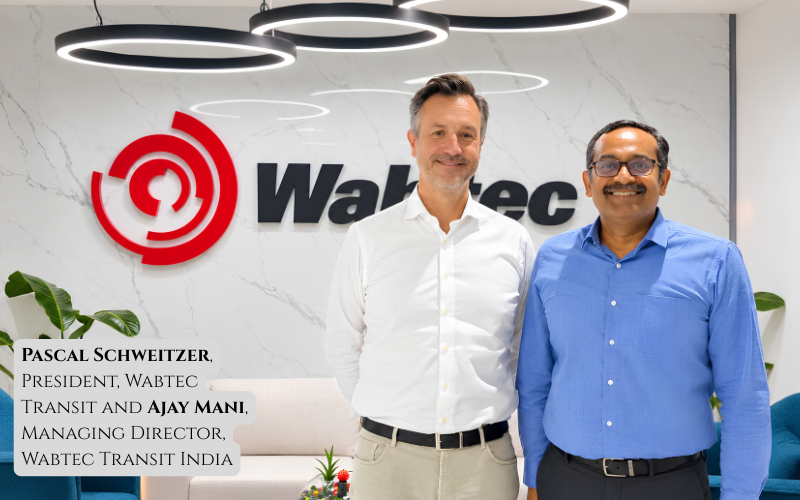
At an exclusive media roundtable, Pascal Schweitzer, President of Wabtec Transit, Ajay Mani, Managing Director of Wabtec Transit India, and Sunil Yesudas, Senior Director of Engineering and R&D for Transit India, outlined the company’s manufacturing scale, engineering philosophy, and aggressive vision to hit ₹5,000 crore in transit revenue over the next three to four years.
A $94 Million Milestone for Vande Bharat Sleeper
The media roundtable coincided with a significant commercial development: Wabtec securing contracts valued at US$ 94 million (approximately ₹839 crore) to supply critical transit subsystems for the Vande Bharat Sleeper train program. Under the agreement awarded through the Integral Coach Factory (ICF), Wabtec will supply complete braking systems, pantographs, gangways, and automatic door systems for 50 trainsets consisting of 24-car configurations.
The Vande Bharat Sleeper order will be executed over two financial years, concluding by March 2029. While the train shares foundational technologies with the existing Vande Bharat chair-car fleet, configuring a high-speed sleeper requires bespoke structural adaptation.
“The sleeper train requires significantly larger water reservoirs for toilets, which alters the vehicle layout,” explained Ajay Mani, Managing Director, Wabtec Transit India. “The brake arrangements, mounting positions, and subsystem positioning all had to be re-engineered to accommodate these auxiliary functions. It represents the same proven technological core, packaged for a demanding new operational reality.”
Four Decades in Tamil Nadu: From TVS Roots to a Global Rail Hub
While Wabtec Corporation is an S&P 500 entity headquartered in the United States, its presence in Hosur dates back 40 years. The site began under the TVS Group before transitioning through Faiveley Transport, which Wabtec acquired globally in 2016.
“Even though our parent company is American, we are Indian by heart,” Mr. Mani remarked. “We take pride in having an Indian ethos, an Indian soul, and a culture centered on customer satisfaction. Our roots here are humble, but our engineering footprint is vast.”
Today, Wabtec Transit India operates across multiple strategic locations. This includes Hosur (Tamil Nadu) that houses the flagship manufacturing facility for pneumatic braking systems, high-reach pantographs, HVAC systems, couplers and automatic door mechanisms. The next two facilities are at Chennai added through Wabtec’s acquisition of Delner, strengthening its regional precision engineering base.
The Anekal / Attibele warehouse corridors include expanded warehousing, servicing and manufacturing footprint near Hosur to handle growing production volumes.
Located at Rohtak, in Haryana, is the manufacturing center dedicated to air brakes, carbon strips, friction brake pads, and brake blocks.
This multi-facility ecosystem accounts for roughly 1.2 million safe working hours across Hosur and Rohtak, with Hosur achieving over 1,000 incident-free days, a testament to rigorous operational discipline.
The manufacturing depth is supported by a localized supply base. Wabtec works with more than 450 domestic suppliers, achieving 80% to 85% local content across its subsystems.
Powering Every Metro and Locomotive
Wabtec’s components touch virtually every passenger rail corridor in India. Over 20,000 braking system installations are currently active on Indian Railways’ LHB passenger coaches. Furthermore, Wabtec has delivered couplers, pantographs, and doors to over 3,500 metro cars.
“Every operational metro system in India has at least one Wabtec product on board,” Mr. Mani noted. “In Bengaluru, we supply the doors. In Chennai, we deliver the brakes, couplers, and doors. In Delhi, our brakes and door systems are running every day. From Kolkata to Kochi, our footprint spans the entire country.”
Beyond passenger cars, Wabtec supplies heavy freight locomotives. The company outfits WAG-9 and WAP-7 electric locomotives built by Chittaranjan Locomotive Works (CLW) and Banaras Locomotive Works (BLW), while partnering with Siemens on advanced brake systems for the 9,000 HP electric freight locomotives being manufactured in Dahod, Gujarat. In public-private joint ventures, Wabtec’s systems are running on high-capacity electric and diesel locomotives produced at Madhepura (Alstom) and Marhowra (Wabtec) in Bihar.
Engineering for Indian Conditions
Wabtec’s product strategy eschews direct imports of off-the-shelf Western designs in favour of application-specific engineering conceived and validated locally.
“Many multinational companies attempt a ‘push strategy’, introducing overseas products without adaptation, only to find the Indian market rejects them,” said Mr. Mani. “We design for India, manufacture in India, and service in India. We remove the unnecessary frills, identify the exact requirements of Indian Railways, and engineer robust solutions.” He provided two notable innovations that illustrate this customer-centric R&D.
The 3.6-Metre High-Reach Pantograph: India’s unique railway electrification architecture features overhead catenary wires positioned at exceptional heights—up to 7.5 meters—to accommodate double-stack container freight trains on the Dedicated Freight Corridors (DFCs). “Nowhere else in the world does a high-reach pantograph operate with a 3.6-to-3.8-meter working extension,” explained Pascal Schweitzer, President of Wabtec Transit. “Faiveley originally invented the pantograph, but our Hosur and Bengaluru teams took that heritage and engineered an entirely unique subsystem specifically for Indian Railways’ electrification profile. Today, five out of every six high-reach pantographs operating in India are built in Hosur.”
Anti-Drag Passenger Door Technology: Addressing unique safety challenges on urban transit systems, Wabtec developed an anti-drag door safety mechanism for Indian metro networks. “In India, passengers often wear loose, flowing attire such as sarees or dupattas, which run the risk of becoming trapped between closed doors,” Mr. Mani explained. “With conventional systems, if a train begins moving with trapped fabric, the passenger can be dragged. Our engineering team developed an anti-drag sensor. If an external pull force exceeding 30 kg is detected on a trapped object, the door automatically breaks its seal and releases, immediately signaling the train to halt. It was first commissioned for the Chennai Metro and is now becoming standard in Indian metro tenders.”
R&D Muscle: The Bangalore-Hosur Innovation Network
Wabtec’s product customization is powered by a large engineering contingent based in southern India. Sunil Yesudas, Senior Director of Engineering and R&D for Transit India, oversees an engineering team of 1,500 professionals across its Bengaluru Global Technology Centre and the Hosur application facility, with approximately 350 to 400 engineers dedicated solely to the transit portfolio.
During the roundtable, Mr. Yesudas addressed the complexity of engineering for Indian requirements compared to European or North American standards.
“It is not merely a matter of complexity; it is about extreme operational diversity,” Mr. Yesudas observed. “Our operating environment brings high ambient heat, pervasive trackside dust, severe humidity, and heavy passenger overloading. You cannot blindly replicate a European design here. What sets us apart is proximity to the customer. Our engineering center in Bengaluru houses the Wabtec Global Laboratory (WGL), where we conduct complete electrical, mechanical, and dynamic current-collection testing before any product goes to the field. We collaborate directly with RDSO and production units like ICF to build what the track demands.”
Mr. Schweitzer reinforced this view, highlighting the reciprocal flow of Indian engineering innovations into Wabtec’s worldwide portfolio.
“Our transit business operates globally at a $4 billion scale with 12,000 employees,” Mr. Schweitzer stated. “Yet Hosur is exceptional because of its culture of innovation. The intellectual contributions of Indian engineers extend across our global footprint. In fact, the individual holding the highest number of patents within Wabtec globally is an Indian-origin engineer, A.J. Kumar, who holds 362 patents. The innovations perfected here, such as the HVAC efficiency under extreme ambient temperatures, are increasingly being exported to help European and North American networks adapt to climate change.”
‘India for India’ and ‘India for the World’
The Hosur plant serves as an international manufacturing hub within Wabtec’s global transit network. Addressing the strategic balance between domestic commitments and exports, Schweitzer pointed out that the shop floors at Hosur are actively assembling components destined for transit networks in North America, Western Europe, and Southeast Asia.
“When we articulate our vision, it operates on two complementary pillars: India for India, followed by India for the World,” said Mr. Schweitzer. “We build local engineering, local supply chains, and local servicing to meet Indian Railways’ aspirations. Once that industrial foundation is rock-solid, Indian facilities begin delivering first-time orders for international transit authorities. Export volumes are growing rapidly because global clients inspect this plant, validate the quality standards, and trust the output.”
The ₹5,000-Crore Ambition
With the current transit revenue in India hovering around ₹3,200 crore, Wabtec has set a target of crossing ₹5,000 crore (approximately US$ 600 million) by 2029–2030. Achieving this 56% growth will rely on three primary growth drivers:
- Fleet Modernization and Expansion: Sustained delivery of subsystems for Vande Bharat chair-car, Vande Bharat Sleeper, Namo Bharat (RRTS), and the upcoming Vande Metro platforms.
- Upcoming Production Unit Tenders: Bidding on long-term equipment contracts for modern rolling stock programs, including MRVC tenders, ICF, MCF Raebareli, and RCF Kapurthala programs, alongside the new coach manufacturing project in Kazipet.
- Condition-Based Maintenance and AI: Incorporating internet of things (IoT) sensors, automated computer-vision quality inspections, and machine-learning algorithms to shift Indian Railways from scheduled maintenance to predictive reliability.
Wabtec has also recently launched ForgeWorks, an industrial digital initiative focused on deploying artificial intelligence, predictive diagnostics, and advanced asset health monitoring across rolling stock fleets.
“Indian Railways tenders now mandate 35-year life-cycle maintenance agreements, as seen in the recent Siemens and Vande Bharat awards,” said Mr. Mani. “When maintenance is built into the contract, you have real skin in the game. You cannot deliver a subsystem that fails or demands high maintenance costs. By deploying predictive diagnostics and high-reliability design, we extend maintenance intervals from six years to eight or nine years, lowering life-cycle costs for the operator.”
As the Hosur plant blends with precision CNC machining, robotic welding and testing of high-reach pantographs, the facility stands as a tangible model of advanced rail manufacturing. By fusing four decades of localized operational experience with global research capabilities, Wabtec Transit India is helping propel India’s rail transit network toward higher speeds, improved passenger safety, and indigenous manufacturing self-reliance.
