

“As industries expand capacity and modernize their operations, they need greater coordination between the systems that power their facilities and the processes that drive production. By bringing together the strengths of Hitachi Energy and Rockwell Automation, we can help customers navigate this complexity, improve operational performance, and support more efficient, resilient, and sustainable industrial operations.” Marco Berardi, Head of Grid & Power Quality Solutions and Service at Hitachi Energy
“By combining Hitachi Energy’s leadership in electrification with Rockwell Automation’s experience in automation and digital transformation, we help customers design, build, and operate more intelligent, resilient, and sustainable sites. Together, we are enabling a grid-to-process approach that improves performance, accelerates growth, and helps customers bring new manufacturing capacity online faster, more predictably, and at greater scale.” Brian Holte, Vice President, Global Industry Growth, Rockwell Automation
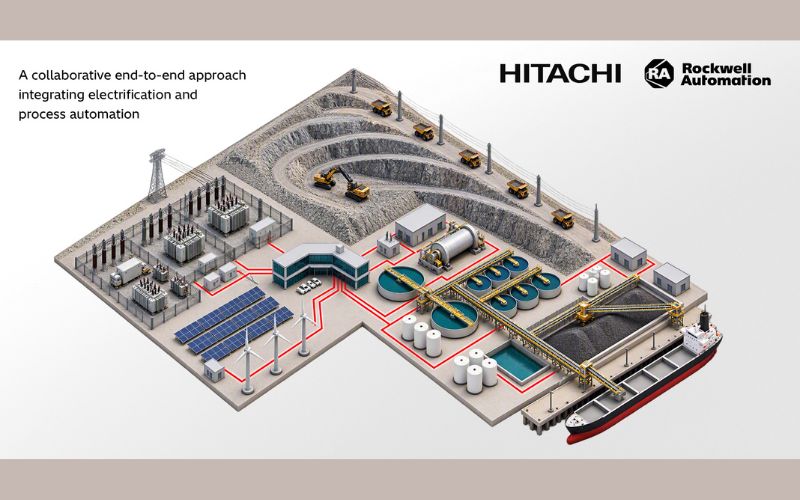
Hitachi Energy and Rockwell Automation, Inc. have announced a collaboration centered on an integrated grid-to-process architecture that combines the infrastructure powering industrial facilities with the systems that manage production.
As industrial companies face rising power demand, growing pressure to decarbonize, and increasing constraints on capital investment, electrical systems and production operations can no longer be planned in isolation. Decisions about power infrastructure increasingly influence operational performance, while production requirements play a larger role in planning, deploying, and operating electrical systems.
By bringing together expertise in grid connection, power quality, energy management, protection and control, process automation, and digital operations, Hitachi Energy and Rockwell Automation aim to help customers achieve a more seamless integration of grid and process systems. Planning power and production systems together can streamline engineering, improve cross functional coordination and support digital mining operations, while exploring scalable and modular approaches that can support future expansion and evolving electrification requirements.
Mining and metals will serve as the initial focus of the collaboration. As demand grows for the critical minerals, mining companies must simultaneously expand production, modernize operations, and accelerate the electrification of their own facilities. Analysis estimates that growth capital expenditures for new capacity could require $1 trillion over the next decade1. Reliable, high-quality power is fundamental to these operations, particularly in energy-intensive processes such as crushing, grinding, conveying, and processing, where disruptions can affect equipment utilization, production continuity, and operating costs.
“Electrification is changing the economics of industrial operations. Decisions about energy infrastructure increasingly influence productivity, sustainability, and growth,” said Marco Berardi, Head of Grid & Power Quality Solutions and Service at Hitachi Energy. “As industries expand capacity and modernize their operations, they need greater coordination between the systems that power their facilities and the processes that drive production. By bringing together the strengths of Hitachi Energy and Rockwell Automation, we can help customers navigate this complexity, improve operational performance, and support more efficient, resilient, and sustainable industrial operations.”
“The future of industry will be defined by how effectively companies integrate energy and production,” said Brian Holte, vice president, Global Industry Growth, Rockwell Automation. “By combining Hitachi Energy’s leadership in electrification with Rockwell Automation’s experience in automation and digital transformation, we help customers design, build, and operate more intelligent, resilient, and sustainable sites. Together, we are enabling a grid-to-process approach that improves performance, accelerates growth, and helps customers bring new manufacturing capacity online faster, more predictably, and at greater scale.”
Once facilities are operational, the combination of electrification, automation, and digital technologies can provide greater visibility across energy consumption, production performance and asset utilization. The approach also provides a scalable foundation for future capacity expansion, increased electrification, and the integration of new energy resources.
The companies are exploring opportunities in solution development, customer engagement, and selected industrial applications. While initially focused on mining and metals, the companies see broader potential across other energy-intensive industries.
Reference: 1 – McKinsey & Co. Report “The capex crystal ball: Beating the odds in mining project delivery” Predicting cost and schedule overruns in mining | McKinsey, November 2024.
