

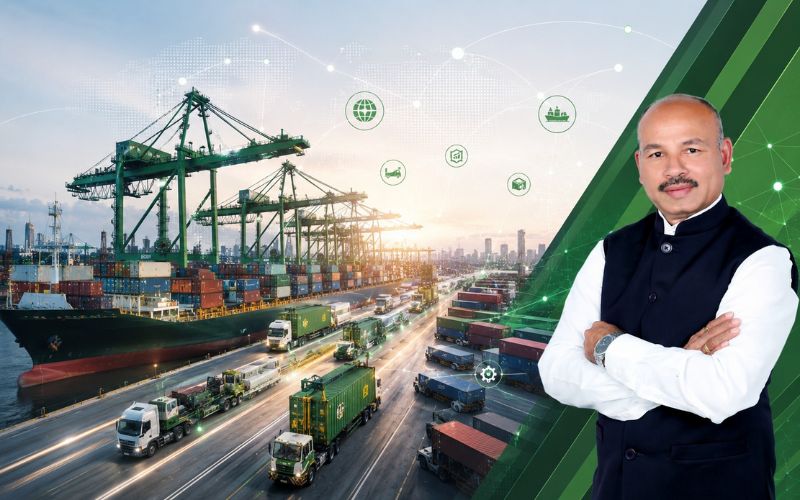
“As India strengthens its position as a global manufacturing hub, logistics will play an increasingly central role in shaping outcomes. Expanding production capacity is essential, but lasting competitiveness will also depend on how efficiently goods move from factories to markets.” Pavithran M. Kallada, Managing Director, PSA India
India is at a pivotal stage in its industrial journey. Through initiatives such as Make in India, Production Linked Incentive schemes, and the broader aspiration of becoming a US$5 trillion economy, the country has articulated an ambitious manufacturing vision. Sustaining this growth, however, will depend not only on production capacity, but also on how efficiently goods move across domestic and international supply chains.
Manufacturing and logistics must therefore be viewed as a single, integrated system. The efficiency with which raw materials reach factories, the reliability of delivering finished goods to markets, and India’s ability to participate in global value chains are all critical determinants of industrial performance. In sectors such as electronics, automotive, and pharmaceuticals—where speed, precision, and predictability are essential—supply chain connectivity directly shapes competitiveness.
As India moves into its next phase of development, further attention to structural inefficiencies will be important. Gaps in first- and last-mile connectivity, fragmented planning across agencies, overdependence on road transport, and limited multimodal integration continue to influence delivery costs and reliability. Foundational initiatives such as PM Gati Shakti, Sagarmala, and the Dedicated Freight Corridors have set a strong direction. The next step lies in sustained execution and closer coordination across ports, rail, roads, logistics parks, customs, and industrial clusters.
A key issue is modal imbalance. Road transport continues to dominate, even though rail and waterways offer more cost-effective and sustainable options for long-distance freight movement. Expanding rail capacity, enabling competitive freight structures, and strengthening coastal and inland waterway integration will be increasingly important — particularly as manufacturing expands beyond established hubs into Tier-2 and Tier-3 cities.
In this context, port efficiency should be viewed through a broader, system-level lens. While terminal automation and cargo handling performance remain important, they represent only part of the picture. Overall efficiency is also shaped by the ecosystem beyond the port gate. Constraints in evacuation, congestion, or limited hinterland connectivity can diminish the benefits of terminal-side improvements.
This underscores the need to move beyond standalone infrastructure investments towards enhancing end-to-end supply chain performance. Seamless multimodal connectivity — across road, rail, coastal shipping, and inland waterways — supported by coordinated traffic flows, holding areas, and scheduling systems, can significantly improve predictability and throughput. Digital integration, including robust Port Community Systems, further enables real-time coordination among shipping lines, terminals, CFSs, ICDs, rail operators, customs authorities, and transporters.
The wider logistics ecosystem is equally important. Driver welfare facilities, safe parking, sanitation, and well-planned warehousing and logistics zones contribute to faster turnaround times, safer operations, and more reliable cargo movement. Ultimately, efficiency should be measured not only by how cargo is handled within a port, but by how seamlessly it moves across the entire supply chain.
In this context, PSA’s presence in India illustrates how integrated port and logistics capabilities can support the country’s broader manufacturing and trade ambitions. Through PSA Mumbai, PSA contributes to strengthening a key gateway at JNPA with deep-draft berths, expanded capacity, and rail-linked infrastructure connecting to inland container depots across the country. Its readiness for Dedicated Freight Corridor-linked operations, ability to support double-stack container movements, and focus on digitalization, real-time visibility, and renewable energy contribute to a more efficient and resilient logistics ecosystem.
Alongside PSA Mumbai and PSA Chennai’s container terminal operations, PSA Ameya’s container freight stations, PSA BDP’s integrated supply chain solutions, and CrimsonLogic’s digital solutions, PSA’s operations in India extend beyond port infrastructure to support end-to-end connectivity as part of our Node-to-Network strategy —linking manufacturing hubs, inland markets, and global trade routes. This integrated approach reflects a broader focus on reliability, operational excellence, and long-term partnership in supporting supply chain development.
Looking ahead, India’s continued progress will benefit from a more integrated and data-driven supply chain backbone—one that aligns manufacturing expansion with efficient cargo movement. This includes further advances in multimodal integration, stronger last-mile connectivity, digital platforms that enhance visibility and coordination, and continued progress towards more sustainable transport modes. Over time, industrial competitiveness is likely to depend increasingly on how effectively supply chains are planned, coordinated, and executed.
As India strengthens its position as a global manufacturing hub, logistics will play an increasingly central role in shaping outcomes. Expanding production capacity is essential, but lasting competitiveness will also depend on how efficiently goods move from factories to markets. In that context, a well-coordinated, resilient, and efficient supply chain ecosystem will remain a critical enabler of India’s long-term growth.
The author is Pavithran M. Kallada, Managing Director, PSA India
