

“The West Asia conflict is a stark reminder that the modern factory is globally integrated. At The Manufacturing Frontier, we believe that while we cannot control geopolitical tides, we can certainly fortify our domestic “Frontier” through agility and strategic foresight.”
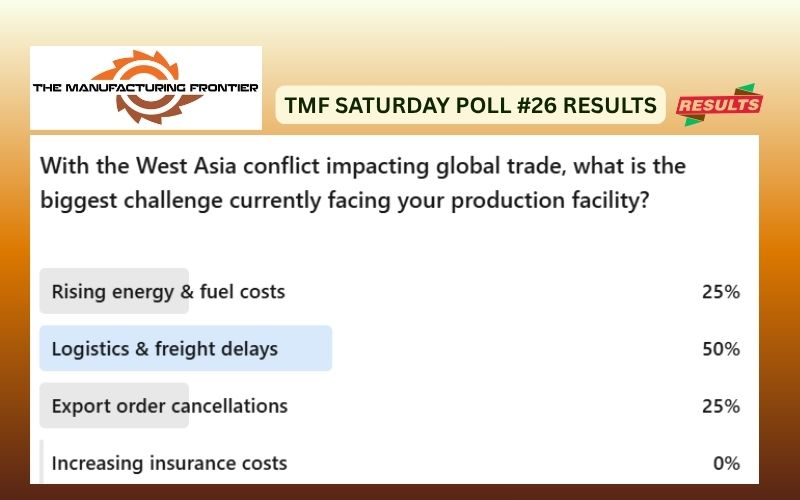
The results of our latest TMF Saturday Poll are in, and they provide a sobering snapshot of how geopolitical volatility in West Asia is vibrating through the Indian manufacturing shop floor. While the conflict may be geographically distant, the effect is clearly hitting home, with logistics and freight delays emerging as the primary pain point for half of our respondents.
The Logistics Bottleneck
With 50% of participants citing logistics and freight delays as their biggest hurdle, it is evident that the issue is no longer just a maritime headline; it is a production crisis. For Indian manufacturers, this translates to extended lead times, inventory stockouts, and a significant crunch in working capital. When “Just-in-Time” becomes “Just-in-Case”, the resulting inefficiency eats directly into the bottom line.
The Cost of Uncertainty
Tied for second place, rising energy and fuel costs (25%) and export order cancellations (25%) highlight a dual-front battle.
Energy: Despite localized efforts to stabilize power, the global uptick in crude prices inevitably finds its way into manufacturing overheads and inland transportation costs.
Demand: Perhaps more concerning is the 25% reporting order cancellations. This suggests that the conflict isn’t just making goods harder to ship; it is dampening the appetite of global buyers who are wary of long-term commitments amidst regional instability.
Interestingly, increasing insurance costs registered at 0%. While maritime insurance premiums have certainly surged globally, it appears that for most of our community, these costs are currently being absorbed further up the value chain or are being overshadowed by the sheer physical challenge of moving cargo.
The Path Forward: Resilience over Reactivity
These results underscore a critical shift in the industrial mindset. To navigate this crisis, manufacturers must move beyond reactive measures. We are seeing a renewed urgency in:
Supply Chain Diversification: Reducing over-reliance on single trade routes.
Digital Visibility: Leveraging real-time tracking to manage customer expectations around delays.
Local Sourcing: Evaluating domestic alternatives to insulate production from international transit shocks.
The West Asia conflict is a stark reminder that the modern factory is globally integrated. At The Manufacturing Frontier, we believe that while we cannot control geopolitical tides, we can certainly fortify our domestic “Frontier” through agility and strategic foresight. What is your strategy for mitigating these transit delays? Let’s discuss in the comments.
