
“While manufacturing industry professionals might not have capes or cosmic abilities, the technologies they champion are bringing us closer to these capabilities every day.”
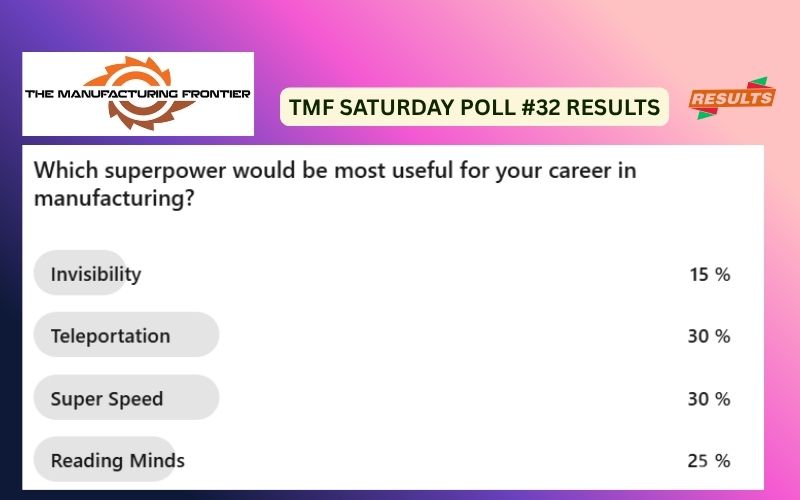
Recently, we stepped away from the data-heavy reports on CNC precision and IIoT protocols to ask a slightly more “fantastical” question in our TMF Saturday Poll: Which superpower would be most useful for your career in manufacturing? The results were telling. Far from being a mere whimsical exercise, the responses provided a fascinating window into the current pressures and aspirations of industry professionals. Here is how the community voted:
Teleportation: 30%
Super Speed: 30%
Reading Minds: 15%
Invisibility: 15%
The Need for Instant Presence & Rapid Throughput
The clear winners—Teleportation and Super Speed—tied for the top spot. In an era where supply chains are global and “Just-in-Time” is the baseline, the desire to collapse time and space is palpable. For a plant manager or a project lead, “Teleportation” isn’t about science fiction; it’s about the reality of managing multiple shop floors across geographies. It speaks to the logistical fatigue of modern manufacturing and the high value placed on physical presence at critical moments.
“Super Speed” reflects the relentless drive for throughput and efficiency. Whether it’s reducing cycle times or accelerating the R&D phase for a new prototype, speed remains the ultimate competitive advantage. If we could move faster, we could produce more, solve more, and innovate more.
The Human Element: Soft Skills vs. Hard Walls
The votes for Reading Minds (15%) highlight the evergreen challenge of the sector: communication. From aligning shop floor operations with executive vision to understanding a client’s unstated requirements, the ability to “know” would solve many of the friction points that lead to production delays.
Interestingly, Invisibility (15%) suggests a need for objective observation. Sometimes, the best way to understand a process is to watch it unfold without the “observer effect” changing how teams work. It also perhaps hints at the rare desire for a quiet moment of focus amidst the hum of the factory floor.
While manufacturing industry professionals might not have capes or cosmic abilities, the technologies they champion are bringing us closer to these capabilities every day.
What do you think? Did the right power win? Let’s discuss in the comments.
